
Italian Villas for Sale by Property Type and Price
That range makes a single headline price nearly useless. Property type, location, land and size all shape what a listing offers, so comparing similar homes matters more than chasing the lowest figure.
This guide compares apartments, farmhouses, villas and larger estates, explaining the features behind their asking prices. You’ll see what different budgets can buy and how a compact apartment differs from a rural home with substantial land or a Tuscan estate. Compare each property type with your search in mind, rather than guessing from the label.
Featured property listings and prices
Compare each property’s size, land and location alongside its asking price.
Villa Prices and Property Sizes
Price alone offers a narrow view of value. These examples show why it helps to compare both building size and setting. A lower price can reflect a different location, layout or property type, rather than a better bargain.
Property Prices and Land Sizes
Land adds another dimension to a property comparison. Compare usable outdoor space, building size and location together, rather than treating acreage as a standalone measure of value.
Prices by Region and Currency
Listings are priced in euros. These are individual asking prices, not regional averages. No single listing represents every villa in a region, because location, size, land and property type all affect the comparison.
For Tuscany, Umbria, Puglia and Sicily, a meaningful average requires comparable properties in each region. The featured prices provide specific Tuscan examples, not a defensible average for all four regions. Compare similar homes: a coastal villa, rural farmhouse and compact town property serve different needs and fall into different price brackets.
US citizens can buy villas in Italy. The purchase involves Italian transaction formalities, and requirements depend on the buyer and property. Budget for transaction taxes and notarial or professional costs, which vary with the transaction and buyer’s circumstances. Ongoing ownership costs can include maintenance, utilities and applicable property charges, depending on the home and its use. For American buyers comparing foreign buying procedures with domestic property acquisitions, established teams like Team239 illustrate the contrasting processes and expectations found in US residential markets.
When reviewing listings, look for a clear asking price, a named location and specific property details. For example, compare the stated area and land of a Roccamare villa with the detailed description of the Molise country house. Treat listings as starting points, not regional price averages. Foreclosure properties come with a distinct timing risk: the Board of Governors of the Federal Reserve System reports that Italy’s foreclosure process can last five to seven years.
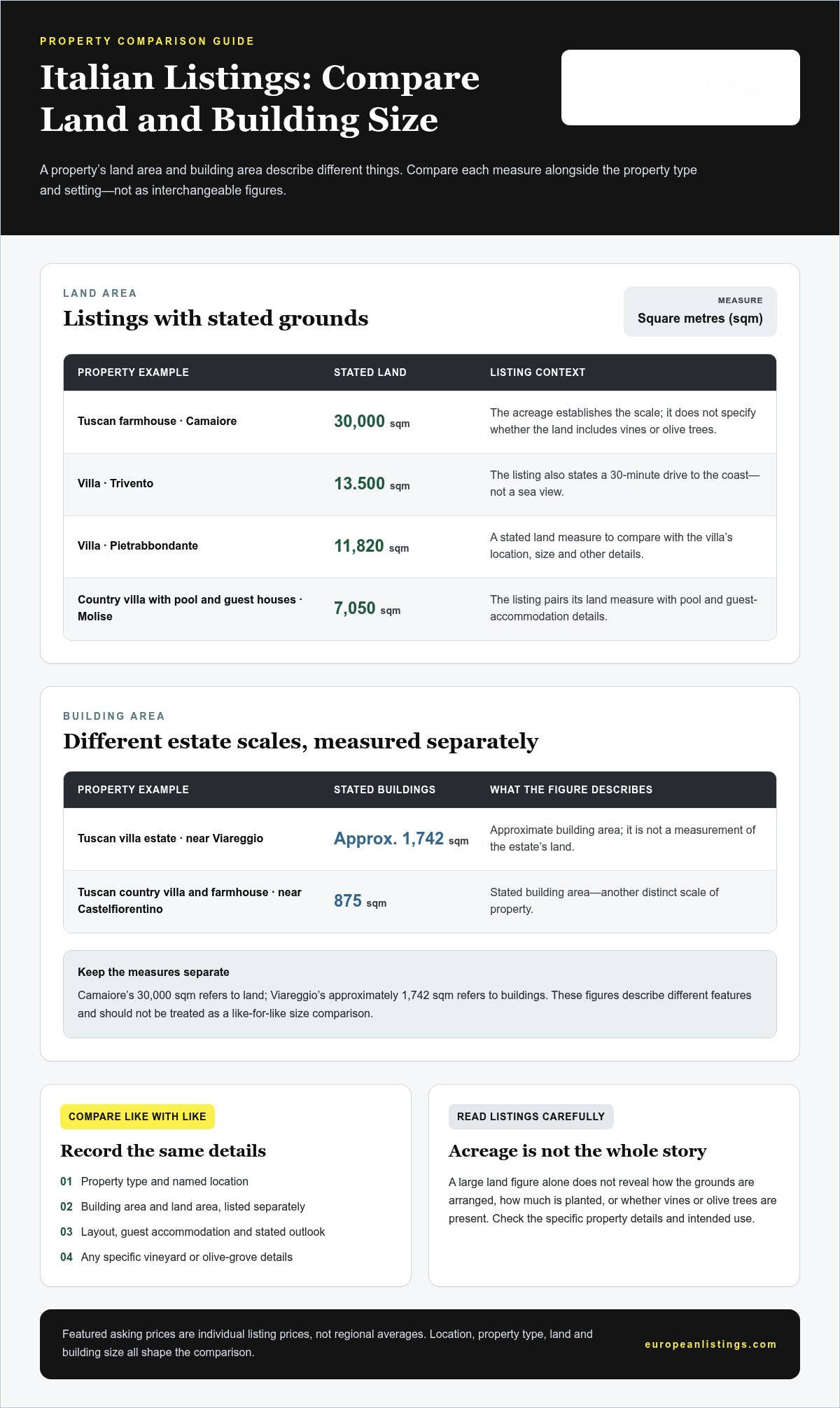
The Pietrabbondante villa has 11,820 sqm of land, and the Trivento villa is surrounded by 13.500 sqm.
Estates with vineyards and olive groves
A vineyard or olive grove changes an estate’s character, workload and land use. Compare the grounds with the buildings, access and intended use, rather than relying on the property’s romantic description.
Start by separating established agricultural features from general acreage. A listing’s reference to an estate does not, by itself, describe planted vines, olive trees or current production. Look for specific details about the land, its layout and how it relates to the residence. The Tuscan farmhouse in Camaiore, for example, is listed with 30,000 m² of land. That figure establishes the scale, but acreage alone doesn’t tell you whether the land includes a vineyard or olive grove.
Compare outdoor space with the buildings and asking price. The Tuscan villa estate near Viareggio has approximately 1,742 m² of buildings, while the Tuscan country villa and farmhouse near Castelfiorentino has 875 m² of buildings. Those examples show why “estate” can describe very different property scales. For vineyard or olive-grove buyers, the key questions are practical: how much land is planted, how it is arranged, and whether the residence and grounds suit the intended use.
Multilingual property details matter when listings use unfamiliar terms. When comparing a farmhouse near Villamagna with a Tuscan estate, distinguish living space, land area and agricultural features. Keep a short glossary of listing terms and compare the same details across properties. This helps ensure an attractive description does not overshadow the facts that shape day-to-day ownership.
Property listings and real estate agency services are not interchangeable. A listing presents a property; agency services may include arranging viewings or coordinating an offer. A polished description or expansive estate label does not establish the condition or practical suitability of the land. Keep these distinctions in mind when comparing rural properties, especially if vines or olive trees are central to your plans.
For a foreign buyer, the process starts with a shortlist based on location, budget and intended use. Review the listing details, arrange a viewing, negotiate proposed terms, then complete the transaction documents with appropriate local support. A villa’s agricultural character adds a point of comparison, but does not replace understanding the property itself.
For example, compare Camaiore’s 30,000 m² of land with the Viareggio estate’s approximately 1,742 m² of buildings. They describe different scales and features, not interchangeable measures. A disciplined shortlist records the asking price, building area, land area and any stated vineyard or olive-grove details separately. That makes each estate easier to assess on its own terms.
Apartments, farmhouses, villas, and country houses
Property type affects the balance between privacy, upkeep and location. A compact apartment in Penne differs sharply from a farmhouse near Villamagna or a detached villa in Gissi. Compare the actual layout, setting and land alongside the asking price. The label alone cannot show how a property fits your plans.
These listings suit different searches: one emphasizes a historic building, while the other gives its room count. Compare usable space, building character and location before treating either as a like-for-like alternative.
Farmhouses and country houses bring land into the decision. Acreage may appeal if you want rural space, but it also makes the property fundamentally different from an apartment. Consider how much land you want to use and maintain.
Villa listings range from multi-unit homes to larger family properties. Compare room count, separate living areas and setting, not just the headline price.
Some homes combine residential space with guest accommodation. This differs from a single-family house, as independent units can offer more flexible use. Consider how the layout works for your household, guests or potential rental plans, without assuming the property will generate income.
For coastal searches, separate a genuine sea view from general proximity to the shore. The Trivento listing, for example, states a 30-minute drive to the coast, a useful location detail but not a sea view. Record each property’s type, bedrooms, land, location and stated outlook in one comparison. That simple step clarifies whether an apartment, farmhouse, villa or country house deserves a closer look.
The Molise country villa with a pool and guest houses is set on 7,050 sqm of land, adding a land measure to its guest-accommodation details.
Other listings show how widely asking prices can differ across house and apartment categories. Treat each as an individual comparison: check its property type and stated features rather than assuming a similar regional setting means similar space or use.
Italian villas for sale
The right region depends on how you’ll use the villa, not its postcard appeal. Compare Tuscany, Abruzzo, Lazio and Sicily by setting, property scale and lifestyle.
Choosing an Italian Region
There’s no single best region for every buyer. Tuscany offers examples from the Chianti hills near Florence to Arezzo, while Sicily has a restored early-20th-century villa with 400 m² of accommodation. Lazio includes a luxury villa in Cerveteri with 765 m² of property area. These listings show contrasting settings and scales, not regional averages. Prioritize daily needs, access and preferred landscape before narrowing your search.
Use a consistent shortlist. Record region, property type, building area, land and stated features for each home. A medieval-tower villa in Chianti has 610 m² of accommodation; the Arezzo villa has 371 m². Compare those interior figures with your space needs, then consider whether each location suits your intended use. A larger building isn’t automatically a better fit.
Risks to Check Before Buying
Before deciding, examine the listing’s specific claims about the building, grounds and intended use. Compare stated areas and features, then note questions about condition, access or land that could affect your plans. Foreclosure purchases carry a distinct timing risk: the Board of Governors of the Federal Reserve System reports that Italy’s foreclosure process can last five to seven years.
Keep practical questions separate. A villa with extensive accommodation may require more upkeep than a smaller home, while rural land can bring different maintenance demands. For a Sicily villa with 400 m² of accommodation, consider whether the building’s scale matches your intended use. For a Cerveteri property with 765 m² of area, focus on how its size affects your day-to-day needs. Listing details help frame the comparison; they don’t replace a careful review of the individual property.
Make the decision in stages. First, choose a region based on lifestyle and setting. Next, compare suitable properties by building area, grounds and stated features. Then identify property-specific risks that could affect your plans, including any foreclosure timeline. This keeps striking architecture from distracting you from practical considerations.
For a focused next step, compare Italian property listings by region, type and stated features. A clear shortlist makes it easier to distinguish a compelling villa from one that simply photographs well.
European Listings: Weekly Curated Property Newsletter
European Listings is a practical next step when comparing Italian homes across property types, regions and budgets. Its Weekly Curated Property Newsletter gathers listings from dozens of portals, filters them for foreign-buyer friendliness and delivers 18 vetted properties to subscribers each Saturday.
European Listings’ Premium Membership Plans and Buying Support and Guidance help you move from browsing to a more focused search. The weekly curated selection brings together homes to compare, without the noise of browsing broad listing sites.
To explore the newsletter and available guidance, visit European Listings.
Turn your shortlist into a confident next step
Start by defining what you need the property to do for you. Write down your preferred setting, intended use, essential features and acceptable trade-offs, then rank them. A clear order helps separate genuine priorities from details that merely look appealing in a listing.
As you refine your search for Italian villas for sale, keep your shortlist beside you. Use it to compare new options consistently and decide which properties merit closer attention. You don’t need to resolve every purchase question at once. Start with a focused search, then seek suitable guidance as your plans take shape.
European Listings offers a Weekly Curated Property Newsletter, Premium Membership Plans and Buying Support and Guidance. Choose the next step that fits your stage of the search, or contact European Listings about Italian properties.
A considered shortlist is a strong beginning. Keep your priorities clear and move forward at your own pace.
Frequently Asked Questions
What types of villas are available for sale in Italy?
Listings include detached and semi-detached villas, country houses, farmhouses, apartments and larger estates. Some homes offer independent guest accommodation; others focus on a single residence or extensive grounds. If you want separate space for visitors, for example, prioritize a villa with multiple living units. Compare layout, land and setting instead of relying on labels such as “country villa” or “estate,” which can describe very different homes.
What additional taxes and fees apply when buying property in Italy?
Budget for transaction taxes and notarial or professional costs. The amounts depend on the transaction and the buyer’s circumstances.
Disclaimer
European Listings is a media publication. We are not a real estate agent, broker, lawyer, tax advisor, or financial advisor, and nothing here is legal, tax, or financial advice.
Properties, prices, and rules change. We do our best to keep things accurate, but we can't promise every detail is current or correct. Always check with a qualified local professional before you buy, sign, or send money.
We sometimes earn a commission from partners and sponsors we link to. This never changes what we choose to cover or what we say about it.
Any decision you make is your own.
Frequently Asked Questions
Listings include detached and semi-detached villas, country houses, farmhouses, apartments and larger estates. Some homes offer independent guest accommodation; others focus on a single residence or extensive grounds. If you want separate space for visitors, for example, prioritize a villa with multiple living units. Compare layout, land and setting instead of relying on labels such as “country villa” or “estate,” which can describe very different homes.
Budget for transaction taxes and notarial or professional costs. The amounts depend on the transaction and the buyer’s circumstances.