
Buy a Vacation Home in Europe: Compare the Trade-Offs Before You Choose
Planning to buy vacation home in Europe? The most beautiful setting may still be the wrong fit. A sea view or stone village house can win you over in a listing, but the right choice depends on how often you’ll visit, how easily you can get there, and what the property asks of you between stays.
It’s hard to compare homes when each setting sells a different dream. The asking price is only part of the commitment: access, upkeep, and the practicalities of owning a home from afar all affect whether it feels like a pleasure or another responsibility.
This guide helps you compare the trade-offs before moving from browsing to a serious purchase. You’ll weigh settings against your travel habits and intended use, consider lifestyle appeal alongside maintenance and access, and identify questions to resolve before choosing a property. The aim isn’t to find the most picturesque listing. It’s to find a home whose realities fit the way you’ll use it.
Define Your Goals Before Buying a Vacation Home in Europe
A European escape can look effortless in listing photos: a sunlit terrace, a quiet lane, a view worth lingering over. The uncertainty starts when you try to choose. A home that suits a week away may frustrate you during a longer stay, and a promising rental property may not feel like a home you want to use yourself. Before you buy, define what you need the property to do.
Start with use, not appearance. A general overview of Housing in Europe can help frame how varied the market is. Your own brief should be more personal: how you’ll spend time there, who will come with you, and which compromises you can accept.
Which kind of second-home use are you planning?
Occasional holidays call for different priorities than frequent visits or extended seasonal stays. For short breaks, access and ease of arrival may matter more than extra rooms. Longer stays put daily routines, social life, and comfort in different seasons under closer scrutiny. If you’re considering retirement, picture ordinary weekdays, not only an ideal summer escape. Rental use is a separate objective, with practical questions about intended guests, local requirements, and how much personal use you want to preserve.
Be specific about who will use the home and what a satisfying stay looks like. Is it a quiet base for two, a gathering place for family, or somewhere you can settle in for weeks?
What should your European vacation-home brief include?
Write a compact brief before returning to listings. Separate essential requirements from appealing extras. This keeps an attractive photo from quietly redefining your plan and helps you compare homes on the same terms.
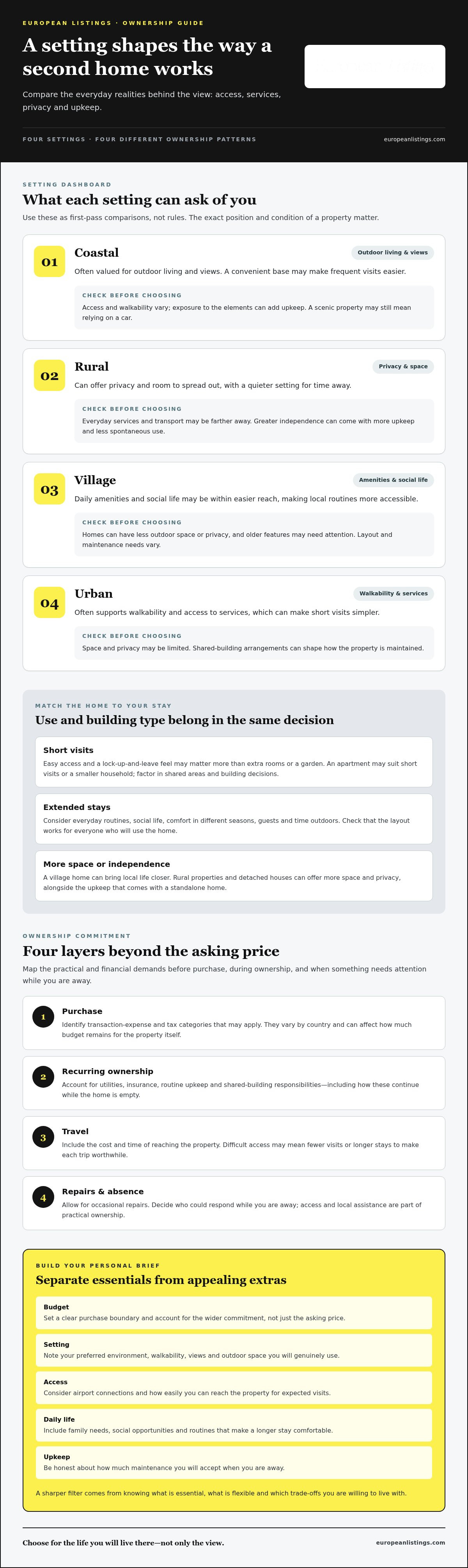
- Budget: Set a clear purchase boundary and account for the wider commitment, not just the asking price.
- Setting: Note your preferred environment, walkability, views, and the outdoor space you’ll genuinely use.
- Access: Consider airport connections and how easy it will be to reach the property for the visits you expect to make.
- Daily life: Include family needs, social opportunities, and the routines that make a longer stay comfortable.
- Upkeep: Be honest about how much maintenance you’ll accept when you’re away.
Mark each item as essential or flexible. Perhaps a view is a preference, while easy access is a must. That distinction creates a sharper filter while leaving room for unexpected homes that fit the life you actually want.
Compare European Vacation-Home Settings by Lifestyle, Access, and Upkeep
A terrace by the sea can be irresistible. So can a quiet rural home or a central apartment. But the setting shapes everyday ownership: how you get around, what’s within reach, how private your stay feels, and how much attention the property needs while you’re away. Compare those realities, not just the view.
How does the property setting change everyday ownership?
Use this as a first-pass comparison, not a rulebook. A home’s exact position and condition matter. A scenic property may still mean relying on a car; a compact home may offer less privacy but make quick visits simpler. Consider how each setting would work on an ordinary day, especially during a longer stay.
Coastal: Often valued for outdoor living and views. Access and walkability vary, and exposure to the elements can add upkeep. A convenient base may make frequent visits easier.
Rural: Can offer privacy and space, but everyday services and transport may be farther away. Greater independence may come with more upkeep and less spontaneous use.
Village: May put daily amenities and social life within easier reach. Homes can have less outdoor space or privacy, while older features may need attention.
Urban: Often supports walkability and access to services. Space and privacy may be limited, and shared-building arrangements can shape how the property is maintained.
Which property type fits the way you will use it?
Match the building to your likely occupancy and household. An apartment may suit short visits or a smaller household, with shared areas and building decisions to factor into ownership. A village home can bring local life closer, but layout and maintenance needs vary. Rural properties and detached houses can offer more space and privacy, alongside the upkeep that comes with a standalone home.
Think beyond the arrival photo. If visits are brief, easy access and a lock-up-and-leave feel may matter more than extra rooms or a garden. For extended stays, consider whether the home supports everyday routines, guests, and time outdoors. If household members have different needs, check that the layout works for everyone who’ll use it.
Before you buy, rank the trade-offs: what makes regular use easier, what you’ll gladly maintain, and what could turn a dream setting into friction. Concise listing context can help keep those compromises visible. Curated European property listings offer one way to explore options beyond familiar searches.
Calculate the Real Commitment of Owning a European Vacation Home
The asking price is only the beginning of the ownership picture. To judge whether a home fits your life, map out what it may require before purchase, during ownership, and whenever something needs attention while you’re away. The details depend on the property, its location, how you use it, and your own arrangements.
What should a realistic ownership plan account for?
Build your estimate in layers. Keep personal use separate from any hoped-for rental income, and account for time and logistics as well as bills.
- Purchase: Identify the categories of transaction expenses and taxes that may apply. These vary by country and can affect how much of your budget remains for the property itself.
- Recurring ownership: Account for utilities, insurance, routine upkeep, and any shared-building responsibilities. Consider how these continue while the home is empty.
- Travel: Include the cost and time of reaching the property. A home that’s difficult to get to may mean fewer visits or longer stays to make each trip worthwhile.
- Repairs and absence: Allow for occasional repairs, then decide who could respond if an issue arises while you’re away. Planning for access and local assistance is part of practical ownership, not an afterthought.
For country-specific tax and ownership questions, seek current, independent advice. General comparisons can help you shortlist, but they can’t settle the obligations that apply to a particular home or owner. For buyers exploring specific destinations like southern Spain, regional property agencies such as Spaindinavia can help clarify local lifestyle, community context, and ownership realities.
How can you test rental assumptions without relying on wishful thinking?
A home used mainly for personal holidays is not the same proposition as one operated as a rental. Start by deciding how much time you want for yourself. Then consider whether the home would be available when guests might want it, and how cleaning, repairs, and local requirements would be handled. Tax treatment and rental rules can differ by location and change over time, so get current independent guidance before including them in your plan.
Keep your assumptions cautious. Don’t count on steady bookings, guaranteed income, rising property values, or a particular return. If the purchase only feels workable under an optimistic rental scenario, reassess it as a personal-use home first. That’s a clearer test of whether you can comfortably buy a vacation home in Europe for the life it offers.
To compare possibilities with the trade-offs in view, explore curated European property listings as you refine your ownership plan.
Turn Your Vacation-Home Comparison into a Clear Next Step
A clear brief turns a stream of listings into a more useful search. Keep the process simple: refine what you need, compare the real trade-offs, then shortlist homes worth a closer look. You don’t need to predict every preference in advance. As you compare options, you’ll see which compromises feel acceptable and which don’t.
- Refine the brief: Use what you’ve learned about your intended use, access needs, and tolerance for upkeep to sharpen your priorities.
- Compare trade-offs: Look at how each home fits your routine, not just its most striking feature.
- Build a short list: Keep a few contrasting possibilities, including one that challenges your assumptions.
What to learn from a shortlist of contrasting homes
Compare a plausible fit with a surprising alternative. Perhaps one home is easy to reach but offers less privacy; another has more outdoor space but asks more of you between visits. Photos, price, location, key facts, source, and concise context can make those differences easier to weigh. Save a few homes as a memory aid, not another task to manage.
Revisit the shortlist after some time. If the unexpected option still appeals, ask what it reveals about your priorities. If it doesn’t, you’ve clarified what matters. Discovery should challenge assumptions, but a useful selection still needs editorial judgment. More listings aren’t automatically better listings.
How European Listings supports the discovery stage
European Listings is a weekly curated property newsletter for people exploring homes in Europe. Its listing pages bring together property photos, price, location, key facts, and source, with a save option, a clear route to the listing agent, and concise context on trade-offs and price in the area. The aim is to make discovery more considered, not to replace local professionals or manage a purchase.
When a buyer’s intent becomes stronger, European Listings can introduce relevant independent professionals. The service doesn’t handle legal, financing, due-diligence, or transaction work. Those responsibilities remain separate from the discovery stage, and country-specific questions call for appropriate independent advice.
If you’re ready to compare a more considered selection, Explore European Listings. A clearer brief and a thoughtful shortlist can help you decide whether to buy, and what kind of home is genuinely worth pursuing.
Make Your Next Search More Intentional
The best next step isn’t rushing toward a decision. Stay open to homes that may fit your real priorities, including options outside the locations or styles you first imagined. A clearer sense of what feels right can make the search more focused and help you buy with greater confidence.
In a European Listings survey, 19 of 20 respondents valued discovering homes they wouldn’t find themselves, while 17 of 20 valued honest downsides and trade-offs in listing context. That points to a more useful kind of browsing: not simply more choice, but relevant discoveries presented with enough context to judge them thoughtfully.
Explore European Listings and discover curated homes for sale. Stay curious, keep your priorities clear, and let the right possibilities earn a closer look.
Frequently Asked Questions
Can foreigners buy a vacation home in Europe?
Foreign buyers may be able to purchase property, but rules depend on the country and sometimes on the buyer’s circumstances. Separate three questions: whether you’re eligible to own, what steps apply to the purchase, and whether you can live there for the length of time you want. Property ownership doesn’t automatically settle residency questions. Before making commitments, get current, country-specific guidance from an independent qualified professional, or work with an international property agency like Konradian to help guide your overseas search and purchase.
Is buying a vacation home in Europe a good investment?
There’s no universal answer. It depends on whether your priority is personal enjoyment or earning rental income. If you buy a vacation home in Europe mainly for holidays, consider whether the experience justifies the full commitment without rental proceeds. For an income goal, test assumptions about vacancy, upkeep, travel, taxes, and local rules. Don’t treat projected demand, appreciation, or rental income as certain. Assess the decision against your own finances and intended use.
How much does it cost to own a vacation home in Europe?
The total cost extends beyond the purchase price, and the amount depends on the property, location, use, and personal arrangements. Build a property-specific budget that includes purchase-related charges, travel, utilities, insurance, and maintenance. If you plan to rent the home, account for related administration as well. A useful test is to estimate the commitment for a year when you use the property often and one when you visit less.
Can I rent out my European vacation home when I am not using it?
Possibly, but permissions and obligations depend on the country, property, and local rules. Before including rental in your plan, investigate applicable permissions, tax questions, insurance, cleaning, repairs, and who will handle practical arrangements. Your own calendar matters too: dates reserved for personal use may limit availability to guests. Build a scenario that includes empty periods, and don’t assume rental proceeds will cover ownership expenses or produce a return.
What should I compare when choosing a vacation home in Europe?
Compare how each home fits your actual routine, not just its photographs. Consider intended use, travel access, walkability, nearby services, privacy, upkeep, and how frequently you expect to visit. Include the broader ownership commitment and any rental assumptions in the same comparison. Mark each requirement as essential or preferred. For example, if you’ll arrive without a car, access to everyday services may matter more than a secluded setting.
What happens if I buy a European vacation home and rarely use it?
Even an empty home can still need attention, insurance, maintenance, and payment of recurring expenses. Infrequent visits may also make it harder to spot a developing issue or arrange a response from afar. Before buying, consider how often you can realistically travel, who could address a property need during your absence, and whether the home still feels worthwhile without frequent stays. Don’t rely on rental income to make rare use seem practical.
Explore European Listings to discover a curated selection of homes and compare the trade-offs that matter to you.
Disclaimer
European Listings is a media publication. We are not a real estate agent, broker, lawyer, tax advisor, or financial advisor, and nothing here is legal, tax, or financial advice.
Properties, prices, and rules change. We do our best to keep things accurate, but we can't promise every detail is current or correct. Always check with a qualified local professional before you buy, sign, or send money.
We sometimes earn a commission from partners and sponsors we link to. This never changes what we choose to cover or what we say about it.
Any decision you make is your own.
Frequently Asked Questions
Occasional holidays call for different priorities than frequent visits or extended seasonal stays. For short breaks, access and ease of arrival may matter more than extra rooms. Longer stays put daily routines, social life, and comfort in different seasons under closer scrutiny. If you’re considering retirement, picture ordinary weekdays, not only an ideal summer escape. Rental use is a separate objective, with practical questions about intended guests, local requirements, and how much personal use you want to preserve. Be specific about who will use the home and what a satisfying stay looks like. Is it a quiet base for two, a gathering place for family, or somewhere you can settle in for weeks?
Write a compact brief before returning to listings. Separate essential requirements from appealing extras. This keeps an attractive photo from quietly redefining your plan and helps you compare homes on the same terms. Mark each item as essential or flexible. Perhaps a view is a preference, while easy access is a must. That distinction creates a sharper filter while leaving room for unexpected homes that fit the life you actually want. A terrace by the sea can be irresistible. So can a quiet rural home or a central apartment. But the setting shapes everyday ownership: how you get around, what’s within reach, how private your stay feels, and how much attention the property needs while you’re away. Compare those realities, not just the view.
Use this as a first-pass comparison, not a rulebook. A home’s exact position and condition matter. A scenic property may still mean relying on a car; a compact home may offer less privacy but make quick visits simpler. Consider how each setting would work on an ordinary day, especially during a longer stay. Coastal: Often valued for outdoor living and views. Access and walkability vary, and exposure to the elements can add upkeep. A convenient base may make frequent visits easier. Rural: Can offer privacy and space, but everyday services and transport may be farther away. Greater independence may come with more upkeep and less spontaneous use. Village: May put daily amenities and social life within easier reach. Homes can have less outdoor space or privacy, while older features may need attention. Urban: Often supports walkability and access to services. Space and privacy may be limited, and shared-building arrangements can shape how the property is maintained.
Match the building to your likely occupancy and household. An apartment may suit short visits or a smaller household, with shared areas and building decisions to factor into ownership. A village home can bring local life closer, but layout and maintenance needs vary. Rural properties and detached houses can offer more space and privacy, alongside the upkeep that comes with a standalone home. Think beyond the arrival photo. If visits are brief, easy access and a lock-up-and-leave feel may matter more than extra rooms or a garden. For extended stays, consider whether the home supports everyday routines, guests, and time outdoors. If household members have different needs, check that the layout works for everyone who’ll use it. Before you buy, rank the trade-offs: what makes regular use easier, what you’ll gladly maintain, and what could turn a dream setting into friction. Concise listing context can help keep those compromises visible. Curated European property listings offer one way to explore options beyond familiar searches. The asking price is only the beginning of the ownership picture. To judge whether a home fits your life, map out what it may require before purchase, during ownership, and whenever something needs attention while you’re away. The details depend on the property, its location, how you use it, and your own arrangements.
Build your estimate in layers. Keep personal use separate from any hoped-for rental income, and account for time and logistics as well as bills. For country-specific tax and ownership questions, seek current, independent advice. General comparisons can help you shortlist, but they can’t settle the obligations that apply to a particular home or owner.
A home used mainly for personal holidays is not the same proposition as one operated as a rental. Start by deciding how much time you want for yourself. Then consider whether the home would be available when guests might want it, and how cleaning, repairs, and local requirements would be handled. Tax treatment and rental rules can differ by location and change over time, so get current independent guidance before including them in your plan. Keep your assumptions cautious. Don’t count on steady bookings, guaranteed income, rising property values, or a particular return. If the purchase only feels workable under an optimistic rental scenario, reassess it as a personal-use home first. That’s a clearer test of whether you can comfortably buy a vacation home in Europe for the life it offers. To compare possibilities with the trade-offs in view, explore curated European property listings as you refine your ownership plan. A clear brief turns a stream of listings into a more useful search. Keep the process simple: refine what you need, compare the real trade-offs, then shortlist homes worth a closer look. You don’t need to predict every preference in advance. As you compare options, you’ll see which compromises feel acceptable and which don’t.
Foreign buyers may be able to purchase property, but rules depend on the country and sometimes on the buyer’s circumstances. Separate three questions: whether you’re eligible to own, what steps apply to the purchase, and whether you can live there for the length of time you want. Property ownership doesn’t automatically settle residency questions. Before making commitments, get current, country-specific guidance from an independent qualified professional.
There’s no universal answer. It depends on whether your priority is personal enjoyment or earning rental income. If you buy a vacation home in Europe mainly for holidays, consider whether the experience justifies the full commitment without rental proceeds. For an income goal, test assumptions about vacancy, upkeep, travel, taxes, and local rules. Don’t treat projected demand, appreciation, or rental income as certain. Assess the decision against your own finances and intended use.
The total cost extends beyond the purchase price, and the amount depends on the property, location, use, and personal arrangements. Build a property-specific budget that includes purchase-related charges, travel, utilities, insurance, and maintenance. If you plan to rent the home, account for related administration as well. A useful test is to estimate the commitment for a year when you use the property often and one when you visit less.
Possibly, but permissions and obligations depend on the country, property, and local rules. Before including rental in your plan, investigate applicable permissions, tax questions, insurance, cleaning, repairs, and who will handle practical arrangements. Your own calendar matters too: dates reserved for personal use may limit availability to guests. Build a scenario that includes empty periods, and don’t assume rental proceeds will cover ownership expenses or produce a return.
Compare how each home fits your actual routine, not just its photographs. Consider intended use, travel access, walkability, nearby services, privacy, upkeep, and how frequently you expect to visit. Include the broader ownership commitment and any rental assumptions in the same comparison. Mark each requirement as essential or preferred. For example, if you’ll arrive without a car, access to everyday services may matter more than a secluded setting.
Even an empty home can still need attention, insurance, maintenance, and payment of recurring expenses. Infrequent visits may also make it harder to spot a developing issue or arrange a response from afar. Before buying, consider how often you can realistically travel, who could address a property need during your absence, and whether the home still feels worthwhile without frequent stays. Don’t rely on rental income to make rare use seem practical. Explore European Listings to discover a curated selection of homes and compare the trade-offs that matter to you.