
Cheap Houses in Italy: How to Find a Real Opportunity, Not a Costly Surprise
A low asking price can be the most expensive part of a house in Italy. That’s the trap behind searches for “cheap houses Italy”: a striking listing may come with repair needs, a remote setting, or ownership costs that change the picture. The price gets your attention. The compromises determine whether it’s a real opportunity.
It’s natural to compare homes by asking price first, especially when listings vary widely in condition and setting. But a bargain only makes sense in relation to your plans and full budget. A renovation project may suit one buyer and frustrate another. A quiet setting may be appealing, or simply too far from the places and services you need.
This guide shows you how to read low-priced listings, weigh their trade-offs, and shape a search around how you’ll use the property and what you’re prepared to take on. You’ll also learn what to investigate before pursuing a promising home, so your shortlist reflects more than an attractive number. The aim isn’t to find the cheapest house. It’s to find a compromise that works for you.
Cheap houses in Italy: what a low asking price does, and does not, tell you
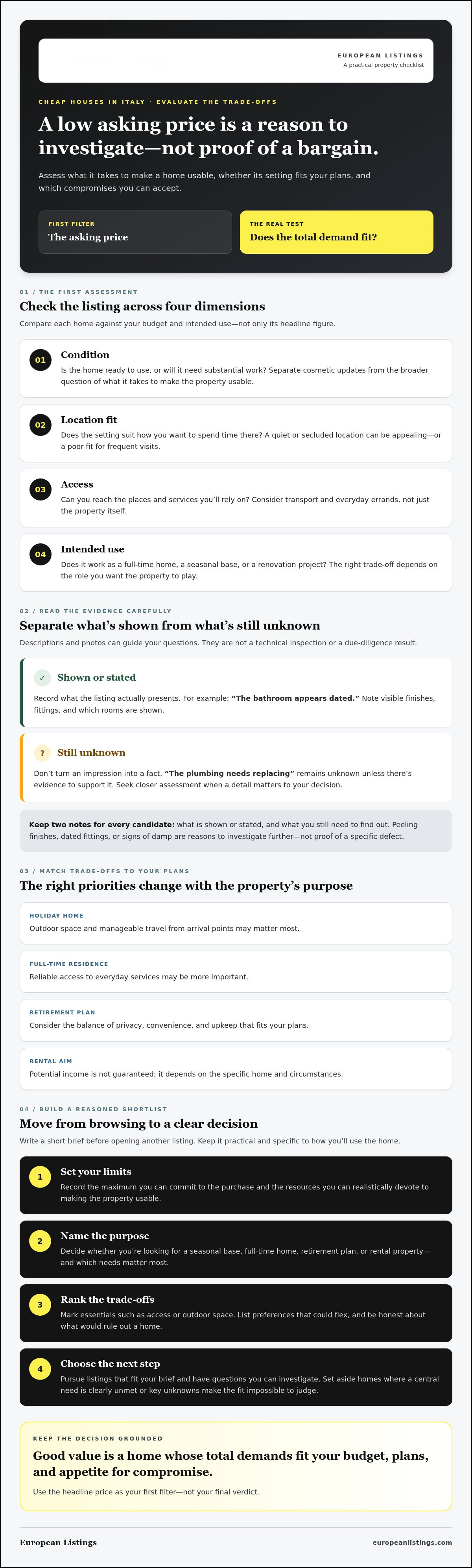
A low asking price is a reason to investigate, not proof you’ve found a bargain. The price alone can’t tell you what it will take to make a home usable, whether its setting suits your plans, or whether the compromises are acceptable. For cheap houses italy searches, assess each property against your budget and intended use, not just its headline figure.
Compare listings across four practical dimensions:
- Condition: Is the home ready to use, or will it need substantial work?
- Location fit: Does the setting suit how you want to spend time there?
- Access: Can you reach the places and services you’ll rely on?
- Intended use: Does the property work as a full-time home, a seasonal base, or a renovation project?
A low asking price is a number. Good value is a home whose total demands fit your budget, plans, and appetite for compromise.
Why can a house in Italy appear unusually cheap?
Condition, the work a property needs, and buyer demand can all shape its asking price. A dated kitchen or worn finishes may call for updates without changing the home’s basic suitability. By contrast, a property that’s difficult to access may not suit someone who expects frequent visits or easy daily errands. A low price doesn’t automatically signal a hidden problem, but it does make the reasons behind the price worth investigating.
What does “cheap” mean for your own search?
Affordability depends on your circumstances. Start with the funds you can commit to the purchase, then account for the practical work and ongoing effort needed to use the home as intended. A modestly priced property that needs extensive renovation may be a poor fit if you want a ready-to-use retreat. The same house could suit someone with time, patience, and a clear renovation plan.
Write down your non-negotiables and the points where you could be flexible. Would you accept a longer journey in exchange for more space, or choose a smaller home that needs less work? Broader comparisons can help you weigh these choices. This guide to comparing buying locations offers a wider frame for deciding where to focus.
Use the headline price as your first filter, not your final verdict. A promising listing earns a closer look when its condition, setting, access, and likely use make sense together.
How to read the trade-offs behind cheap houses in Italy
A listing gives you a first impression, not the whole picture. Renovation can demand more than money: it may take time to coordinate work, make decisions from afar, and wait before the home is comfortable to use. Access matters too. A scenic property may be less convenient if everyday services or transport are far away. These are practical costs in time and effort, even when they don’t appear in the asking price.
A home’s value depends on what it takes to own and use it, not just what it costs to buy. Price context can help you interpret a listing, but it can’t determine whether a particular home suits your plans. For broader context, Global Property Guide tracks Italian property price trends and regional variations.
Assess condition without treating photos as proof
Read the description alongside the photographs. If the text mentions updates but shows only a few rooms, note what you can’t see. Peeling finishes, dated fittings, or signs of damp are reasons to seek closer assessment, not proof of a particular defect. Separate what the listing states from what you infer. Photos and listing details are not a technical inspection or a due-diligence result.
Use two columns in your notes: shown or stated and still unknown. “The bathroom appears dated” belongs in the first. “The plumbing needs replacing” belongs in the second unless there’s evidence to support it. This distinction helps keep an attractive image from becoming an assumption about the work involved.
Match compromises to your intended use
The right trade-off depends on the role you want the property to play. For a holiday home, outdoor space and manageable travel from arrival points may matter most. For a full-time residence, reliable access to everyday services may be more important. A retirement plan can call for a different balance of privacy, convenience, and upkeep. If you’re considering rental income, remember that potential income isn’t guaranteed. It depends on the specific home and circumstances.
Before pursuing a listing, ask which compromises you can live with and which would undermine your plan. A secluded location may be a pleasure for occasional stays and a burden for frequent visits. A larger garden may be appealing, but only if its upkeep fits your available time. European Listings’ weekly property selection brings together selected homes with concise context on their trade-offs.
How to evaluate cheap houses in Italy before pursuing a listing
A disciplined shortlist starts before you open another listing. Write a short brief, then compare each home against it. This keeps cheap houses italy searches focused on properties that could genuinely work, rather than listings that look compelling only because of their asking price.
Build a brief that makes the search useful
Keep your brief practical: your budget boundary, intended use, and essential lifestyle needs. Separate non-negotiables from preferences you might reconsider for the right home. Be open about geography only if you’d genuinely consider living in or travelling to the places you include. A wider search is useful when the locations still fit your plans.
Use this sequence to move from browsing to a reasoned decision:
- Set your limits. Record the maximum you can commit to the purchase and the resources you can realistically devote to making the property usable.
- Name the purpose. A seasonal base, full-time home, retirement plan, and rental aim call for different priorities. Decide which needs matter most for your actual use.
- Rank the trade-offs. Mark essentials such as access or outdoor space, then list preferences that could flex. Be honest about what would make you rule out a home.
- Choose a next step. Pursue listings that fit your brief and have questions you can investigate. Set aside those where a central need is clearly unmet or key unknowns make the fit impossible to judge.
Compare listings without overlooking unknowns
For each candidate, note the asking price, the condition described, the practical fit, and the questions still open. Record the listing source and route to the agent, too. These details help you compare like with like and return to the original information instead of relying on memory or polished photographs.
Keep evidence separate from assumption. “The description says the home needs updating” is a stated detail. The scope, time, and resources that work might involve remain questions. Listing context can help you notice trade-offs and decide what to explore next, but it doesn’t verify title, physical condition, or transaction details. Legal, financial, and technical questions call for appropriate independent professional input.
European Listings presents property details, source information, agent contact routes, and concise trade-offs to support discovery and comparison. It doesn’t replace buyer research or professional checks. Explore the weekly property selection as you refine your shortlist.
Find cheap houses in Italy through a more considered search
A concise shortlist makes it easier to compare more than price. Put a home’s character beside its setting, stated condition, and compromises. Then ask whether those details fit how you’d actually use it. For buyers searching cheap houses italy, focused discovery can be more useful than an endless stream of listings with little context.
What useful listing context should help you notice
Good context supports the property, not the other way around. Concise notes on trade-offs and price-area context help frame what you’re seeing, while a clear source and route to the listing agent make it easier to decide on a next step. European Listings is an independent weekly curation service, not a broker or a replacement for local professionals. In the member survey, 19 of 20 selected “Show me homes I would not find myself” as an explicit value.
The aim is a small selection with room for relevance and surprise. A home beyond your usual search area may be worth considering, or it may confirm that your original brief is right. Either way, a curated selection gives each property space to be assessed on its own merits instead of disappearing in a crowded search.
When to move from discovery to professional guidance
As your interest in a specific property strengthens, relevant professional introductions may be a useful next step. European Listings provides discovery and buying guidance, but doesn’t provide legal, financing, inspection, or transaction services. Listing context can help you decide what to pursue; it isn’t a substitute for independent professional input on a purchase.
If you’re still working out how to search across countries and listing sources, this guide to European property search offers useful perspective. A simpler, considered rhythm can also help you keep discovering homes through the weekly curated property service. The right shortlist starts with homes that suit your plans, not just a low number.
Let your next search reflect what matters most
Your brief doesn’t need to stay fixed. As you compare homes, notice which trade-offs you’re willing to accept and which make a property less suitable. That evolving sense of fit can help you search for cheap houses italy with more purpose, while staying open to a home that challenges your first assumptions.
Discovery matters too. In the European Listings member survey, 19 of 20 selected “Show me homes I would not find myself” as an explicit value, and 17 of 20 valued listing context (honest downsides/trade-offs). The weekly curated property service brings together a considered selection and useful context to help you decide what deserves a closer look. It supports discovery, not professional checks or purchase decisions.
Start with a brief built around your budget, intended use, and the compromises you can accept. Explore the weekly curated property service to discover a considered selection of homes and see whether one fits your plans. The right opportunity may not be the one with the lowest asking price. It’s the one you can pursue with confidence and clear eyes.
Frequently Asked Questions
Why are some houses in Italy so cheap?
Some houses have low asking prices because of their condition, setting, access to services, or the seller’s circumstances. There isn’t one explanation that applies to every listing. A home far from the places you need may be unsuitable for you but still make sense for another buyer. Compare the details provided with your own plans, and treat missing information as a question to resolve, not proof of either a bargain or a hidden problem.
Can foreigners buy cheap houses in Italy?
International buyers do purchase homes in Italy, but the rules that apply can depend on personal circumstances, including citizenship and residency. Don’t rely on a general article to determine your own eligibility or requirements. Get independent professional guidance for your situation before making commitments. Separately, assess whether the property fits your budget and intended use. Eligibility to buy doesn’t establish that a particular home is practical or suitable.
What should I check before buying a cheap house in Italy?
Compare what the listing says about condition with the home’s setting, access, nearby services, and your intended use. Check that you can identify the listing source and route to the agent, then keep a written list of unanswered questions. Photos and descriptions can help you decide what needs further attention, but they aren’t technical inspections or due-diligence findings. Seek independent professional input on legal, financial, and property-condition matters before committing.
Are cheap houses in Italy usually renovation projects?
Some low-priced homes need renovation or updates, but others may be inexpensive for different reasons. Don’t assume one listing represents the wider market. Read the description carefully and distinguish stated work from your own guess based on photographs. Then consider whether any proposed work suits your budget, available time, intended use, and tolerance for uncertainty. If the listing leaves the condition unclear, treat that as an open question, not a confirmed repair bill.
Is the asking price the total cost of buying a house in Italy?
No. The asking price is only one part of the financial picture. Depending on the purchase and your circumstances, you may also need to account for transaction-related costs, ongoing ownership expenses, and work needed to use the property. The relevant amounts can vary, so don’t build a decision around a headline price alone. Ask appropriate independent professionals to explain the costs that apply to the specific property and your situation.
How do I find cheap houses in Italy that fit my plans?
Start with a short brief covering your budget, intended use, essential needs, and compromises you could accept. Use it to compare listings rather than sorting by price alone. Leave room for an unexpected home that challenges your assumptions, but assess its details just as carefully as familiar options. A curated selection can make discovery more focused; it can’t verify a property or replace independent professional checks before you act.
Disclaimer
European Listings is a media publication. We are not a real estate agent, broker, lawyer, tax advisor, or financial advisor, and nothing here is legal, tax, or financial advice.
Properties, prices, and rules change. We do our best to keep things accurate, but we can't promise every detail is current or correct. Always check with a qualified local professional before you buy, sign, or send money.
We sometimes earn a commission from partners and sponsors we link to. This never changes what we choose to cover or what we say about it.
Any decision you make is your own.
Frequently Asked Questions
Condition, the work a property needs, and buyer demand can all shape its asking price. A dated kitchen or worn finishes may call for updates without changing the home’s basic suitability. By contrast, a property that’s difficult to access may not suit someone who expects frequent visits or easy daily errands. A low price doesn’t automatically signal a hidden problem, but it does make the reasons behind the price worth investigating.
Affordability depends on your circumstances. Start with the funds you can commit to the purchase, then account for the practical work and ongoing effort needed to use the home as intended. A modestly priced property that needs extensive renovation may be a poor fit if you want a ready-to-use retreat. The same house could suit someone with time, patience, and a clear renovation plan. Write down your non-negotiables and the points where you could be flexible. Would you accept a longer journey in exchange for more space, or choose a smaller home that needs less work? Broader comparisons can help you weigh these choices. This guide to comparing buying locations offers a wider frame for deciding where to focus. Use the headline price as your first filter, not your final verdict. A promising listing earns a closer look when its condition, setting, access, and likely use make sense together. A listing gives you a first impression, not the whole picture. Renovation can demand more than money: it may take time to coordinate work, make decisions from afar, and wait before the home is comfortable to use. Access matters too. A scenic property may be less convenient if everyday services or transport are far away. These are practical costs in time and effort, even when they don’t appear in the asking price. A home’s value depends on what it takes to own and use it, not just what it costs to buy. Price context can help you interpret a listing, but it can’t determine whether a particular home suits your plans. For broader context, Global Property Guide tracks Italian property price trends and regional variations.
Some houses have low asking prices because of their condition, setting, access to services, or the seller’s circumstances. There isn’t one explanation that applies to every listing. A home far from the places you need may be unsuitable for you but still make sense for another buyer. Compare the details provided with your own plans, and treat missing information as a question to resolve, not proof of either a bargain or a hidden problem.
International buyers do purchase homes in Italy, but the rules that apply can depend on personal circumstances, including citizenship and residency. Don’t rely on a general article to determine your own eligibility or requirements. Get independent professional guidance for your situation before making commitments. Separately, assess whether the property fits your budget and intended use. Eligibility to buy doesn’t establish that a particular home is practical or suitable.
Compare what the listing says about condition with the home’s setting, access, nearby services, and your intended use. Check that you can identify the listing source and route to the agent, then keep a written list of unanswered questions. Photos and descriptions can help you decide what needs further attention, but they aren’t technical inspections or due-diligence findings. Seek independent professional input on legal, financial, and property-condition matters before committing.
Some low-priced homes need renovation or updates, but others may be inexpensive for different reasons. Don’t assume one listing represents the wider market. Read the description carefully and distinguish stated work from your own guess based on photographs. Then consider whether any proposed work suits your budget, available time, intended use, and tolerance for uncertainty. If the listing leaves the condition unclear, treat that as an open question, not a confirmed repair bill.
No. The asking price is only one part of the financial picture. Depending on the purchase and your circumstances, you may also need to account for transaction-related costs, ongoing ownership expenses, and work needed to use the property. The relevant amounts can vary, so don’t build a decision around a headline price alone. Ask appropriate independent professionals to explain the costs that apply to the specific property and your situation.
Start with a short brief covering your budget, intended use, essential needs, and compromises you could accept. Use it to compare listings rather than sorting by price alone. Leave room for an unexpected home that challenges your assumptions, but assess its details just as carefully as familiar options. A curated selection can make discovery more focused; it can’t verify a property or replace independent professional checks before you act.