
Buying Overseas Property Mistakes: Practical Guide for 2026
The most costly buying overseas property mistakes often begin before an offer: a beautiful listing becomes the plan before the buyer has defined what a good fit means. Then the full budget, unfamiliar transaction costs and local process tell a different story.
It’s easy to see why. Attractive homes are hard to compare when your priorities are still vague, and the rules and costs that shape a purchase vary across borders. A listing can help you discover possibilities, but it can’t replace independent checks or tell you which compromises you’ll be happy to live with.
This guide will help you build a brief around your needs, compare homes against it and recognise when legal or technical advice from an independent professional matters. You’ll also learn to look beyond the headline price and treat trade-offs as part of the decision, not an afterthought. The aim isn’t to rush you towards an offer. It’s to move from browsing to a considered next step, with a clearer sense of what fits and what still needs checking.
Buying overseas property mistakes often start with a vague brief
A home abroad can promise a different rhythm of life, more space, or a place to return to year after year. The difficulty is knowing whether a particular property can deliver that life once the holiday glow fades. One of the most avoidable buying overseas property mistakes is letting an appealing listing define the search before you’ve decided what you need.
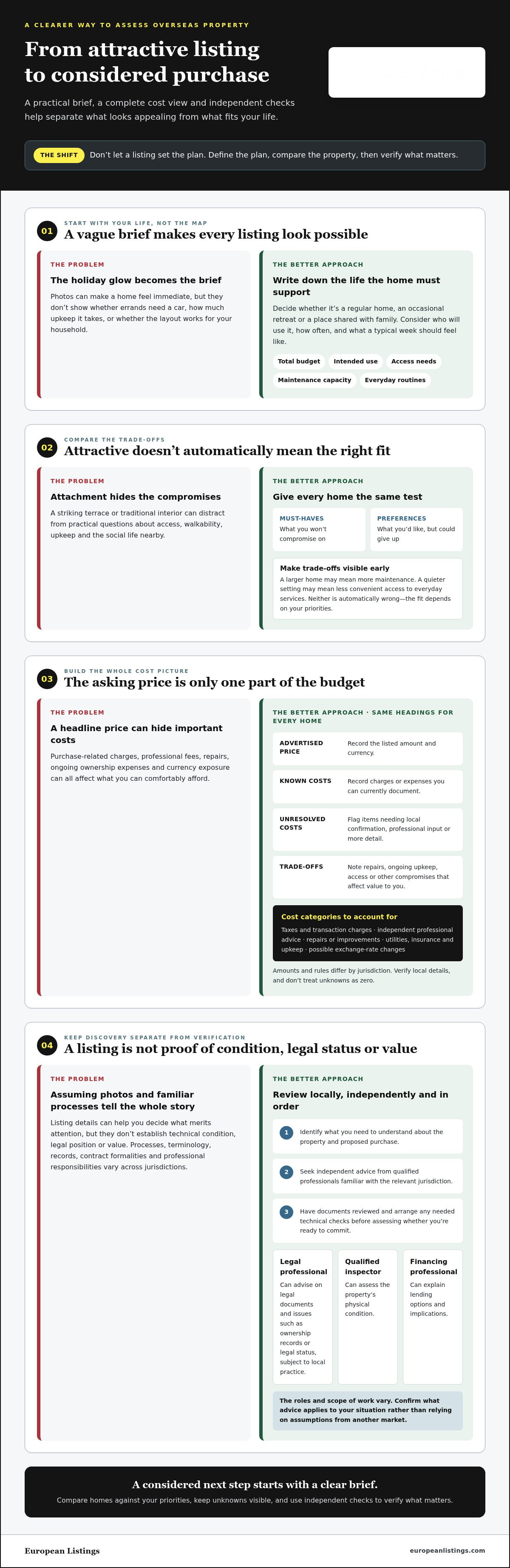
Photographs make a home feel immediate. They don’t show whether everyday errands require a car, how much upkeep the property needs, or whether its layout works for your household. Set a few practical priorities first: your total budget, intended use, access needs, maintenance capacity and the routines you want your home to support. This international real estate overview illustrates how cross-border purchases involve different contexts. That’s a reason to be deliberate, not to choose based on a headline or holiday memory.
Choosing a country before defining the life you want
Start with the life, not the map. Will the property be a regular home, an occasional retreat, or a place shared with family? Consider who will use it, how often, and what a typical week should feel like. Then compare possible destinations against those needs. A destination comparison guide can help frame that decision around priorities rather than assumptions about a place.
Treating every attractive listing as a good fit
A striking terrace or traditional interior can earn a closer look, but it shouldn’t settle the decision. Compare the property with practical needs: access, walkability, upkeep and the kind of social life you want nearby. Before viewing options, write down what you won’t compromise on and what you could accept in return for a stronger fit elsewhere.
For example, a larger home may mean more maintenance; a quieter setting may involve less convenient access to everyday services. If you intend to rent the property out seasonally, consulting local hospitality and management providers like GuestLee can clarify what running and maintaining a home actually entails. Neither trade-off is automatically wrong. The mistake is discovering it only after becoming attached. A focused brief makes those compromises visible while comparison is still easy. It also helps you assess homes for sale against the life you actually want, not an idealised image of living abroad.
Keep the brief simple: list your must-haves, separate them from preferences, and decide which compromises you could accept. That gives every listing the same test. Attractive homes may still make the shortlist, but they won’t distract you from the essentials.
Avoid overseas property mistakes by looking beyond the asking price
An asking price is a starting point, not a complete budget. Some buying overseas property mistakes happen because buyers count only the advertised amount, overlooking purchase-related charges, professional fees, repairs, recurring ownership expenses or currency exposure. These costs can affect what you can comfortably afford, even when the property itself appears to fit.
Assuming the asking price is the full budget
Build a separate estimate for each cost category. Include taxes and transaction charges, fees for independent professional advice, repairs or improvements, and regular expenses such as utilities, insurance and upkeep. If exchange rates could change the amount you need to pay, account for that uncertainty too. Categories, amounts and rules differ by jurisdiction, so verify current local details before relying on an estimate. A guide to hidden costs when buying property provides a useful reminder that the asking price is only one part of the calculation.
Keep the comparison disciplined. Use the same headings for each home, and mark unknowns as unresolved rather than quietly treating them as zero. This makes it easier to see which estimates are based on documented costs and which still need professional input.
| Comparison | What to record |
|---|---|
| Advertised price | The listed amount and currency |
| Known costs | Charges or expenses you can currently document |
| Unresolved costs | Items needing local confirmation, professional input, or further detail |
| Trade-offs | Repairs, ongoing upkeep, access, or other compromises that affect value to you |
Reading listing details as proof of condition or value
Photos and descriptions help you decide what merits attention. They don’t establish a home’s technical condition, legal position or value. Compare appealing features with disclosed downsides and missing details, then consider how the asking price sits in its local context. A property with attractive finishes may still need work; an incomplete description is a reason to seek answers, not assume the best. Avoiding buying overseas property mistakes means keeping these distinctions clear.
Listing context helps you compare; independent checks help you verify. European Listings’ weekly curated property selection brings together homes with useful details, price and area context, and honest trade-offs. It supports discovery, while legal and technical assessment remains the work of independent professionals. If you’re shaping a shortlist, explore curated overseas property listings to compare homes with their context in view.
Skipping independent checks is a costly overseas buying mistake
Buying overseas property mistakes often begin with assuming that a familiar process works the same way across a border. Terminology, ownership records, contract formalities, taxes and professional responsibilities vary by jurisdiction. Don’t assume a document or professional role carries the same meaning elsewhere. Get current, jurisdiction-specific advice, especially before making a binding commitment.
Assuming one country’s buying process applies everywhere
Keep the next steps clear and in order. First, identify what you need to understand about the property and proposed purchase. Then obtain independent advice from qualified professionals familiar with the relevant jurisdiction. Have the documents reviewed and arrange any needed technical checks before assessing whether you’re ready to commit.
A lawyer qualified in the relevant jurisdiction can advise on legal documents and issues such as ownership records or the property’s legal status, subject to local practice. A qualified inspector can assess physical condition. A financing professional can explain lending options and implications. For cross-border purchasers navigating an unfamiliar market, it can also be valuable to explore Real Estate Investment Management services that guide foreign buyers through property searches, negotiations, and expert coordination. Their roles and the scope of their work vary, so establish what advice applies to your situation rather than relying on assumptions drawn from another market. A careful, locally informed review can help you avoid these buying overseas property mistakes.
Confusing listing discovery with due diligence
Curated property information can help you discover homes, understand their stated details and notice disclosed trade-offs. It doesn’t verify title, condition, debts, planning status or legal compliance. Those questions call for independent review. A lawyer may examine relevant records and contract terms; an inspector may identify physical defects or maintenance concerns. What they can assess depends on local rules, access and the work agreed.
Use a simple sequence before moving forward:
- Write down unanswered questions about the property and purchase.
- Obtain independent legal, technical and financing advice as relevant.
- Review documents and findings with the appropriate qualified professionals.
- Assess your commitment only after you understand the remaining risks and uncertainties.
Pressure to sign or transfer funds before you’ve had a reasonable chance to complete checks is a reason to pause and seek independent advice. Urgency doesn’t resolve unanswered questions. It can make them easier to overlook. Treating pressure as a warning, rather than a reason to hurry, can help you steer clear of buying overseas property mistakes.
Keep discovery and verification distinct: listing context helps you decide what merits attention; independent professionals assess matters that require specialist review. For a closer look at how curated selections support the search, explore this curated property newsletter selection guide. You can also compare curated property listings before deciding which homes warrant further checks.
Use a simple overseas property buying checklist before making an offer
A checklist won’t remove every uncertainty, but it can stop momentum from replacing judgment. Before progressing towards an offer, use the same final review for each property. If a key answer is missing, keep it unresolved rather than treating it as settled. That pause can prevent buying overseas property mistakes driven by assumptions or pressure.
A pre-offer checklist that keeps decisions grounded
- Revisit the purpose. Does the home still suit how you plan to use it and the needs of the people who will stay there?
- Review the full budget. Include the advertised price, known purchase costs, recurring ownership expenses, possible repairs and any currency exposure relevant to your finances.
- Name the trade-offs. Confirm that the property’s access, upkeep and compromises remain acceptable, not just attractive on paper.
- Collect unresolved questions. Note anything unclear about ownership, documents, legal status, condition or costs.
- Arrange independent checks. Have relevant documents and technical concerns reviewed by qualified professionals who understand the jurisdiction and their scope of work.
- Choose your timing deliberately. Don’t let pressure to sign or transfer funds replace the time needed to understand important facts.
If essential details are still unclear, pause. A considered delay is better than making a commitment on an assumption. The right moment to proceed is when you understand the remaining questions, the advice you need and the compromises you’re accepting.
Make the next search more focused, not more complicated
A useful brief doesn’t need to predict every preference. It should capture the essentials while leaving room for a home you might not have thought to search for. European Listings’ weekly property selection is shaped around a member’s brief. Each listing page brings the property to the fore with photos, price, location, key facts, source information, a save option and a clear route to the listing agent. Concise context and honest trade-offs support discovery and comparison, not legal or technical verification, financing or transaction execution.
Keep the distinction clear: finding a promising property is a step towards a decision, not the decision itself. Independent professionals remain essential for checks that require specialist judgment. When you’re ready to continue browsing with your priorities in view, explore European Listings’ weekly property selection.
Take the next step at your own pace
The strongest next move isn’t necessarily an offer. It may be a more focused search, a question for an independent professional, or time to reconsider whether a property suits the life you want. Avoiding buying overseas property mistakes doesn’t mean eliminating every unknown. It means recognising what still needs an answer before you commit.
Discovery can widen your view without adding noise. In a member survey, 19 of 20 respondents valued discovering homes they would not find themselves, while 17 of 20 valued honest downsides and trade-offs. That perspective can help you consider possibilities with open eyes, then decide which ones deserve closer attention.
When you’re ready to browse again, explore this week’s curated property selection. Keep your priorities close, take the time you need, and make the next step a considered one.
Frequently Asked Questions
Is buying property overseas riskier than buying at home?
Not automatically. The risks depend on the jurisdiction, property, transaction and your circumstances. Distance can make it harder to inspect a home or interpret unfamiliar documents, so allow time to arrange independent legal and technical checks. If you can’t visit in person, consider how you’ll obtain a clear view of the property and its surroundings. General online guidance can orient you, but it can’t assess the details of your specific purchase.
Can foreigners buy property in every country?
There’s no universal rule. Foreign ownership conditions can vary by jurisdiction and may depend on the buyer or property. A friend’s successful purchase, or a general article, doesn’t establish that your own proposed purchase is permitted. Before making a commitment, ask an independent lawyer qualified in the relevant jurisdiction to explain the current rules and any conditions that apply to your circumstances.
What should I check before making an offer on an overseas property?
First, make sure the home still suits its intended use, your budget and the compromises you’re willing to accept. Then turn unanswered questions into a short list for professional review. For example, clarify what is included in the sale, whether the stated access arrangements meet your needs, and which documents remain to be reviewed. Overseas property mistakes often happen when assumptions go untested, so don’t treat a checklist as a substitute for advice on the specific purchase.
How much should I budget beyond the overseas property asking price?
There’s no reliable universal amount. Your estimate may need to account for purchase taxes, professional fees, currency conversion, repairs and ongoing ownership expenses, with the details depending on the jurisdiction and transaction. Separate one-off costs from recurring ones, and consider how a currency movement could affect funds you’ll need later. Build a location-specific estimate with qualified independent professionals. For an example of why the asking price is only one part of the calculation, see this guide to hidden costs when buying property.
Do I need a lawyer when buying property overseas?
Independent legal advice can help you understand the documents, ownership questions, obligations and process relevant to your purchase. Ask a lawyer qualified in the property’s jurisdiction to review the proposed agreement and explain what you would be committing to before you sign or transfer funds. A listing service can help you discover and compare homes, but it doesn’t provide legal advice or replace a lawyer’s review of your transaction.
What happens if I discover a problem after agreeing to buy?
Your options depend on the contract, the problem and the jurisdiction. Don’t assume you can withdraw, recover funds or resolve the issue on the same terms that might apply at home. Contact your independent lawyer promptly, share the relevant agreement, and preserve related messages and records. Keep a dated note of when you noticed the issue and who you informed. Timely, jurisdiction-specific advice can help you understand what steps are available.
Disclaimer
European Listings is a media publication. We are not a real estate agent, broker, lawyer, tax advisor, or financial advisor, and nothing here is legal, tax, or financial advice.
Properties, prices, and rules change. We do our best to keep things accurate, but we can't promise every detail is current or correct. Always check with a qualified local professional before you buy, sign, or send money.
We sometimes earn a commission from partners and sponsors we link to. This never changes what we choose to cover or what we say about it.
Any decision you make is your own.
Frequently Asked Questions
Not automatically. The risks depend on the jurisdiction, property, transaction and your circumstances. Distance can make it harder to inspect a home or interpret unfamiliar documents, so allow time to arrange independent legal and technical checks. If you can’t visit in person, consider how you’ll obtain a clear view of the property and its surroundings. General online guidance can orient you, but it can’t assess the details of your specific purchase.
There’s no universal rule. Foreign ownership conditions can vary by jurisdiction and may depend on the buyer or property. A friend’s successful purchase, or a general article, doesn’t establish that your own proposed purchase is permitted. Before making a commitment, ask an independent lawyer qualified in the relevant jurisdiction to explain the current rules and any conditions that apply to your circumstances.
First, make sure the home still suits its intended use, your budget and the compromises you’re willing to accept. Then turn unanswered questions into a short list for professional review. For example, clarify what is included in the sale, whether the stated access arrangements meet your needs, and which documents remain to be reviewed. Overseas property mistakes often happen when assumptions go untested, so don’t treat a checklist as a substitute for advice on the specific purchase.
There’s no reliable universal amount. Your estimate may need to account for purchase taxes, professional fees, currency conversion, repairs and ongoing ownership expenses, with the details depending on the jurisdiction and transaction. Separate one-off costs from recurring ones, and consider how a currency movement could affect funds you’ll need later. Build a location-specific estimate with qualified independent professionals. For an example of why the asking price is only one part of the calculation, see this guide to hidden costs when buying property.
Independent legal advice can help you understand the documents, ownership questions, obligations and process relevant to your purchase. Ask a lawyer qualified in the property’s jurisdiction to review the proposed agreement and explain what you would be committing to before you sign or transfer funds. A listing service can help you discover and compare homes, but it doesn’t provide legal advice or replace a lawyer’s review of your transaction.
Your options depend on the contract, the problem and the jurisdiction. Don’t assume you can withdraw, recover funds or resolve the issue on the same terms that might apply at home. Contact your independent lawyer promptly, share the relevant agreement, and preserve related messages and records. Keep a dated note of when you noticed the issue and who you informed. Timely, jurisdiction-specific advice can help you understand what steps are available.