
Is There a European Zillow? What Property Buyers Should Know in 2026
What if the best european zillow isn’t a single website at all? Europe’s property search is spread across national markets, each with its own portals, languages, and listing conventions. If you’re comparing homes across borders, one search tab won’t give you the full picture. And even a listing that looks current online needs to be confirmed with its source.
That fragmentation can make it hard to decide where to look, which details to compare, and what to verify before taking a property seriously. This guide explains what local portals and cross-border search tools can do, where their limits lie, and how to keep your search manageable. A considered selection can help you discover homes worth exploring, while further research remains important when you focus on a particular property. European Listings’ weekly newsletter brings together 18 curated properties each Saturday, with listing details, useful context, and a route to the listing agent. As your plans become more serious, the service can also introduce you to relevant independent professionals. First, here’s why no single portal has become Zillow for Europe.
Is There a European Zillow? Why One Portal Cannot Cover Every Market
No single site should be assumed to offer complete, consistent property coverage across Europe. Some platforms bring listings from multiple countries into one interface, which can make browsing easier. But one search box doesn’t guarantee that every relevant home is included or that details are presented in the same way.
What buyers usually mean by “European Zillow”
Usually, they want one convenient place to search listings, view photos and prices, apply filters, and find a clear route to an agent. Those features describe a familiar search experience, not proof of complete inventory or equally reliable information across borders. “European Zillow” is best understood as shorthand for the experience buyers want, not the name of a verified universal service.
A property portal is a searchable platform that displays property listings. A curated property-discovery service selects a smaller set of homes and adds concise context to help buyers decide what merits a closer look. One emphasizes breadth and search; the other, selection and discovery. They can complement each other.
Why property search varies across Europe
Property listings aren’t presented to one shared European standard. Languages, listing conventions, and the information supplied can vary by market and source. The overview of Housing in Europe also reflects the range of housing conditions and trends across countries. A polished interface can bring results together without making the underlying details uniform.
Listings may appear on local portals, cross-border platforms, international catalogs, or more than one of these. A local portal can be useful when you’re focused on one market. A cross-border site or international catalog can help surface options across several markets, but its selection may not represent every available listing. Treat each as a discovery route, not a definitive record of the whole market.
Use each platform for what it does well, then follow the source when a property stands out. Compare the location, price, key facts, and any listing context, and contact the listing agent for current property details. A curated selection can make early exploration more manageable; local portals remain useful when you’re ready to search more deeply in a particular market.
European Property Websites: Portals, Aggregators, and International Search
The useful question isn’t which site has the biggest-looking map. It’s what kind of search each platform supports and what details you’ll need to confirm. The distinctions below are practical, not rankings. AirDNA’s guide names Idealista, Green-Acres, and Rightmove Overseas as examples. That mention isn’t an endorsement or a verified ranking.
Local portal | Idealista is an example of a portal with listings in several European markets. Useful for: searching within the markets it serves. Limit: a focused search won’t necessarily reveal homes listed elsewhere or on other platforms.
Cross-border search site | Green-Acres is an example of a site used to discover properties across markets. Useful for: browsing beyond one country. Limit: coverage and listing detail can vary by location and source.
International catalog | Rightmove Overseas and Realtor.com International present property listings through an international interface. Useful for: scanning options by location in one place. Limit: a shared interface doesn’t establish complete European inventory or independently verify each property detail.
Curated discovery service | A considered selection presents fewer properties with concise context. Useful for: spotting homes worth exploring. Limit: it isn’t intended to replace a portal’s broader search or the specialist work involved in assessing a property.
How local and cross-border portals differ
Local portals can be practical once you’re focused on a particular market. Cross-border sites widen the discovery net, though their depth may differ from one country to another. If a listing catches your attention, open its original source when available. Compare the source’s date and details with the version you found. An international interface alone can’t tell you whether a listing is current or complete.
What an international property catalog can, and cannot, tell you
One interface can reduce the friction of moving between locations and browsing property types. But displaying a price, photo, or filter is not the same as independently verifying the information behind it. The European Commission’s Housing in the European Union report examines differing market developments and the forces behind them. It’s useful context for understanding why a uniform search experience shouldn’t be mistaken for a uniform market.
Use catalogs to find possibilities, then follow listings back to their sources for current particulars. For a more focused starting point, European Listings’ weekly curated property selection brings together 18 selected homes each Saturday, with concise context and source details.
How to Search Across Property Websites Without Getting Lost
More tabs won’t necessarily bring you closer to the right home. A simple process will. Whether you’re looking for a european zillow or comparing several local sites, keep your search anchored to your priorities. Track the properties that genuinely merit a closer look instead of saving every result.
Start with a useful brief, not endless filters
Set a working budget, clarify whether the home is for holidays, a move, or another purpose, and name the lifestyle essentials that matter most. Decide how open you are to different countries or areas. Separate must-haves from preferences so you can compare homes that don’t match every wish. If you’re still weighing locations, this 2026 guide to choosing where to buy can help frame that decision.
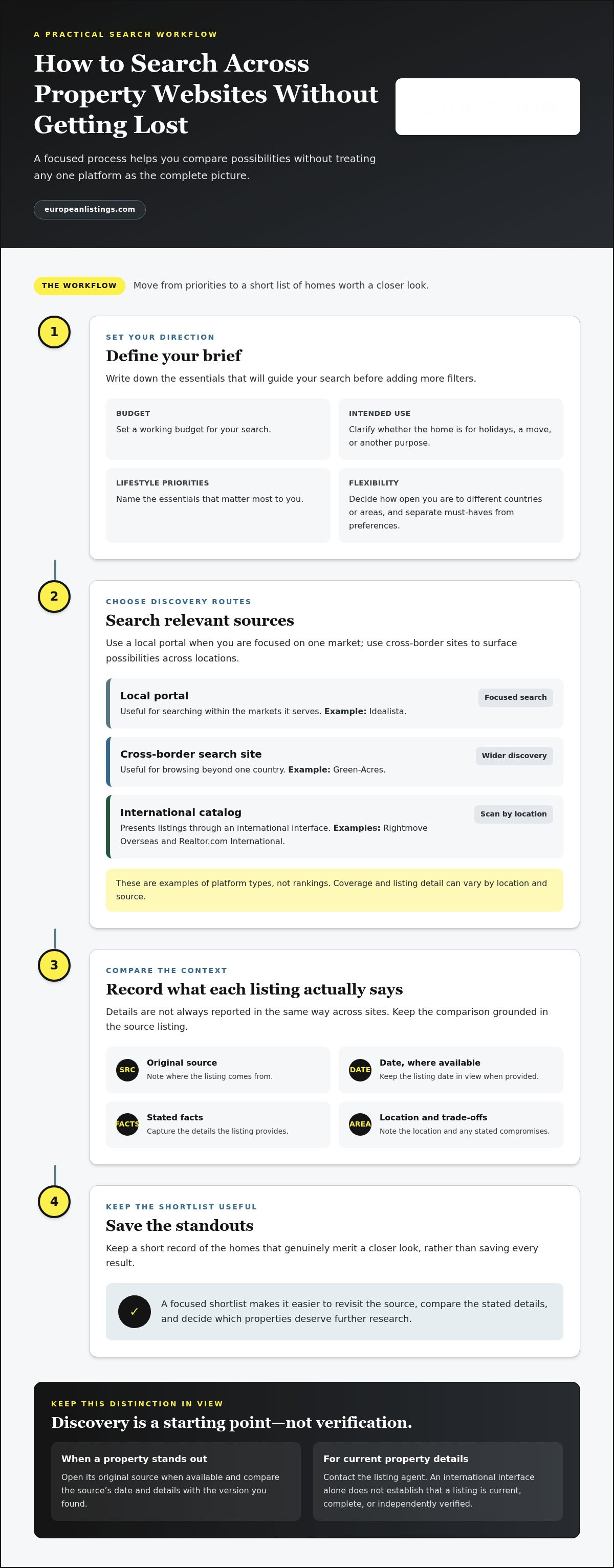
- Define your brief. Write down your budget, intended use, lifestyle priorities, and acceptable compromises.
- Search relevant sources. Use a local portal when focused on one market and cross-border sites to surface possibilities across locations.
- Compare the context. Note each listing’s original source, date where available, stated facts, location, and any stated trade-offs. Don’t assume details are reported in the same way across sites.
- Save the standouts. Keep a short record of the homes you want to remember and what caught your attention. A few thoughtful comparisons are more useful than an ever-growing folder of links.
- Follow up when intent strengthens. Contact the listing agent for current property information. As you move toward a decision, consider which independent professionals can help with legal, financial, and inspection work.
Compare listings and keep track of the trade-offs
For each saved home, capture the asking price as stated, key property facts, source, and date. Add brief area context and note the compromise you’d be making, such as a less central location or a feature you’d have to forgo. If information is missing, record that rather than filling the gap with an assumption. A portal listing is a starting point, not due diligence.
Curated discovery can make the first pass calmer without replacing those follow-up steps. Explore 18 selected European properties each Saturday, presented with concise context, source details, and a save option.
When a Curated Property Newsletter Helps, and What It Does Not Replace
A portal gives you room to search widely. A curated newsletter offers a different advantage: a smaller selection chosen to help you notice homes worth exploring, with useful context and a direct route to the listing agent. It can complement the search habits you already have, especially while your preferred location or priorities are still taking shape. It isn’t a european zillow or a complete database, and it doesn’t replace the research needed to assess a specific property.
A considered selection is different from a complete database
European Listings sends members 18 curated properties each Saturday. The selection is personalized around a buyer’s brief while retaining editorial judgment and room for a few unexpected possibilities. Each listing page brings together photos, price, location, key facts, source, concise context, and a save option. Context can help you remember what caught your attention, including a property’s trade-offs and how its price relates to its area.
Discovery matters to members: in a survey, 19 of 20 respondents valued finding homes they wouldn’t find themselves. Still, selection is not completeness. Use portals when you want to search broadly, and draw on independent professionals as you assess a specific property. Curation helps you decide what merits attention; it doesn’t verify every detail or replace specialist work.
A simple next step for buyers still exploring
A weekly selection can be a useful discovery habit when your brief is evolving. Each issue offers a manageable set of homes to consider, save, or rule out, rather than another open-ended search session. You don’t need to have settled on one country to learn what styles, locations, and compromises appeal to you. For prospective buyers scouting UK coastal locations firsthand, flexible serviced accommodation providers such as flexiestays.com offer a practical base to experience the area before committing to a purchase.
As your plans become more serious, specialist questions call for specialist help. In the member survey, 14 of 20 respondents wanted introductions to trusted experts once they were serious. European Listings offers contextual introductions to relevant professionals; those professionals provide legal, financial, inspection, and other specialist work. The roles are distinct, and that distinction matters.
If a considered weekly view of European homes would complement your own searches, explore European Listings for weekly property discovery.
Let the Right Home Refine Your Search
The search for a european zillow can keep you focused on finding one perfect tool. A better next step is to decide what you need from your search: broad coverage, local depth, or a thoughtful way to discover homes worth a closer look. Then let real properties sharpen your sense of what matters. A promising home might reveal a location or compromise you hadn’t considered. Its drawbacks might make your priorities clearer.
That balance matters. In a member survey, 19 of 20 respondents valued discovering homes they wouldn’t find themselves, while 17 of 20 valued honest downsides and trade-offs. Good discovery isn’t about making every property sound irresistible. It’s about helping you spot possibilities with clear eyes, then choose what deserves further attention.
Keep your search open, but your next step manageable. Explore this week’s curated European homes and see what catches your attention.
Frequently Asked Questions
Is there a single website that lists every home for sale in Europe?
No. No one site should be treated as a complete record of every home or market. A property might appear on a local agency site but not on an international catalog, or appear on several platforms with different details. Note the original source and listing date where shown, and compare sources when a property or area matters to your search.
Can I use Zillow to search for homes in Europe?
Zillow is associated with property search in the United States, and it shouldn’t be assumed to provide comprehensive European listings. If you’re searching for a european zillow experience, start with platforms serving the countries you’re considering, then follow promising results to their original listing sources. Check whether a listing is still active and whether the displayed facts answer your questions before treating it as a serious option.
Which websites are similar to Zillow for European property searches?
AirDNA’s guide names Idealista, Green-Acres, and Rightmove Overseas as examples, while Realtor.com International offers an international catalog. These are examples, not a verified ranking or interchangeable services. Choose according to your search: are you focused on one market, comparing countries, or browsing international listings? Then consider whether the listing source, language, and date are clear enough for the comparison you want to make.
Are property listings on international websites always up to date?
No. An international site may display information supplied by another source, and a visible listing date may not tell you when every detail was last checked. If a property interests you, contact the listing agent to ask whether it’s still available and to clarify important particulars, such as the asking price or included features. Treat the listing as a lead, not confirmation of the property’s current status or condition.
Can I search for European homes in English?
Often, international platforms provide English-language browsing, but language support can vary across sites and listings. A translated menu doesn’t guarantee that every description or property term has been translated accurately. If a detail affects your decision, compare it with the original listing and seek help from a qualified translator or relevant independent professional as needed. Keep notes of unclear phrases so you can resolve them before moving forward.
What should I do after finding a property I like?
Save the listing and make a brief note of what appeals to you, what concerns you, and what you still need to learn. Then use the listed agent contact route to ask property-specific questions and confirm the home’s current status. If you’re considering a purchase, identify independent legal, financial, and inspection professionals for their respective work. A listing page or discovery newsletter can help you explore, but it doesn’t perform those specialist checks.
Disclaimer
European Listings is a media publication. We are not a real estate agent, broker, lawyer, tax advisor, or financial advisor, and nothing here is legal, tax, or financial advice.
Properties, prices, and rules change. We do our best to keep things accurate, but we can't promise every detail is current or correct. Always check with a qualified local professional before you buy, sign, or send money.
We sometimes earn a commission from partners and sponsors we link to. This never changes what we choose to cover or what we say about it.
Any decision you make is your own.
Frequently Asked Questions
No. No one site should be treated as a complete record of every home or market. A property might appear on a local agency site but not on an international catalog, or appear on several platforms with different details. Note the original source and listing date where shown, and compare sources when a property or area matters to your search.
Zillow is associated with property search in the United States, and it shouldn’t be assumed to provide comprehensive European listings. If you’re searching for a european zillow experience, start with platforms serving the countries you’re considering, then follow promising results to their original listing sources. Check whether a listing is still active and whether the displayed facts answer your questions before treating it as a serious option.
AirDNA’s guide names Idealista, Green-Acres, and Rightmove Overseas as examples, while Realtor.com International offers an international catalog. These are examples, not a verified ranking or interchangeable services. Choose according to your search: are you focused on one market, comparing countries, or browsing international listings? Then consider whether the listing source, language, and date are clear enough for the comparison you want to make.
No. An international site may display information supplied by another source, and a visible listing date may not tell you when every detail was last checked. If a property interests you, contact the listing agent to ask whether it’s still available and to clarify important particulars, such as the asking price or included features. Treat the listing as a lead, not confirmation of the property’s current status or condition.
Often, international platforms provide English-language browsing, but language support can vary across sites and listings. A translated menu doesn’t guarantee that every description or property term has been translated accurately. If a detail affects your decision, compare it with the original listing and seek help from a qualified translator or relevant independent professional as needed. Keep notes of unclear phrases so you can resolve them before moving forward.
Save the listing and make a brief note of what appeals to you, what concerns you, and what you still need to learn. Then use the listed agent contact route to ask property-specific questions and confirm the home’s current status. If you’re considering a purchase, identify independent legal, financial, and inspection professionals for their respective work. A listing page or discovery newsletter can help you explore, but it doesn’t perform those specialist checks.