
How to Buy Property in Southern Europe from the US and Understand the Costs
Yes, Americans can buy property in Southern Europe. Buying property in southern Europe from the US is possible, but owning a home does not itself grant residency rights. From 1 September 2026, non-residents buying urban residential property in Portugal pay a flat IMT rate of 7.5%, plus 0.8% stamp duty.
The appeal is clear: a second home, a future retirement base, or a property with rental potential. The complication is that Southern Europe is not one market. Prices, purchase taxes, paperwork, and ownership costs vary by country, so the listing price alone cannot tell you what a property will really cost.
This guide explains what Americans should consider before choosing a country, how Portugal’s tax change affects non-resident buyers, and which costs to include in a budget. It also compares the types of homes available across Southern Europe, helping you narrow the search by location and purpose, not just by the most appealing photograph.
Can Americans Buy Property in Europe?
Yes, Americans can buy property in Southern European countries. Buying property in southern Europe from the US means comparing each country’s rules, costs, and property market separately.
-
Compare Prices and Advantages by Country
Compare specific locations and property types rather than relying on country averages. These are distinct markets, so assess a home’s condition and setting alongside its asking price.
City listings show how sharply prices can vary between neighborhoods.
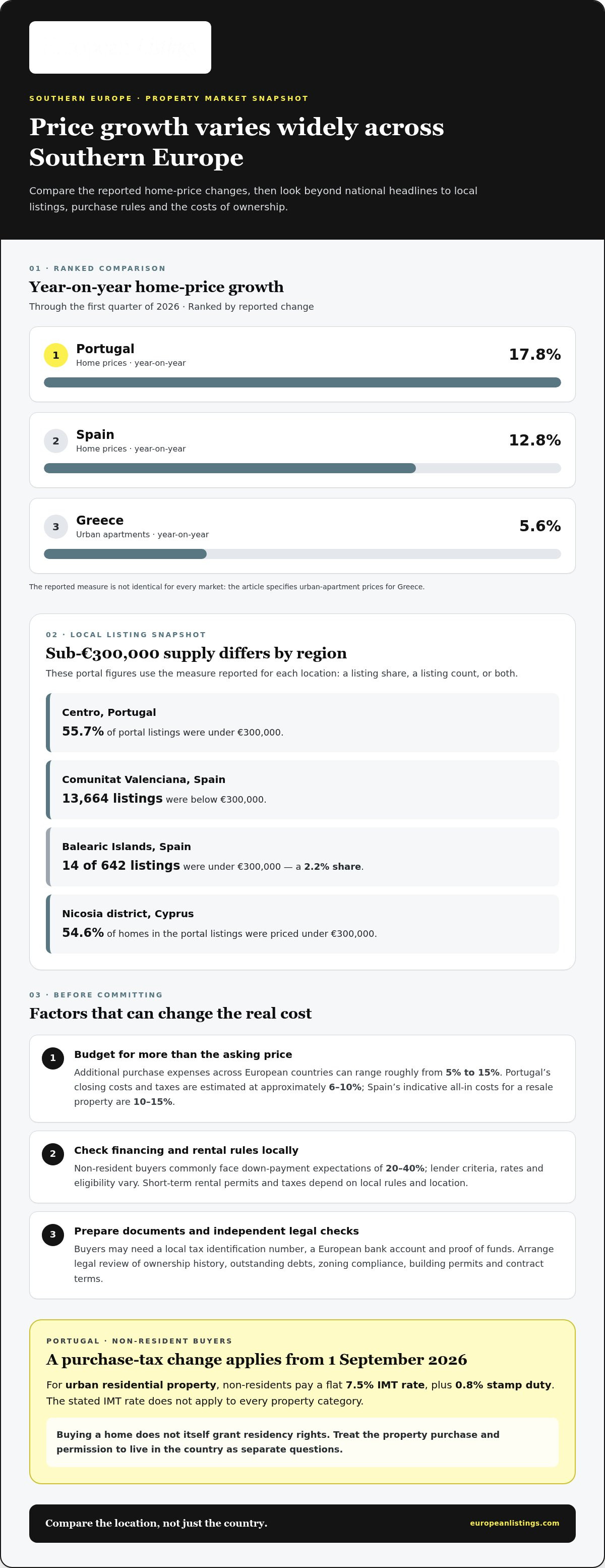
Compare regions before choosing a country. Portugal’s Centro region had 55.7% of portal listings under €300,000; Spain’s Comunitat Valenciana had 13,664 listings below that price. By contrast, 14 of 642 listings in the Balearic Islands were under €300,000, a 2.2% share. Through the first quarter of 2026, home prices rose year-on-year by 17.8% in Portugal, 12.8% in Spain, and 5.6% for Greek urban apartments.
-
Check Requirements for US Buyers
Map out the paperwork before making an offer. Buyers may need a local tax identification number, a European bank account, and proof of funds. Americans must also comply with anti-money-laundering rules, and a solicitor may be needed to complete the purchase.
Arrange independent legal review of the ownership history, outstanding debts, zoning compliance, building permits, and contract terms. In Spain, buyers are advised to work with an independent lawyer, a local tax adviser, and a certified translator when needed. Requirements and timing vary by country, so identify the document and payment steps before committing funds.
-
Assess Financing, Renting, and Tax Risks
Ask lenders about non-resident mortgage criteria before setting your budget. Non-resident buyers commonly face down-payment expectations of 20-40%; rates and eligibility depend on lender criteria, income, property, and loan structure. Americans can rent out a property, but short-term rental permits and taxes depend on local rules and location. Establish those costs before relying on rental income.
US owners may need to report foreign bank accounts, rental income, and capital gains, and consider estate planning. Potential double taxation depends on the income, property location, and applicable tax treatment—for example, buyers exploring markets like Slovenia can consult dedicated firms such as taxslovenia.com to clarify cross-border tax rules. A sound plan for buying property in southern Europe from the US accounts for these obligations before purchase, not after.
Has Portugal’s new tax changed what non-residents pay?
Yes. Portugal’s change affects the purchase tax paid by non-residents buying urban residential property. It does not change the residency rights that property ownership provides.
US buyers can assess title, zoning, permits, debts, and building condition before purchase. An independent attorney can review ownership history, outstanding debts, zoning compliance, building permits, and contract terms. Assess the building’s condition through an in-person inspection and available records.
- Calculate Portugal’s purchase tax for the property type and your non-resident status. From 1 September 2026, non-residents buying urban residential property in Portugal pay a flat IMT rate of 7.5%, plus 0.8% stamp duty. The stated IMT rate applies to urban residential property, so don’t treat it as the rate for every property category. Include both taxes when comparing Portugal with another country.
- Separate property ownership from permission to live in Portugal. Buying a home abroad does not itself grant residency rights in many European countries, including Portugal. Treat the property and immigration decisions as separate: consider housing, work, and family needs alongside the residence route, rather than assuming a deed settles your right to stay.
- Match the home’s location to your long-term housing and education plans. Compare access to schools, commute options, and daily services in the specific town or neighborhood, not just in the listing photos. A rural home requiring renovation, for example, offers a different lifestyle from an apartment in Lisbon, while renovation work and school access may affect whether either suits your family. Set these practical priorities before making an offer.
- Check whether a residence-permit route actually fits your plan before treating a listing as eligible. Some European golden visa programs have allowed residence-by-investment through property purchases above thresholds as low as €250,000. That historical threshold does not establish current eligibility for Portugal or any individual property. Ownership, investment eligibility, and permission to reside are distinct questions; assess the applicable route and its criteria separately from the home’s appeal.
Portugal’s golden visa program requires an investment of roughly $585,000 in a regulated fund, and buyers should assess this route separately from a property purchase. A forum participant advised US buyers to consult an accountant or tax adviser about reporting a non-US bank account with more than $10,000.
UK first-time buyers who have owned property in the United States or elsewhere do not qualify for the reduced Stamp Duty fee. A forum post stated that Italian restoration rules required existing buildings, including rubble, to be restored to their original condition. In the portal listings, 54.6% of homes in Cyprus’s Nicosia district were priced under €300,000.
Purchase taxes and additional buying costs
Build a country-specific budget before making an offer. Purchase taxes are only the start: closing expenses, upkeep, and rental rules also affect the cost of ownership.
-
Calculate Purchase Taxes and Fees
Start with the purchase tax, then add transaction fees rather than relying on the asking price. Additional purchase expenses across European countries can range roughly from 5% to 15%. Portugal’s closing costs and taxes are estimated at approximately 6-10%, while Spain’s indicative all-in costs for a resale property are 10% to 15%.
Compare local rules carefully. Spain’s resale transfer tax, ITP, ranges from 6% to 13% by region. Greece charges 3.09% transfer tax. Italy’s resale registration tax is 9% of cadastral value, with a €1,000 minimum. France’s resale transfer duties range from 5.09% to 6.32%, depending on department; Cyprus transfer fees are 1.5% to 4% after a standing 50% reduction.
-
Budget for Closing Costs and Property Taxes
Separate taxes from legal, notary, registration, and agency costs. Agency commissions are roughly 2% to 6%, depending on country. Notary fees can vary by country and transaction.
Estimate ongoing costs for the specific home. Annual property taxes depend on local rules and the property’s assessed basis; maintenance depends on its condition, age, and renovation needs. Landlord rules and rental taxes also vary by location and rental type. A Lisbon apartment may have a different ongoing cost profile from a rural home in Greece.
- Follow the transaction in sequence: agree on the offer, arrange contract review, complete the required payment and documentation steps, then close and register the purchase. The exact sequence and documents vary by country, so account for them in your timeline before committing funds. A purchase program or residence plan is not a substitute for checking transaction costs.
As a US buyer, compare the cash needed at closing with the purchase price, not just the deposit. Include taxes, professional fees, currency conversion, and any immediate repairs. This gives you a more useful comparison between listings in Spain, Portugal, or another country than asking prices alone.
Property listings across Southern European countries
Compare actual listings across countries rather than relying on a single “typical” Southern European home. Location, property type, and condition can affect the price more than the country name.
- Filter by property type before comparing prices. These examples show why “Italian property” is too broad a search: rural estates and town homes suit different budgets and plans.
- Compare coastal listings with inland alternatives. Check the precise location, property size, and setting before treating asking prices as comparable. For buyers evaluating coastal markets in Spain, regional specialists like kingestates.es provide a clear view of local luxury pricing and property availability.
- Use regional examples to identify where affordable listings cluster. Portugal’s Centro region had 55.7% of portal homes listed below €300,000, while the Balearic Islands had 14 such homes among 642 listings. A regional filter gives a sharper view than a country-wide search.
- Read listing details as carefully as the headline price. Before comparing properties, note whether each needs renovation, includes land, or is in a high-demand urban location.
- Check the listing source, currency, and intended use before shortlisting places. A listed price in euros needs to be assessed against your US-dollar budget, and a rental-income plan requires different property features from a retirement home. For a broader view, compare curated Southern European property listings across destinations and home types, then shortlist only properties that fit your priorities.
European Listings: Weekly Curated Property Newsletter
European Listings helps turn a broad search into a more focused shortlist. Its Weekly Curated Property Newsletter gathers listings from dozens of portals, filters them for foreign-buyer friendliness, and delivers 18 vetted properties each Saturday. It suits US buyers comparing homes across countries who want a regular selection rather than an unfiltered stream of listings.
European Listings’ Premium Membership Plans and Buying Support and Guidance offer additional ways to explore the search and purchase process. They complement your own legal, tax, and property checks, but do not replace them.
Visit European Listings to explore homes across Southern Europe.
Turn your shortlist into a clear next step
Make your next move a decision, not another round of open-ended browsing. Write down what you need the property to deliver, whether that is a place for regular stays, a future retirement home, or rental potential. Then rank your priorities: location, condition, access to daily services, and how much renovation you are prepared to take on. A focused brief makes it easier to rule out appealing listings that do not fit your plans.
A deliberate approach to buying property in southern Europe from the US means separating the search from the professional advice a purchase requires. Use listings to build a shortlist, then take legal, tax, and technical questions to the appropriate independent professionals.
European Listings offers a Weekly Curated Property Newsletter, Premium Membership Plans, and Buying Support and Guidance to help you move from broad browsing toward a considered shortlist. Contact European Listings about buying abroad and take the next step at your own pace. A clearer search starts with priorities you can stand behind.
Frequently Asked Questions
Treat that as an asking-price threshold, not an indication of the home’s condition or your total purchase budget. Before shortlisting, compare the property’s location, repair needs, and transaction costs. A lower-priced home may need substantial renovation, while a ready-to-use apartment may cost more upfront but involve fewer immediate decisions.
How can you find real estate in Europe?
Start by defining your intended use, budget, preferred property type, and acceptable trade-offs. Then search listings in the countries and locations that match those priorities. Compare each listing’s details, including location, condition, and what the stated price covers. For a US buyer, saving a shortlist with notes on currency, access, and renovation needs makes comparisons more useful than browsing photos alone.
How much is an apartment in Europe?
There is no single useful price for an apartment across Europe. These are individual listings, not countrywide averages. Compare the same property type and location category, then account separately for taxes, fees, condition, and renovation work.
Is the Algarve still affordable?
The Algarve may fit some budgets, but affordability depends on the specific location, property type, condition, and total spending limit. Prices in Portugal’s Centro region are not a proxy for Algarve homes: they are different regions. Compare current Algarve listings with alternatives that match your priorities, then include purchase expenses and likely renovation needs. An asking price alone does not show whether a property fits your budget.
The headline price is only one part of the decision. Assess the building’s condition, the work needed, and local renovation requirements before deciding whether the property is affordable. These homes suit buyers prepared to take on a restoration project, not anyone expecting a ready-to-occupy house for the advertised amount.
What kind of taxes and fees will you need to pay?
Expect purchase taxes and transaction fees, with the exact charges depending on the country, region, and property type. For example, resale transfer tax in Spain ranges from 6% to 13% by region, while Greece’s property transfer tax is 3.09%. Budget separately for legal, notary, registration, and possible agency costs. Also plan for ongoing property taxes, maintenance, and rental-related obligations if you’ll let the home.
Disclaimer
European Listings is a media publication. We are not a real estate agent, broker, lawyer, tax advisor, or financial advisor, and nothing here is legal, tax, or financial advice.
Properties, prices, and rules change. We do our best to keep things accurate, but we can't promise every detail is current or correct. Always check with a qualified local professional before you buy, sign, or send money.
We sometimes earn a commission from partners and sponsors we link to. This never changes what we choose to cover or what we say about it.
Any decision you make is your own.
Frequently Asked Questions
Start by defining your intended use, budget, preferred property type, and acceptable trade-offs. Then search listings in the countries and locations that match those priorities. Compare each listing’s details, including location, condition, and what the stated price covers. For a US buyer, saving a shortlist with notes on currency, access, and renovation needs makes comparisons more useful than browsing photos alone.
There is no single useful price for an apartment across Europe. These are individual listings, not countrywide averages. Compare the same property type and location category, then account separately for taxes, fees, condition, and renovation work.
The Algarve may fit some budgets, but affordability depends on the specific location, property type, condition, and total spending limit. Prices in Portugal’s Centro region are not a proxy for Algarve homes: they are different regions. Compare current Algarve listings with alternatives that match your priorities, then include purchase expenses and likely renovation needs. An asking price alone does not show whether a property fits your budget. The headline price is only one part of the decision. Assess the building’s condition, the work needed, and local renovation requirements before deciding whether the property is affordable. These homes suit buyers prepared to take on a restoration project, not anyone expecting a ready-to-occupy house for the advertised amount.
Expect purchase taxes and transaction fees, with the exact charges depending on the country, region, and property type. For example, resale transfer tax in Spain ranges from 6% to 13% by region, while Greece’s property transfer tax is 3.09%. Budget separately for legal, notary, registration, and possible agency costs. Also plan for ongoing property taxes, maintenance, and rental-related obligations if you’ll let the home.