
How to Check Your Eligibility and Buy a House in Spain
Foreigners can buy a house in Spain, but they need a Spanish tax identification number, known as a NIE, before signing the property deed. Buying a home doesn’t grant residency: Spain closed its Golden Visa on 3 April 2025. The purchase is possible; the key is understanding the requirements and costs before committing.
If you’re considering whether you can buy a house in Spain as a foreigner, look beyond the asking price. Your residency plans, financing, taxes, and the property’s legal and physical condition all matter. A deposit can also have significant consequences if either party withdraws.
This guide covers eligibility, preparation, and the steps from choosing a property to signing the deed. You’ll learn how preliminary contracts and deposits work, which costs to budget for, and what to check before committing. A clear process can help limit surprises.
Are there any requirements to buy a house in Spain?
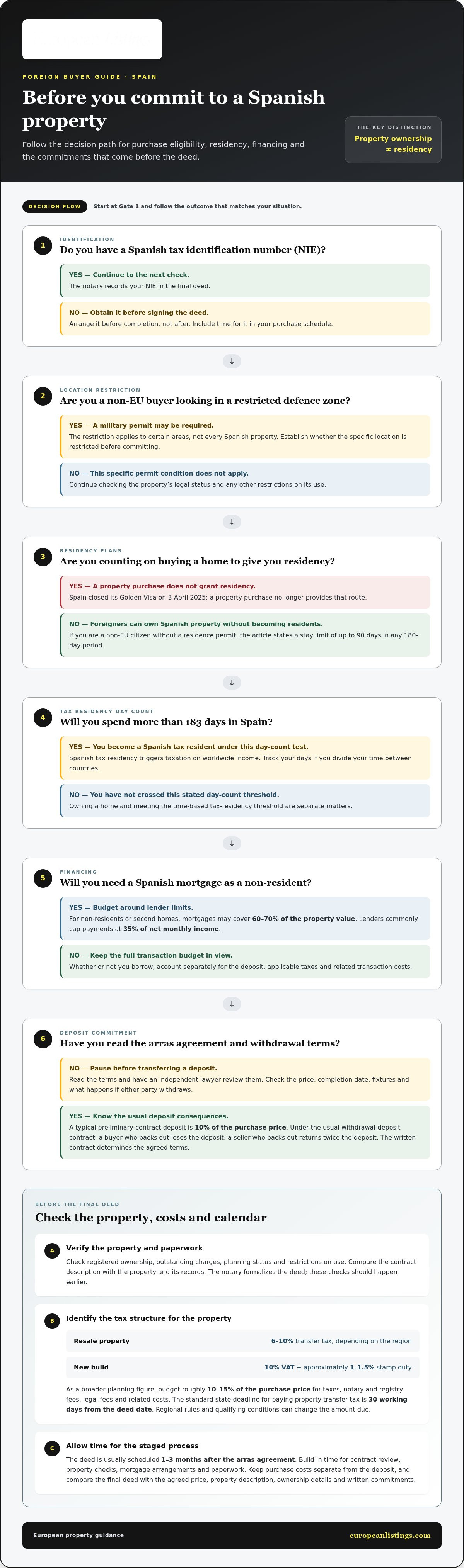
Foreigners can buy Spanish property without becoming Spanish residents. To buy a house in Spain as a foreigner, obtain a NIE before signing the deed; the notary records it there. For non-residents, Spanish mortgages may cover 60-70% of property value. Lenders commonly cap payments at 35% of net monthly income, and a preliminary contract typically requires a 10% deposit.
- Obtain your NIE before signing the deed. The NIE identifies you for Spanish tax and property transactions. Arrange it before the final deed, not after completion. The notary must record your number in the deed. If you plan to buy a house in Spain as a foreigner, include this step in your purchase schedule, especially when coordinating documents from abroad.
- Separate property ownership from residency. Foreign citizens can own Spanish property without becoming Spanish residents. Buying a home does not itself grant residency. Spain closed its Golden Visa on 3 April 2025, so a property purchase no longer provides that route. Non-EU citizens may stay for up to 90 days in any 180-day period without a residence permit.
- Track the days you spend in Spain. Spending more than 183 days in Spain makes you a Spanish tax resident and triggers taxation on worldwide income. Count your days if you divide your time between Spain and another country. Owning an apartment in Barcelona, for example, is distinct from meeting the time-based tax-residency threshold.
- Check whether the property’s location has restrictions. Non-EU buyers may need a military permit to purchase property in certain restricted defence zones. This requirement applies to specific areas, not every Spanish home. Before committing to a property, establish whether its location falls within a restricted zone and account for that permit in your purchase planning.
- Build your mortgage budget around lender limits. For second homes or non-residents, Spanish mortgages may cover 60-70% of property value. Lenders commonly require payments to stay within 35% of net monthly income. Calculate the remaining purchase funds alongside taxes and related costs. If you want to buy a house in Spain as a foreigner, base your budget on the full transaction, not only the mortgage amount.
- Understand the deposit before transferring it. A typical deposit under a Spanish preliminary property contract is 10% of the purchase price. It is a contractual commitment, separate from mortgage funds and purchase taxes. Read the withdrawal terms before paying, and make sure your financing plan accounts for the deposit and remaining balance. Property tax obligations also remain separate from residency and mortgage payments.
Purchase steps, deposits, and due diligence
Use a staged process: review the contract and property, calculate the applicable taxes, then prepare for completion.
-
Review the Purchase Process and Contracts
Read the arras agreement before paying a deposit, and have an independent lawyer review its terms. Check the purchase price, completion date, included fixtures, and the consequences if either party withdraws. Under the usual Spanish withdrawal-deposit contract, a buyer who backs out loses the deposit; a seller who backs out must return twice the deposit.
Before signing, check the property’s registered ownership, outstanding charges, planning status, and any restrictions on its use. Compare the contract’s description with the property and its records. For an American buyer, careful review matters as much as the agreed price. The notary formalizes the deed, but contract and property checks should happen earlier.
-
Budget for Purchase Taxes and Transaction Costs
Calculate taxes using the property type and autonomous community, not a national shortcut. Resale property transfer tax ranges from 6% to 10% of the property’s value, depending on the region. New-build purchases generally incur 10% VAT plus approximately 1-1.5% stamp duty. Madrid and Valencia illustrate why location matters: regional rules and qualifying conditions can change the amount due.
As a broader planning figure, foreign buyers should budget roughly 10% to 15% of the purchase price for taxes, notary and registry fees, legal fees, and related costs. Separate those funds from the purchase deposit. The standard state deadline for paying property transfer tax is 30 working days from the date of the deed. Confirm which tax applies before completion, since resale and new-build transactions use different tax structures.
-
Plan for the Timeline and Professional Fees
Work backward from the expected deed date and build in time for contract review, property checks, mortgage arrangements, and paperwork. The deed is usually scheduled 1-3 months after the arras agreement. Delays can arise when documents, financing, or contract conditions need attention, so avoid treating the signing date as a substitute for completing checks.
Include registry fees in your transaction budget, too. To narrow your search before reviewing contracts, explore curated Spanish property listings.
Can foreigners buy property in Spain?
Yes. Foreign buyers can purchase property in Spain. The process moves from preliminary agreements to a final deed, and each signature deserves careful consideration.
-
Sign Reservation and Deposit Contracts
Review the reservation agreement before paying, then check how it relates to the later arras preliminary contract. Confirm the property, agreed price, payment terms, deadlines, and what happens if either party withdraws. Under the usual Spanish withdrawal-deposit contract, a buyer who backs out loses the deposit; a seller who backs out must return twice the deposit. Make sure the written terms match your understanding.
-
Read the Arras Terms Before Committing
Check the arras contract for the completion date, the amount paid, and the conditions attached to the sale. A typical deposit under a Spanish preliminary property contract is 10% of the purchase price. Do not assume every payment has identical consequences: the contract wording determines what the parties have agreed. Ask for corrections before signing if the property details, payment schedule, or withdrawal terms are unclear.
-
Complete the Final Deeds
Prepare for the final deed after the preliminary agreement, usually scheduled 1-3 months after the arras contract. Before signing, compare the deed with the agreed price, property description, ownership details, and any written commitments. The notary records the NIE in the deed, so have your identification details ready. Check that the deed reflects the transaction you agreed to, rather than relying on earlier paperwork alone.
-
Keep Ownership Separate From Residency
Decide whether the purchase is for personal use, an investment, or another purpose, then keep that aim distinct from your immigration plans. Buying property does not itself provide residency. Spain closed its Golden Visa on 3 April 2025, ending the property-purchase route to residency. Foreign buyers should therefore assess ownership and permission to live in Spain as separate matters before committing funds.
-
Match Due Diligence to the Property
Before completing the purchase, compare the property’s actual condition and description with the contract and deed. Review ownership records, outstanding charges, planning status, and restrictions that could affect your intended use. If you plan to buy as an investment, check that the property’s permitted use fits your plans. Resolve discrepancies before the final signature, when changing agreed terms can become more difficult.
Also check whether any proposed levy applies: Spain's additional property tax on non-EU, non-resident buyers is 100% and had not been enacted as of early 2026.
Eligibility and requirements for foreign buyers
Foreign buyers can purchase property in Spain, but ownership and residency are separate matters. Madrid’s property prices can provide a point of comparison, though they vary by location and transaction basis.
- Separate property eligibility from residency. Buying real estate does not automatically give foreign citizens permission to live in Spain. If you’re considering a non-lucrative visa, its income requirement is €2,400 per month, plus €7,200 per year for each family member. Assess that income threshold separately from the purchase price and funds needed to complete the transaction.
- Compare regions using consistent price measures. The city figures above use euros per square foot, while Madrid’s sold-price figure uses euros per square metre. They describe different measures, so don’t treat them as direct equivalents. Compare properties with the same unit, location type, and transaction basis. A city-centre home in Barcelona and a property outside the centre serve different budgets and investment plans.
- Match the region to your intended use. Choose a location based on how you’ll use the property, not just its headline price. Madrid, Barcelona, Palma de Mallorca, Marbella, Málaga, and Alicante offer distinct urban and coastal settings. Compare the property’s location, condition, access, and likely ongoing obligations against your priorities. A lower purchase price alone doesn’t establish better value.
- Verify the property before transferring funds. Confirm that the seller’s identity and ownership details match the records and contract. Compare the property’s description with what you see, and review planning status, charges, and restrictions affecting use. Treat pressure to send money before documentation is clear as a warning sign. Keep payment instructions and signed agreements together for the transaction record.
- Calculate ownership obligations beyond the purchase. Include regional purchase taxes and recurring property tax in your budget, alongside any costs tied to your intended use. The price on an advertisement doesn’t show the full cost of ownership. Before committing, check whether the property’s condition, permitted use, and location fit your plans. This is especially important when an investment depends on a particular use.
To compare homes across Spanish regions, explore the weekly curated property newsletter and shortlist options that fit your location and budget priorities.
Spain's former Golden Visa program granted residency to foreign real estate investors who invested at least 500,000 EUR. Non-residents in Spain cannot pay more than €10,000 in physical cash per transaction.
European Listings: Weekly Curated Property Newsletter
European Listings helps narrow the search through its Weekly Curated Property Newsletter. It gathers listings from dozens of portals, filters them for foreign-buyer friendliness, and delivers 18 vetted properties to subscribers each Saturday. That gives you a focused starting point when comparing Spanish homes across regions, rather than another sprawling list to sort alone.
Premium Membership Plans and Buying Support and Guidance offer further support as you assess options and plan your next steps. Use the newsletter to identify properties that fit your intended location and purpose, then continue your contract, legal, and technical checks before committing.
Explore European Listings to find a more considered starting point for your Spanish property search.
Make your next move with a clearer brief
The best next step is not to rush toward a property. First, define what matters most: location, intended use, and the trade-offs you’re prepared to make. A clear brief can sharpen your search and help you distinguish homes worth considering from listings that only look appealing at first glance.
If you’re preparing to buy a house in Spain as a foreigner, European Listings can help you explore suitable options through its Weekly Curated Property Newsletter, Premium Membership Plans, and Buying Support and Guidance. Use that support to bring more focus to your search, then keep your purchase decisions grounded in careful review of each property and its paperwork.
Start with a clear picture of the home you want and the compromises you won’t accept. Contact European Listings to discuss your plans and take the next step with greater clarity.
Frequently Asked Questions
Can US citizens get a mortgage in Spain?
Yes. US citizens can apply for Spanish mortgages, including as non-resident buyers. Spanish mortgages may cover 60-70% of a property’s value for second homes or non-residents, and lenders commonly cap payments at 35% of net monthly income. For example, compare the expected payment with your documented income and existing financial commitments. Budget separately for the purchase funds a mortgage won’t cover and transaction costs.
How much tax will you pay on your Spanish home?
It depends on whether you buy a resale or new-build home, where it is, and your tax residency. Annual IBI for an average Spanish apartment might range from €300 to €500. Non-residents may also owe imputed-income tax, generally calculated on 1.1% or 2% of cadastral value. The stated tax rate is generally 19% for EU/EEA residents and 24% for non-EU/EEA residents.
Interest rates & terms: what should you expect?
Use the available reference rate as a comparison point, not as a promise of your personal mortgage rate. Banco de España’s published reference rate for mortgages over three years used for home purchases was around 2.76% as of early 2026. The offer you receive depends on the loan structure and your financial profile. Compare the total repayment terms and monthly payment, not just the headline rate.
The First Decision: Who Is Protecting You?
Choose an independent lawyer to review your interests and the contract before you commit. Ask for clear explanations of payment terms, withdrawal consequences, and obligations attached to the property. The notary formalizes the final deed, but that role is separate from reviewing the transaction in your interests. Keep signed agreements and payment records together so you can compare them with the final paperwork.
What is the Spanish Land Registry?
The Spanish Land Registry is the official record of property ownership and registered rights or charges. It can help establish whether the seller’s stated ownership matches the registered details and whether entries such as a mortgage affect the property. Compare the registry information with the sale documents and the property description. Resolve any mismatch before proceeding.
What do Spanish lenders require from expats?
Spanish lenders assess whether your income can support the proposed mortgage, alongside the property and your overall finances. They commonly require monthly mortgage payments not to exceed 35% of net monthly income. Prepare a clear record of income, existing commitments, available funds, and the property you intend to buy. For non-residents, financing may cover 60-70% of the property’s value, so plan for the remaining funds separately.
Disclaimer
European Listings is a media publication. We are not a real estate agent, broker, lawyer, tax advisor, or financial advisor, and nothing here is legal, tax, or financial advice.
Properties, prices, and rules change. We do our best to keep things accurate, but we can't promise every detail is current or correct. Always check with a qualified local professional before you buy, sign, or send money.
We sometimes earn a commission from partners and sponsors we link to. This never changes what we choose to cover or what we say about it.
Any decision you make is your own.
Frequently Asked Questions
Yes. US citizens can apply for Spanish mortgages, including as non-resident buyers. Spanish mortgages may cover 60–70% of a property’s value for second homes or non-residents, and lenders commonly cap payments at 35% of net monthly income. For example, compare the expected payment with your documented income and existing financial commitments. Budget separately for the purchase funds a mortgage won’t cover and transaction costs.
It depends on whether you buy a resale or new-build home, where it is, and your tax residency. Annual IBI for an average Spanish apartment might range from €300 to €500. Non-residents may also owe imputed-income tax, generally calculated on 1.1% or 2% of cadastral value. The stated tax rate is generally 19% for EU/EEA residents and 24% for non-EU/EEA residents.
Use the available reference rate as a comparison point, not as a promise of your personal mortgage rate. Banco de España’s published reference rate for mortgages over three years used for home purchases was around 2.76% as of early 2026. The offer you receive depends on the loan structure and your financial profile. Compare the total repayment terms and monthly payment, not just the headline rate.
Choose an independent lawyer to review your interests and the contract before you commit. Ask for clear explanations of payment terms, withdrawal consequences, and obligations attached to the property. The notary formalizes the final deed, but that role is separate from reviewing the transaction in your interests. Keep signed agreements and payment records together so you can compare them with the final paperwork.
The Spanish Land Registry is the official record of property ownership and registered rights or charges. It can help establish whether the seller’s stated ownership matches the registered details and whether entries such as a mortgage affect the property. Compare the registry information with the sale documents and the property description. Resolve any mismatch before proceeding.
Spanish lenders assess whether your income can support the proposed mortgage, alongside the property and your overall finances. They commonly require monthly mortgage payments not to exceed 35% of net monthly income. Prepare a clear record of income, existing commitments, available funds, and the property you intend to buy. For non-residents, financing may cover 60–70% of the property’s value, so plan for the remaining funds separately.