
Homes under 200k in Southern Europe: Where to Look
Yes, homes under €100,000 are still listed in Europe. On 25 August 2026, 4,296 homes priced below that mark appeared across Spain, Portugal, France, Italy, Greece and Cyprus, while 27,940 properties across Europe were listed under €200,000. The search for homes under €200k in southern Europe is real, but the best opportunities are not always where buyers first look.
That doesn’t mean every low-priced listing is a straightforward bargain. Location, condition and the kind of property on offer shape what your budget can buy, and France deserves a closer look: it features both very low-priced homes and options below €200,000 with more space. The headline price is only the start of the comparison.
This guide shows where to look across southern Europe, with a focused look at France and examples of what different budgets can uncover. You’ll also get a clearer sense of the trade-offs behind the most affordable listings, so you can narrow the search to places and properties that fit your plans.
1. Can you still buy a house in Europe for under €100,000?
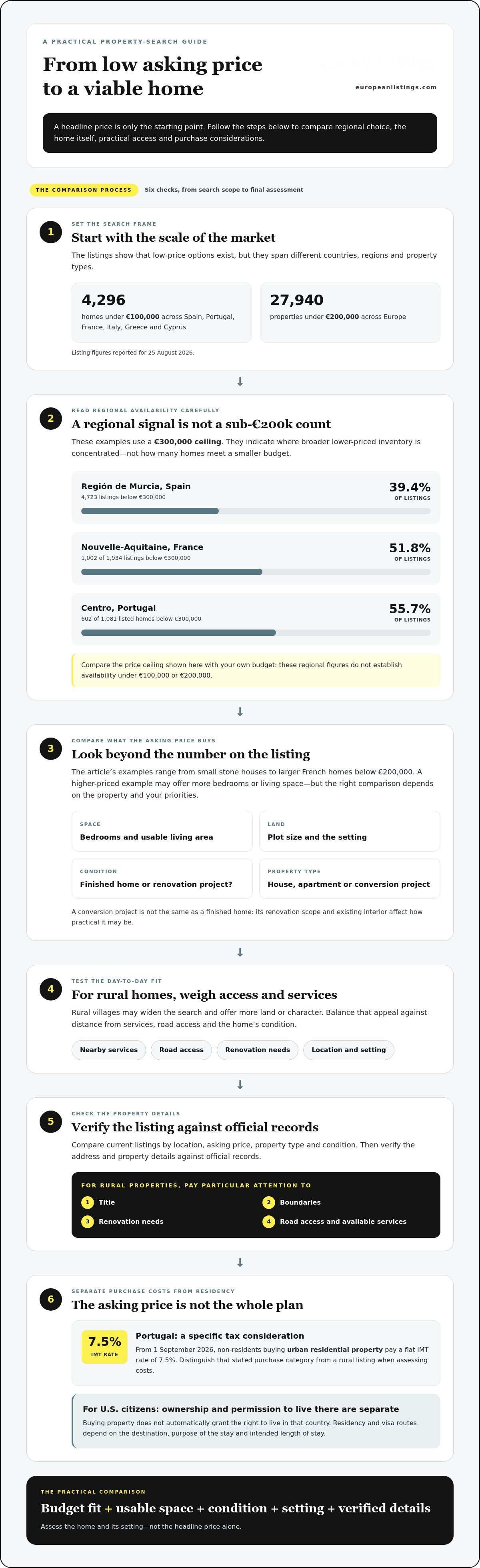
Yes. On 25 August 2026, 4,296 homes under €100,000 were listed across Spain, Portugal, France, Italy, Greece and Cyprus. Across Europe, 27,940 properties were listed below €200,000. The options are real, but the price often reflects location, size, condition or property type. A low asking price alone doesn’t tell you what kind of living space you’ll get.
France offers a striking range, from small stone houses to larger homes below €200,000. These examples show how rural village locations can bring the asking price down, while leaving buyers to weigh the home and its setting carefully.
In France, higher-priced listings in these examples offer more bedrooms or living space.
Other French listings sit close to the €100,000 threshold. The difference between these examples is more than price: bedroom count, usable space, plot size and renovation needs all change what a listing offers.
Portugal also offers lower-priced options beyond the usual apartment search. One example advertises substantial space for its asking price, but its rural location is an important part of the decision.
Lower-priced homes appear across several countries, but availability varies by region. Spain’s Región de Murcia had 4,723 listings under €300,000, or 39.4% of its listings, on 25 August 2026. France’s Nouvelle-Aquitaine had 1,002 of 1,934 listings below that threshold, representing 51.8%. These regional figures use a higher price ceiling than €100,000, but they show where broader lower-priced inventory is concentrated. For homes under €200,000 in southern Europe, compare the asking price with bedrooms, living area, land and condition, not price alone.
2. Affordable property regions in southern Europe
Affordable listings are not confined to one country or property type. On 25 August 2026, Portugal’s Centro region had 602 of 1,081 listed homes below €300,000, equal to 55.7% of listings. That threshold is higher than €200,000, so it indicates regional choice, not the number available within a smaller budget. Rural villages can widen the search, but distance from services and the property’s condition matter.
For listings below €100,000, examples span several markets. Compare the property type and interior space, not just the headline price.
A conversion project is not the same as a finished home: the scope of renovation and the existing interior affect how practical it may be. Rural properties can offer more land or character, but weigh access to nearby services and the home itself against the asking price.
Portugal’s tax treatment is another budget factor. From 1 September 2026, non-residents buying urban residential property in Portugal pay a flat IMT rate of 7.5%. This applies to the stated category of purchase, so distinguish an urban residential property from a rural listing when assessing costs. The asking price is only one part of a purchase budget.
Buying a property does not automatically give a U.S. citizen the right to live in that country. Residency and visa routes depend on the destination, the purpose of the stay and how long you intend to remain. Consider immigration permission separately from the property purchase.
To find and assess affordable homes, compare current listings by location, asking price, type and condition, then verify the address and property details against official records. For a rural home, pay particular attention to title, boundaries, renovation needs, road access and available services. A low asking price may be less appealing if the interior needs extensive work or everyday access is difficult.
Use those checks to separate a viable home from a tempting listing that doesn’t fit. For a more focused way to review homes across the region, browse curated property listings alongside your shortlist.
3.
Compare asking prices, property types, locations and conditions rather than assuming your budget will secure a particular kind of home. The examples below are individual asking prices, not national averages. In Portugal, Spain, Italy, Greece and Croatia, begin by choosing the location.
In Portugal, prices rose 17.8% in the year to Q1 2026. That movement makes the specific region and property condition important when comparing listings within a fixed budget. A buyer might weigh a smaller home in a more sought-after setting against a larger property farther from established centres. The asking price alone can’t settle that choice.
Spain’s home prices rose 12.8% in the year to Q1 2026. Regional listing counts also show why countrywide assumptions can mislead. In the Región de Murcia, 4,723 homes were listed below €300,000 on 25 August 2026, representing 39.4% of listings.
Italy’s lower-priced inventory varies by region as well. On 25 August 2026, 254 of 294 listed homes in Lazio were below €300,000, representing 86.4%. Sicily had 106 of 170 below that threshold, or 62.4%; Umbria had 302 of 612, or 49.3%. Compare individual homes and their condition.
That asking price is a useful reference, but one listing cannot establish typical prices across the country. Compare the property type, location and condition to see whether the example suits your plans.
Apply the same careful approach in Croatia: choose a location, then compare available homes by asking price, size and condition. One attractive listing cannot establish a typical national price. Coastal and inland properties involve different trade-offs, so assess each setting against your priorities rather than assuming the same budget buys an equivalent home everywhere.
To compare all five countries, consider two questions separately: which listings fit your budget, and what do those homes offer? Compare condition, usable space and setting to see whether an appealing asking price represents a practical match, a renovation project or a compromise on location.
4. Can U.S. citizens buy property in Southern European countries, and what restrictions apply?
Buying a home and gaining permission to live in the country are separate matters. For U.S. citizens, there is no single rule covering Portugal, Spain, Italy, Greece and Croatia. Requirements depend on the country, the property’s location and its classification. Treat ownership, residency and visa eligibility as distinct parts of your plan.
Start with how you plan to use the property. A holiday home, permanent residence and rental property can raise different practical questions—investors exploring buy-to-let or portfolio strategies can look to consultancy firms like maddisonvproperties.co.uk for guidance on acquisition and property management. Buying alone should not be treated as proof of a right to reside. Before comparing homes in Portugal or Greece, establish which country’s rules apply to your planned stay and property type.
Assess the property as well as your residency plans. Whether you are considering a rural home in Italy or a coastal apartment in Spain, identify the exact property, its boundaries and the rights attached to it. Compare sale documents and property records with the listing details to spot possible discrepancies in location, size or stated use before making a commitment.
Budget for transaction costs separately from the asking price. Greece’s property transfer tax is 3.09%. Indicative all-in purchase costs for a resale home in France are 7% to 8%. Those figures concern different countries and cost categories, so don’t treat them as interchangeable rates. Portugal also has a distinct tax treatment for non-residents buying urban residential property, which was covered above.
Restrictions are not based on nationality alone. Consider whether the property is residential, where it is located and how you plan to use it. A rural house in Portugal, for example, may need a different review from an apartment in a city. Keep the property classification and intended use clear as you search.
A practical sequence can keep the decision focused: choose the country, define your intended stay, identify the property category, then review ownership documents and purchase costs. For each listing in Spain, Greece or Croatia, compare its description with the records and your planned use. Keep residency planning separate from the purchase decision: one does not resolve the other.
For U.S. buyers, questions about restrictions depend on the country, not on southern Europe as a whole. Compare the exact location and property type, then consider ownership conditions, residency plans and transaction costs separately.
U.S. citizens need to review the rules of the specific country for their intended stay and property type. Buying a property alone does not establish eligibility for residency or a visa.
European Listings: Weekly Curated Property Newsletter
European Listings helps narrow the search through its Weekly Curated Property Newsletter, which gathers listings from dozens of portals and filters them for foreign-buyer friendliness. Subscribers receive 18 vetted properties each Saturday, including affordable homes and higher-end options across southern Europe. It’s a useful next step when you want a more focused selection than an open-ended search provides.
European Listings offers Premium Membership Plans and Buying Support and Guidance for readers who want additional help exploring properties and considering next steps. The right option depends on how much support you want as you search.
To explore the newsletter or learn more about the available support, visit European Listings.
Turn your shortlist into a clear buying brief
Before saving another listing, define what makes a property worth pursuing. For homes under €200,000 in southern Europe, decide which trade-offs you can accept: a quieter location, renovation work, less space, or a longer journey to everyday services. A clear brief helps you compare homes on the qualities that matter to you, rather than letting an attractive photograph set the agenda.
Next, divide your priorities into essentials and preferences. Essentials might include how you plan to use the home, a suitable layout or access to places you visit regularly. Preferences might include a garden, period features or a particular village atmosphere. This distinction helps you act when a suitable property appears while keeping your choices grounded.
When you’re ready to discuss your search and possible next steps, contact European Listings today. A considered brief is a strong starting point. Your next property search can be focused, informed and genuinely yours.
Frequently Asked Questions
Can you still buy a house in Europe for under €100,000?
Yes, listings below €100,000 still appear in several European countries. Treat the asking price as a starting point, not a complete measure of value. For example, a low-priced stone property may offer land but need substantial renovation, while an apartment may be smaller and easier to compare. Before shortlisting, decide whether you prioritise usable space, location, land or a move-in-ready interior.
Is the Algarve still affordable?
Affordability in the Algarve depends on the specific location, property type and condition, not just the regional name. A home away from a sought-after coastal area may suit a different budget from one near the shoreline. Compare listings with your intended use and practical needs, including access to services and renovation requirements. Set your maximum purchase budget before deciding whether an individual property represents good value.
What should I do next?
Write a short property brief before browsing again. Include your budget, preferred countries, intended use and acceptable compromises, such as a rural setting or renovation work. Use these priorities to screen listings instead of saving every attractive photo. For a focused stream of homes to review, explore European Listings’ Weekly Curated Property Newsletter and Buying Support and Guidance.
Where is the cheapest place to buy property in Europe?
There is no reliable answer that fits every buyer, because the lowest asking price may be for a very different property from the one you need. Treat the example as an individual listing, not proof that Crete is always Europe’s cheapest market. Compare condition, location and usable space alongside price.
Listings below €200,000 appear in Portugal, Italy, Greece and France in the examples covered here. Since the question uses dollars while listings use euros, compare each asking price in the same currency before deciding whether it fits your budget.
The regional data in this guide identifies sizeable inventories of lower-priced homes in Portugal’s Centro, Spain’s Región de Murcia, and parts of Italy, Greece and Cyprus. For a focused search, compare specific regions and property types, then assess each listing’s condition, space and location against your priorities.
Disclaimer
European Listings is a media publication. We are not a real estate agent, broker, lawyer, tax advisor, or financial advisor, and nothing here is legal, tax, or financial advice.
Properties, prices, and rules change. We do our best to keep things accurate, but we can't promise every detail is current or correct. Always check with a qualified local professional before you buy, sign, or send money.
We sometimes earn a commission from partners and sponsors we link to. This never changes what we choose to cover or what we say about it.
Any decision you make is your own.
Frequently Asked Questions
Yes, listings below €100,000 still appear in several European countries. Treat the asking price as a starting point, not a complete measure of value. For example, a low-priced stone property may offer land but need substantial renovation, while an apartment may be smaller and easier to compare. Before shortlisting, decide whether you prioritise usable space, location, land or a move-in-ready interior.
Affordability in the Algarve depends on the specific location, property type and condition, not just the regional name. A home away from a sought-after coastal area may suit a different budget from one near the shoreline. Compare listings with your intended use and practical needs, including access to services and renovation requirements. Set your maximum purchase budget before deciding whether an individual property represents good value.
Write a short property brief before browsing again. Include your budget, preferred countries, intended use and acceptable compromises, such as a rural setting or renovation work. Use these priorities to screen listings instead of saving every attractive photo. For a focused stream of homes to review, explore European Listings’ Weekly Curated Property Newsletter and Buying Support and Guidance.
There is no reliable answer that fits every buyer, because the lowest asking price may be for a very different property from the one you need. Treat the example as an individual listing, not proof that Crete is always Europe’s cheapest market. Compare condition, location and usable space alongside price. Listings below €200,000 appear in Portugal, Italy, Greece and France in the examples covered here. Since the question uses dollars while listings use euros, compare each asking price in the same currency before deciding whether it fits your budget. The regional data in this guide identifies sizeable inventories of lower-priced homes in Portugal’s Centro, Spain’s Región de Murcia, and parts of Italy, Greece and Cyprus. For a focused search, compare specific regions and property types, then assess each listing’s condition, space and location against your priorities.