
Dordogne Village Houses for Sale: Property Types and Local Areas
The Dordogne’s village-home market includes attached village houses and townhouses, traditional Périgourdine homes, fermettes, country houses, gîtes and grand châteaux. This guide to Dordogne village houses for sale explains how these property types differ and why the setting matters as much as the house itself.
Honey-coloured stone and quiet lanes can be an easy draw. The practical choice is more specific: do you want shops close by, the amenities of a larger town, or the space and seclusion of the countryside? Village houses are often attached to neighbouring homes and near local shops. Rural properties can offer a very different balance of land, privacy and upkeep.
This guide outlines the Dordogne’s main property types and local divisions, then looks at towns and villages including Périgueux, Bergerac and Sarlat. It also covers country-house listings, helping you compare character, setting and everyday convenience without mistaking a beautiful façade for the whole decision.
What Property Types Are Found in the Dordogne?
A Dordogne village house might be a compact stone home, a restored townhouse or part of a larger rural estate. The right fit depends on whether you’re looking for a main residence, a holiday base or space for guests. Across Périgord, settings range from attached homes near shops to isolated houses surrounded by land.
Village houses are often attached to neighbouring homes and close to local shops.
A small rural farmstead usually has two or three rooms, making it a smaller-scale option than a family home or estate. A stone house with an outbuilding may suit buyers looking for extra guest space, while a castle is larger and typically more demanding to maintain.
For a main home, balance village access with the space and upkeep you can manage. A second home may call for character, outdoor areas and access to places such as Sarlat-la-Canéda. For a rental, consider whether the layout works for visitors and how easily they can reach shops and transport. These uses can overlap, but a holiday home with guest rooms requires different planning from a compact village residence.
Dordogne summers are typically hot and dry, with temperatures of 25-30°C. July and August temperatures typically range from 30 to 35 degrees Celsius, and some winter nights can reach 10 degrees below zero. Holiday-rental high season runs from mid-July to mid-August; rental rates may be as much as 40% higher during July and August than standard rates.
Holiday cottages and guest houses can make use of spare rooms or a separate building for visitor accommodation. That is a business purchase, not simply an ordinary home with a guest room. Distinguish a ready-to-run setup from a house that needs conversion.
How do Dordogne village properties compare with houses in nearby regions? Compare similar settings and features: village or countryside location, condition, outdoor space and access to amenities. Even within the Dordogne, a small village townhouse and a traditional Périgord stone house offer very different choices.
How much do renovations and ongoing maintenance cost in rural Dordogne? It depends on the building’s condition, the work required, its materials and the grounds. A stone house with outbuildings or extensive land involves a different maintenance workload from an attached townhouse.
How do I find and buy a village house in Dordogne as a US buyer? First decide whether you’re looking for a main home, a holiday property or a rental opportunity. Then compare listings by location, type, condition and intended use. Before proceeding with a candidate, review the seller’s diagnostic reports, building condition, drainage, boundaries and local planning rules.
Dordogne’s location and administrative divisions
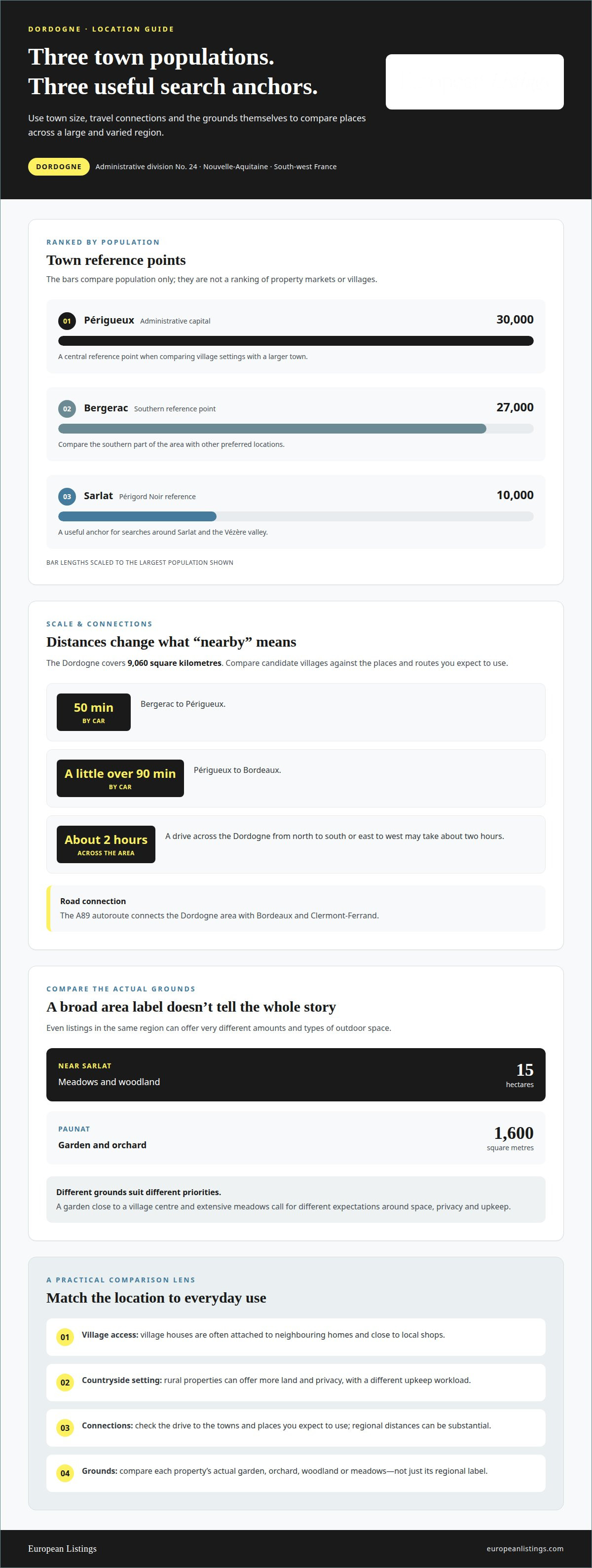
The Dordogne is administrative division number 24 in Nouvelle-Aquitaine, south-west France, with Périgueux as its administrative capital. Its local divisions matter because a village’s character and access depend on where it sits across this large area.
Location and Regional Character
The Dordogne covers 9,060 square kilometres, so “nearby” can mean different things here. Périgord Noir is the area around Sarlat and the Vézère valley, while Périgord Vert is another named local area. These labels help narrow a search before comparing individual villages. A restored stone house near Sarlat offers a different setting from a property elsewhere in the area.
The A89 autoroute connects the Dordogne area with Bordeaux and Clermont-Ferrand. Bergerac is a 50-minute drive from Périgueux, while Bordeaux is a little over 90 minutes away. Driving across the area, north to south or east to west, may take about two hours. That scale makes a location’s roads and connections central to choosing a practical base.
Rural listings can also differ sharply in land and setting. A property near Sarlat is listed with 15 hectares of meadows and woodland; a house in Paunat has a garden and orchard of 1,600 square metres. Those examples show why buyers should compare the actual grounds, not rely on a broad area label. A garden close to a village centre and extensive meadows serve different priorities.
Village and Town Locations
Villages and towns are spread across the area rather than clustered around Périgueux alone. Périgueux has 30,000 inhabitants, Bergerac has 27,000, and Sarlat has 10,000. These towns provide distinct reference points when narrowing a search. Buyers can weigh a village setting against proximity to a larger town, instead of treating the Dordogne as one uniform market.
For a village setting in Périgord Noir, explore the area around Sarlat and the Vézère valley. Périgueux may suit buyers prioritising the area’s administrative capital, while Bergerac offers a southern reference point. The best fit depends on your intended base and preferred setting, not a single ranking of villages.
For a first comparison, map candidate villages against Périgueux, Bergerac and Sarlat, then consider the drive to the places you expect to use. The A89’s connection to Bordeaux and Clermont-Ferrand may also matter for regular journeys. For a broader view of homes by location, explore Dordogne property listings alongside these regional distinctions.
Local towns, villages, and amenities
In the Dordogne, a home’s setting shapes daily routines as much as its architecture. Compare the convenience of a village centre with countryside privacy, then weigh the amenities that matter in everyday life.
Local Towns and Villages
Sarlat-la-Canéda is a reference point for searches around the valley, while smaller communities offer a quieter village setting. The practical difference is clear: a home near local services supports different routines from an isolated property with extensive grounds. Choose a setting that suits how you’ll use the house, whether as a main home, holiday base or guest accommodation.
An estate near Sarlat-la-Canéda is about ten minutes from shops, motorway access and a railway station. That combination can make a countryside address more connected than its rural setting suggests. A stone house in La Roque-Gageac offers another scale: one listed property has three bedrooms and three bathrooms across 130 square metres. Bedroom count helps compare capacity, but the surrounding village determines the daily feel.
To assess a village’s character, look beyond the façade. Check how close homes are to one another, whether shops are within reach and how the location connects to nearby towns. These details help distinguish a picturesque address from a practical base.
Amenities Near Homes
Village homes are often attached to neighbouring houses and close to local shops. Everyday errands may be possible within the settlement, unlike at a remote property where driving may be necessary. The trade-off is less separation from neighbours and often less outdoor space. Check the actual property rather than assuming every village house has a garden or terrace.
Outdoor amenities vary considerably between listings. A renovated stone house with an outbuilding, pool and 18.5 hectares of land is listed in the Dordogne. A contemporary villa near Sarlat offers an infinity pool, spa and landscaped grounds. These examples show how a pool can sit within very different property types, from a rural estate to a designed villa.
Some settings bring transport and services closer. The Sarlat-la-Canéda estate’s roughly ten-minute distance to shops, motorway access and a railway station offers a concrete comparison point. By contrast, a property in Saint-Seurin-de-Prats is 25 minutes from Sainte-Foy-la-Grande; Bergerac and Bordeaux are each accessible within an hour. Such timings shape how easily owners can reach shops, towns and travel connections.
Outdoor space also has practical value beyond appearance. A garden of approximately 543 square metres accompanies the Saint-Seurin-de-Prats property, while extensive grounds can mean more upkeep. Compare the pool, garden, terrace and any separate guest space as distinct features. A large bedroom count may suit visitors, but it doesn’t replace convenient access to village amenities.
Dordogne country-house listings
Country-house listings show how much the Dordogne market varies by setting, size and condition. A stone property near woodland, a village home and a larger estate serve different needs, even if each could be a French holiday home.
What are typical house prices in Dordogne villages?
Listings around Saint-Cyprien show how bedroom count and setting can shape a choice. These are individual asking prices, not a guide to what another property with the same number of bedrooms will cost.
Beyond village homes, buyers can find substantial country properties. Land, condition and facilities shape the proposition just as much as the house itself.
Bergerac illustrates the range at the estate end. A featured Bergerac vineyard property includes 15 hectares of producing vines and another 10 hectares of meadows that can be planted. Such listings require a different decision from a village house bought simply as a holiday home.
For a clearer comparison, group listings by location, property type, condition, bedroom count and land. Then distinguish an attractive exterior from useful space: a barn, separate guest accommodation, woodland or a pool each changes how the property functions. For example, the Sarlat-area estate’s barn is approximately 120 square metres, a substantial feature that should be assessed separately from its living space.
Use the listings to define your shortlist, not to treat one asking price as a regional average. Browse Dordogne country-house listings and compare the setting, land and accommodation alongside the price.
European Listings: Weekly Curated Property Newsletter
European Listings helps Dordogne buyers narrow the search through its Weekly Curated Property Newsletter. It gathers listings from dozens of portals, filters them for foreign-buyer friendliness, and delivers 18 vetted properties to subscribers each Saturday.
That can be useful when you’ve defined your preferred area, property type and intended use, but want a more focused way to review homes. The selection spans options for holidays, rental income and retirement. Premium Membership Plans and Buying Support and Guidance are also available for readers who want further support as they explore potential purchases.
A curated selection can make comparisons more manageable, but choosing a property still means weighing its condition, location and setting against your needs. To explore the newsletter and other support, visit European Listings.
Make your next property decision with clarity
A useful shortlist starts with a clear sense of what you’re willing to compromise on. Before arranging a viewing, write down what would make a house work for your life. Separate genuine priorities from features that simply look appealing in a listing. This can stop an attractive photograph from steering the whole decision.
Use this guide to Dordogne village houses for sale as a framework for comparing candidates, not a checklist every property must satisfy. A home that fits your everyday needs may be a better choice than a more impressive one that requires you to reshape your plans. Keep your priorities in view as new possibilities appear.
When you’re ready to discuss your search, contact European Listings. The right next step is a shortlist that reflects what matters to you. You can approach the search with confidence and a clearer sense of direction.
Frequently Asked Questions
What Is the Landscape Like?
The Dordogne has river valleys, wooded areas, open meadows and historic settlements. Around the Vézère valley, the landscape includes a UNESCO World Heritage area, while rural properties may sit among woodland or farmland. The surroundings influence a home’s feel: a house near a village offers a different outlook and daily rhythm from an isolated country property. Consider the setting as carefully as the building.
What Should You Check Before Buying in the Dordogne?
Before committing, review the seller’s property reports, the building’s condition, drainage, boundaries and local planning rules. For a rural house, consider each point in light of the property’s features: drainage may be especially relevant for a home with outbuildings, while clear boundaries matter when land or woodland is included. Note questions alongside the listing details so you can compare homes consistently, rather than relying on photographs or a brief viewing.
Where Is the Dordogne?
The Dordogne is administrative division number 24 in Nouvelle-Aquitaine, in south-west France. Périgueux is its administrative capital, and the area covers 9,060 square kilometres. That scale matters when choosing a base: driving across it from north to south or east to west may take about two hours. Périgord Noir refers to the area around Sarlat and the Vézère valley, useful orientation when comparing locations.
What Types of Village Houses Are for Sale in Dordogne?
Listings include attached village houses, townhouses, traditional Périgord stone homes and small rural farmhouses. A small rural farmhouse usually has two or three rooms, while larger rural properties may include outbuildings, guest accommodation or extensive grounds. This affects everyday use: an attached house prioritises a village setting, while a farmhouse or country property may offer more space and land. Compare the layout and setting with your intended use.
What Are the French Property Purchase Fees and Taxes in Dordogne?
For older properties, notary fees are usually 7-10%; for new builds, they are around 2-3%. Registration tax on older properties is about 5%, and estate-agent commission in France is often 3-10%. These are separate cost categories, so don’t treat one figure as the total purchase cost. A deposit is typically 5-10% of the price, which is distinct from fees and taxes.
What Legal Checks Should I Make Before Buying a Dordogne Village House?
Review the seller’s property reports, boundaries and local planning rules, as well as the building’s condition and drainage. These checks matter particularly when a listing includes land, an outbuilding or renovation potential. A ten-day cooling-off period applies after signing the preliminary contract for a French property purchase. Keep the contract, reports and property details together so each decision relates to the same home and terms.
Disclaimer
European Listings is a media publication. We are not a real estate agent, broker, lawyer, tax advisor, or financial advisor, and nothing here is legal, tax, or financial advice.
Properties, prices, and rules change. We do our best to keep things accurate, but we can't promise every detail is current or correct. Always check with a qualified local professional before you buy, sign, or send money.
We sometimes earn a commission from partners and sponsors we link to. This never changes what we choose to cover or what we say about it.
Any decision you make is your own.
Frequently Asked Questions
The Dordogne has river valleys, wooded areas, open meadows and historic settlements. Around the Vézère valley, the landscape includes a UNESCO World Heritage area, while rural properties may sit among woodland or farmland. The surroundings influence a home’s feel: a house near a village offers a different outlook and daily rhythm from an isolated country property. Consider the setting as carefully as the building.
Before committing, review the seller’s property reports, the building’s condition, drainage, boundaries and local planning rules. For a rural house, consider each point in light of the property’s features: drainage may be especially relevant for a home with outbuildings, while clear boundaries matter when land or woodland is included. Note questions alongside the listing details so you can compare homes consistently, rather than relying on photographs or a brief viewing.
The Dordogne is administrative division number 24 in Nouvelle-Aquitaine, in south-west France. Périgueux is its administrative capital, and the area covers 9,060 square kilometres. That scale matters when choosing a base: driving across it from north to south or east to west may take about two hours. Périgord Noir refers to the area around Sarlat and the Vézère valley, useful orientation when comparing locations.
Listings include attached village houses, townhouses, traditional Périgord stone homes and small rural farmhouses. A small rural farmhouse usually has two or three rooms, while larger rural properties may include outbuildings, guest accommodation or extensive grounds. This affects everyday use: an attached house prioritises a village setting, while a farmhouse or country property may offer more space and land. Compare the layout and setting with your intended use.
For older properties, notary fees are usually 7–10%; for new builds, they are around 2–3%. Registration tax on older properties is about 5%, and estate-agent commission in France is often 3–10%. These are separate cost categories, so don’t treat one figure as the total purchase cost. A deposit is typically 5–10% of the price, which is distinct from fees and taxes.
Review the seller’s property reports, boundaries and local planning rules, as well as the building’s condition and drainage. These checks matter particularly when a listing includes land, an outbuilding or renovation potential. A ten-day cooling-off period applies after signing the preliminary contract for a French property purchase. Keep the contract, reports and property details together so each decision relates to the same home and terms.