Homes for Sale in Tuscany: Costs, Areas and Property Types
The right Tuscan home isn’t always a restored farmhouse with a postcard view. Homes that need renovation often have lower asking prices, but bring a different set of decisions.
Buying from abroad raises practical questions: how to compare locations, which property types suit your plans, and how to narrow a broad market without overlooking important details. This guide explains what international buyers should consider, including the difference between finding listings and handling the legal steps of a purchase.
You’ll find a comparison of Chianti and Val d’Orcia prices, an overview of Tuscan villas and farmhouses, and a look at coastal homes near Forte dei Marmi. The goal is to help you focus on an area and property type before deciding on your next step.
How much does it cost to buy a property in Chianti or Val d’Orcia?
Prices vary with location, restoration, land, and intended use. Compare the asking price per square metre with the home’s condition and any work its features may require.
Prices by Area and Property Condition
Property Types, Sizes, and Asking Prices
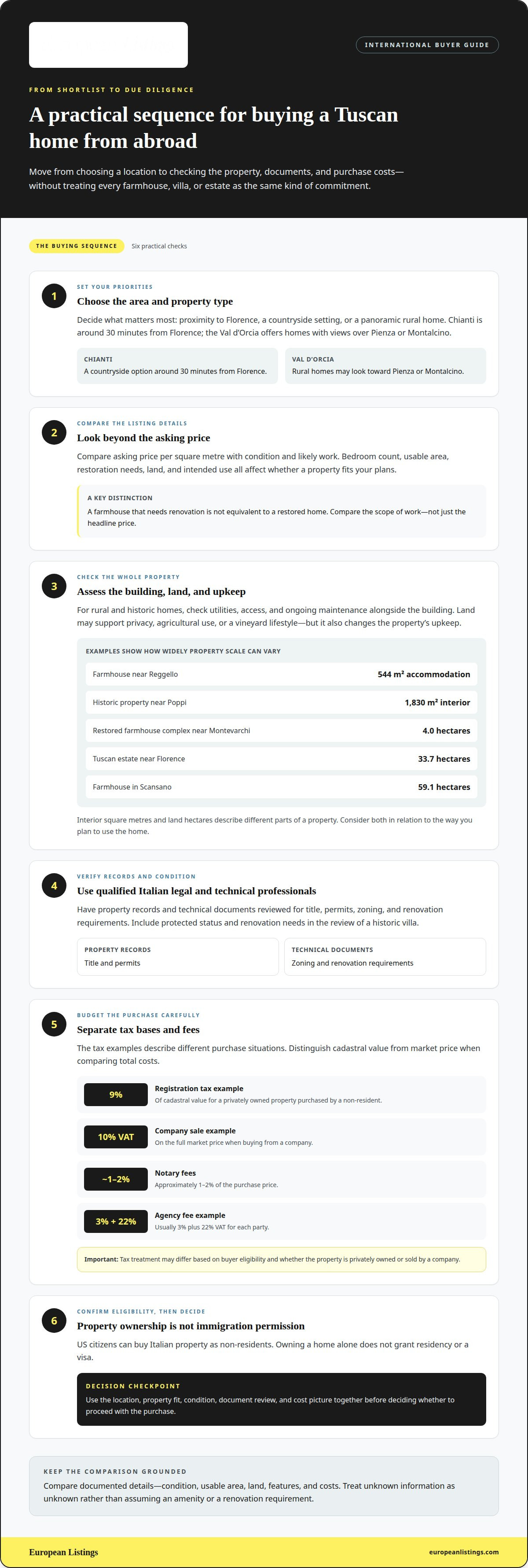
Farmhouses, apartments, villas, and large estates serve different living plans. A farmhouse near Reggello has 544 square metres of accommodation, while a historic property near Poppi offers 1,830 square metres of interior space.
These examples show why headline prices need context: bedroom count, usable area, and restoration needs all affect how well a home suits its purpose.
Land, Features, and Lifestyle Options
Land can support privacy, agricultural use, or a vineyard lifestyle, but it also changes the property’s upkeep. Examples range from a restored farmhouse complex near Montevarchi on 4.0 hectares to a Scansano farmhouse on 59.1 hectares; a Tuscan estate near Florence spans 33.7 hectares.
Before buying a rural or historic home, assess utilities, access, and ongoing maintenance alongside the building itself. Have qualified Italian legal and technical professionals review property records and technical documents for title, permits, zoning, and renovation requirements. The renovation scope matters: a farmhouse needing work is not equivalent to a restored home.
Buying Costs, Taxes, and Eligibility
US citizens can buy Italian property as non-residents; ownership alone does not grant residency or a visa. Non-resident purchase-tax examples are 9% of cadastral value for a privately owned property and 10% VAT on full market price when buying from a company. Tax treatment may differ depending on the buyer’s eligibility and whether the property is privately owned or sold by a company. Normattiva, Presidenza del Consiglio dei Ministri, states that registration tax applies at tariff rates to acts subject to registration and acts voluntarily submitted for registration.
Budget for notary fees of approximately 1-2% of the purchase price, plus agency fees usually at 3% plus 22% VAT for each party. The examples describe different tax bases and purchase situations, so distinguish cadastral value from market price when comparing total costs.
Own a villa in Tuscany?
Villa options range from historic estates to restored country homes with pools. Compare location, land, condition, and intended use before settling on a particular style.
Villa Locations and Property Styles
Chianti is around 30 minutes from Florence, while the Val d’Orcia offers homes with views over Pienza or Montalcino. These locations suit different priorities: proximity to Florence, countryside setting, or a panoramic rural residence. Farmhouses and estates also vary considerably in scale, from substantial interior space to extensive agricultural land.
For example, a neglected property near Castelfiorentino sits on 28.2 hectares. A historic property near Poppi has 1,830 square metres of interior space. Those examples make clear that “villa” can describe very different commitments. Compare the building’s size with the land and the lifestyle you actually want.
Luxury Villas and Historic Homes
These price points represent distinct property types, so compare their settings and estate features rather than treating them as interchangeable.
Other examples show a wider range. Palazzos and historic villas offer another format, though these examples don’t provide bedroom counts.
Pools and Outbuildings
A pool, private garden, or outbuilding can change how a villa works for family stays or entertaining. A property near Cortona is listed with a pool, while the Castellina Marittima villa combines a pool with 6 hectares and a sea view. Assess each feature alongside the main residence: land size alone doesn’t show how usable the property is.
For estates, consider the whole footprint. A Tuscan property near Castelfiorentino has 28.2 hectares, while a historic Poppi home offers 1,830 square metres inside. Match the building and grounds to your intended use, whether that means a private retreat or space for guests.
Buying as a Foreign Buyer
Follow a clear sequence: define the location and property type, shortlist suitable homes, review the documents and physical condition, then proceed with qualified local professionals. For a historic villa, include its protected status and renovation needs in that review. US buyers should also distinguish property ownership from immigration permission: owning a home isn’t itself a visa.
Some owners consider holiday rentals. One property site estimates that an attractive Italian property can be rented for 20-24 weeks per year. To narrow the search by property type and intended use, explore curated property listings.
Coastal homes near Forte dei Marmi
Forte dei Marmi offers a distinct alternative to a farmhouse in the Tuscan countryside. A modern seaside villa near the town was completed in 2023 and has a 400-square-metre private garden. That example gives buyers a concrete starting point: assess the house and outdoor space together, rather than judging the property by its coastal label alone.
For a coastal shortlist, start by defining the lifestyle you want. Decide whether a private garden, swimming pool, or guest space matters most, then compare each listing with those priorities. The available example confirms a garden, but not a pool, bedroom count, or asking price. Let the stated details shape your comparison, not assumptions about what a seaside villa includes.
Land needs a closer look than a headline figure. A 400-square-metre garden describes outdoor space, but hectares describe a much larger holding. Treat those units as different kinds of property feature. For a home near Forte dei Marmi, consider how much outdoor space you want to maintain and use, alongside the interior layout and the home’s condition.
Separate confirmed features from attractive images. For the villa completed in 2023, the documented points are its modern style, seaside location, and private garden. A swimming pool or outbuilding should count as a deciding feature only when the listing identifies it. This simple filter keeps the shortlist accurate and prevents imagined amenities from driving a purchase decision.
Compare a coastal villa with an inland home by intended use, not scenery alone. A garden may support outdoor living, while an estate measured in hectares suggests a different scale of land. Decide whether you want a compact private retreat or grounds that need more attention. Then assess setting, documented features, and upkeep as separate criteria.
Use a consistent review sequence for each Forte dei Marmi listing: record the completion date, interior size, outdoor area, stated amenities, and asking price. The 2023 villa provides a clear example for two fields, completion year and 400-square-metre garden. Keep missing dimensions out of comparisons; otherwise, a detailed listing can appear stronger simply because it supplies more information.
The best coastal choice is the one that suits your plans without relying on assumptions. Compare the garden’s stated area with the outdoor space you want, then check whether a swimming pool is actually included. Compare those features with a Tuscan countryside property only after setting your priorities. This keeps the search focused on the home itself.
Homes and farms for sale across Chianti and Val d’Orcia
Listings appear on property portals and local agency pages, but a strong comparison starts with a clear brief. Separate Chianti from Val d’Orcia, then narrow by property type, condition, land, and intended use. A vineyard farmhouse, village apartment, and agricultural estate meet different needs. Compare each within its own category, not by asking price alone.
Chianti and Val d’Orcia both attract international buyers, yet their listings span very different scales. Market figures report that 85% of buyers in these areas are international, and 60% seek a second home. Those patterns help explain the variety: some listings suit occasional stays, while others include amenities associated with longer visits or agricultural use. Decide whether the property is primarily for living, holidays, or an income-generating plan.
Val d’Orcia listings include more than private farmhouses. These examples highlight an important distinction: a hospitality property and a private rural home may share a countryside setting, but differ in scale and intended use. Review the stated use, buildings, and land together.
For each property, compare the building with its grounds and amenities. Note the interior space, land area, restoration condition, and any vineyard or agricultural features stated in the listing. Check whether it mentions apartments, guest accommodation, or shared facilities. These details show what the property offers; evocative photos alone don’t establish the layout or purpose of each building.
Use a straightforward shortlist process. First, group listings by Chianti or Val d’Orcia. Next, separate apartments, farmhouses, estates, and hospitality properties. Then compare condition and land, followed by amenities and intended use. This prevents a vineyard estate from being judged against a compact apartment on price alone. It also helps reveal which listings suit a second home and which call for a broader operational plan.
Market figures report real estate transactions in Chianti and Val d’Orcia are up 12% compared with 2019. That context makes careful filtering more useful, not less: a rising market figure doesn’t tell you whether a specific home suits your needs. Use current listings to compare the actual property, location, condition, and features, then focus on the few options that meet your criteria. For a buyer interested in an estate, the 20-hectare farm-stay property near Siena illustrates why land and use deserve equal attention alongside the building.
European Listings
European Listings helps narrow a broad Tuscany search to properties aligned with your location, budget, and intended use. Its Weekly Curated Property Newsletter gathers listings from dozens of portals, filters them for foreign-buyer friendliness, and delivers 18 vetted properties each Saturday. Premium Membership Plans and Buying Support and Guidance offer further ways to approach the search.
European Listings can help if you’ve decided whether you want a Chianti farmhouse, a Val d’Orcia estate, or another Tuscan home, but still need a focused shortlist. Its service covers property discovery and buying guidance, not brokerage, legal or financial advice, property management, or technical inspections.
For help narrowing your Tuscan property search, contact European Listings.
Turn your shortlist into a clear next step
Choosing among homes for sale in Tuscany, Italy, starts with a sharper brief, not a longer list. Decide what your future property must offer, where you can be flexible, and which trade-offs you’ll accept. That makes it easier to recognize a genuine fit when one appears.
European Listings supports the search with its Weekly Curated Property Newsletter, Premium Membership Plans, and Buying Support and Guidance. These services help you focus your property search, whether you’re exploring possibilities or refining a shortlist.
Keep your priorities practical and your options selective. The goal isn’t to pursue every appealing listing; it’s to find a home that fits the way you intend to use it. Contact European Listings about Tuscany homes to take your next step with a clearer direction.
Frequently Asked Questions
Are these areas easily accessible for international buyers and travelers?
Chianti is around 30 minutes from Florence and less than one hour from Siena, giving visitors access to two prominent Tuscan cities. Travel convenience still depends on the exact property location and how you plan to reach it. For rural homes, compare the setting with your likely travel route and the services you expect to use during each visit.
Do I need an Italian bank account?
An Italian bank account is a practical payment consideration, separate from choosing a property. Think about how you’ll transfer purchase funds, manage currency conversion, and pay ongoing property expenses. Discuss transaction arrangements with your legal and financial professionals before choosing a payment route. Keep these logistics separate from the property search so they don’t distort your choice of location or home.
Is it a good investment to buy a luxury home in Chianti or Val d’Orcia?
It depends on your investment plan, not the region’s reputation alone. A home for personal use has different priorities from a property intended to generate rental income or operate as a wine estate. Consider purchase costs, upkeep, renovation needs, land, and intended use together. An attractive setting alone cannot establish future income, resale value, or investment performance.
What are the prices of the most exclusive properties?
The most exclusive Tuscan properties are in the multi-million-euro market. Land, buildings, historic character, and business operations distinguish these listings.
What types of homes are for sale in Tuscany, Italy?
Homes for sale in Tuscany, Italy, include village apartments, restored farmhouses, villas, historic estates, coastal homes, and working or hospitality properties. These categories differ in scale and purpose. An apartment may suit a simpler base near town, while a farmhouse or estate can include substantial land and multiple buildings. Compare each listing’s stated layout, condition, grounds, and intended use.
What is the average price of homes for sale in Tuscany by city and property type?
There isn’t one useful average across Tuscany’s cities and property types because asking prices depend on location, condition, size, and land. Compare like with like: a restored farmhouse with another restored farmhouse, or a village apartment with a similar apartment. Distinguish the price per square metre from the total asking price, too. A vineyard, protected status, or extensive grounds can shift the comparison considerably.
Disclaimer
European Listings is a media publication. We are not a real estate agent, broker, lawyer, tax advisor, or financial advisor, and nothing here is legal, tax, or financial advice.
Properties, prices, and rules change. We do our best to keep things accurate, but we can't promise every detail is current or correct. Always check with a qualified local professional before you buy, sign, or send money.
We sometimes earn a commission from partners and sponsors we link to. This never changes what we choose to cover or what we say about it.
Any decision you make is your own.
Frequently Asked Questions
Chianti is around 30 minutes from Florence and less than one hour from Siena, giving visitors access to two prominent Tuscan cities. Travel convenience still depends on the exact property location and how you plan to reach it. For rural homes, compare the setting with your likely travel route and the services you expect to use during each visit.
An Italian bank account is a practical payment consideration, separate from choosing a property. Think about how you’ll transfer purchase funds, manage currency conversion, and pay ongoing property expenses. Discuss transaction arrangements with your legal and financial professionals before choosing a payment route. Keep these logistics separate from the property search so they don’t distort your choice of location or home.
It depends on your investment plan, not the region’s reputation alone. A home for personal use has different priorities from a property intended to generate rental income or operate as a wine estate. Consider purchase costs, upkeep, renovation needs, land, and intended use together. An attractive setting alone cannot establish future income, resale value, or investment performance.
The most exclusive Tuscan properties are in the multi-million-euro market. Land, buildings, historic character, and business operations distinguish these listings.
Homes for sale in Tuscany, Italy, include village apartments, restored farmhouses, villas, historic estates, coastal homes, and working or hospitality properties. These categories differ in scale and purpose. An apartment may suit a simpler base near town, while a farmhouse or estate can include substantial land and multiple buildings. Compare each listing’s stated layout, condition, grounds, and intended use.
There isn’t one useful average across Tuscany’s cities and property types because asking prices depend on location, condition, size, and land. Compare like with like: a restored farmhouse with another restored farmhouse, or a village apartment with a similar apartment. Distinguish the price per square metre from the total asking price, too. A vineyard, protected status, or extensive grounds can shift the comparison considerably.