
How to Buy a House in Italy as a Foreigner and Check Your Eligibility
A €1 house in Italy is rarely a €1 decision. Americans can buy property when Italy’s reciprocity rules allow it, and buying a house in Italy as a foreigner doesn’t by itself grant the right to live there long term. The purchase and the permission to stay are separate questions.
That distinction matters. US citizens who own property in Italy remain subject to the Schengen limit of 90 days in any 180-day period. If you’re considering a longer stay, you’ll need to understand the relevant visa and residency requirements before making plans around the home.
This guide explains how eligibility works, what short stays allow, and how the first-home tax benefit’s 18-month residency deadline fits into a purchase. The headline price is only the beginning.
Use these steps to separate a workable purchase from an appealing offer with demanding conditions. You’ll know which rules to consider first, what the residency deadline means, and why €1 schemes call for a careful look beyond the asking price.
Can Americans legally buy property in Italy?
Yes. Americans may buy property in Italy when reciprocity rules permit the purchase. Buying a house in Italy as a foreigner does not grant residency, and eligibility, financing, taxes and the property’s condition all require separate consideration.
-
Confirm Buyer Eligibility
First, check whether reciprocity applies to your country of origin. Italy’s Ministry of Foreign Affairs periodically verifies reciprocity between Italy and other countries. Non-resident foreign nationals may buy when the rule applies, while a treaty covering mutually requested activities, including property purchases, may remove the requirement. Don’t treat a listing or accepted offer as proof of eligibility. Establish the applicable basis before moving toward a contract.
-
Prepare Documents and Banking
Gather identity documents and obtain an Italian codice fiscale before progressing with the purchase. The Agenzia delle Entrate issues this 16-character alphanumeric tax code. Keep a bank account available for purchase payments and plan how funds will reach the transaction. The codice fiscale supports Italian tax and administrative steps; it doesn’t establish residency or settle eligibility. Buying a house in Italy as a foreigner still requires those separate checks.
-
Plan for Ownership Obligations
Budget for recurring costs, not only the purchase price. Italy’s IMU property tax ranges from 0.4-1.06% of cadastral value, while annual taxes, insurance, and maintenance are estimated at 1-2% of property value. US citizens must file an FBAR when foreign bank or financial accounts exceed $10,000; the threshold concerns accounts, not home ownership alone. For cross-border tax compliance and reporting between the United States and Italy, professional advisory firms like CiDATax SRL can provide guidance.
- Price the full purchase and inspect the home. Buying costs can add 10-20% to the investment. Registration tax is listed at 2%-9%; VAT ranges from 4%-22%, depending on the purchase.
- Secure financing, then follow the purchase sequence. Non-resident foreign buyers typically need a 40-50% down payment; Italian lenders may offer mortgages of around 60-70% loan-to-value. First, establish eligibility and obtain your tax code. Next, assess financing and inspect the property before signing preliminary terms. Then account for taxes and transaction costs, arrange payment, and complete the purchase. Before buying a house in Italy as a foreigner, make sure each decision fits your budget and intended use.
Eligibility for American buyers and short stays
For US buyers, owning property and having permission to reside in Italy are separate legal questions. Use these steps to assess whether you can buy, and don’t mistake a home purchase for an immigration route.
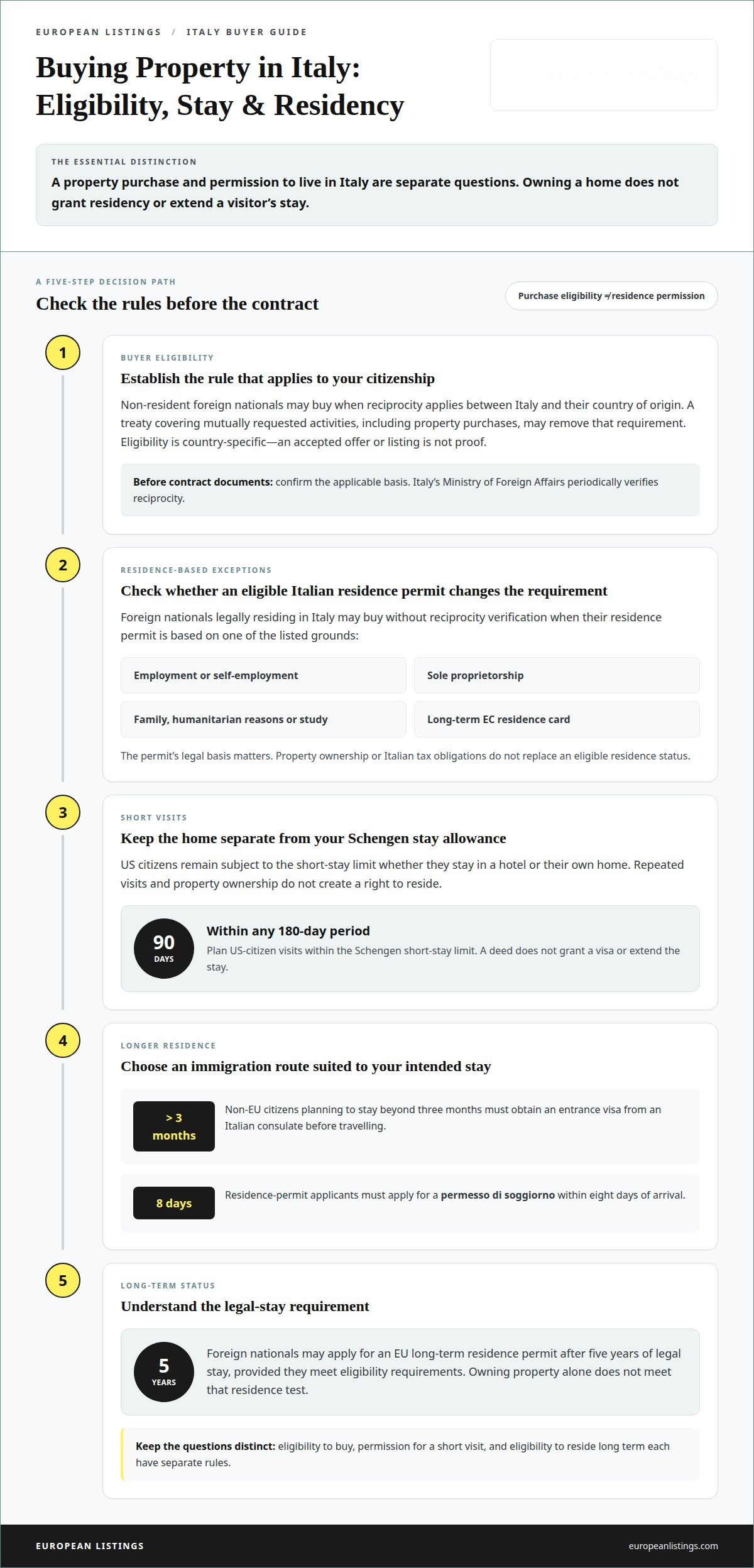
- Establish which eligibility rule applies to your citizenship. A non-resident foreign national may buy property when reciprocity applies between Italy and their country of origin. A treaty covering mutually requested activities, including property purchases and company formation, may remove that requirement. Eligibility is country-specific, not a general approval for every foreign buyer. Confirm the applicable basis before a notary prepares the purchase documents.
- Identify any residence-based exception before proceeding. Foreign nationals legally residing in Italy may buy without reciprocity verification if their residence permit is based on employment or self-employment, sole proprietorship, family, humanitarian reasons or study. A long-term EC residence card is also listed. The permit’s legal basis matters: owning property or having Italian tax obligations does not replace an eligible residence status.
- Keep the purchase and short-stay permission separate. A property deed does not grant a visa or extend a visitor’s stay. US citizens remain subject to the Schengen short-stay limit, whether they stay in a hotel or their own home. Plan visits within that limit. Repeated trips or property ownership do not create a right to reside, an important distinction if you want to spend extended periods in Italy.
- Choose a lawful route for a longer residence. Non-EU citizens planning to stay beyond three months must obtain an entrance visa from an Italian consulate before travelling. Residence-permit applicants must apply for a permesso di soggiorno within 8 days of arrival. Foreign nationals may apply for an EU long-term residence permit after five years of legal stay, provided they meet eligibility requirements. Property ownership alone does not meet that residence test. For prospective expats evaluating relocation pathways across Europe, consultancies like 360 Global Immigration can provide guidance on qualifying programs.
- Match the property search to your intended use. A holiday base, rental property, and future residence involve different practical priorities. Separate the purchase decision from assumptions about income, tax treatment, or immigration status. A notary cannot draft property-purchase contract forms involving citizens of countries without reciprocity, so eligibility needs to be resolved before the contract stage. For a focused search, browse Italian property listings selected for foreign-buyer friendliness.
First-home tax benefits and residency deadlines
Separate tax residence, immigration status and financing before signing. A favorable first-home rate depends on the property and your actions after purchase.
- Assess whether the first-home benefit fits your plans. Italy’s registration tax is 2% for a qualifying primary residence and 9% for a second home. For an eligible prima casa purchase, the 2% rate applies to cadastral value, not necessarily the seller’s price. You must establish residency within 18 months of the deed. Missing that deadline may trigger a 30% penalty, so don’t claim the benefit based only on future intentions.
- Check the property’s classification and tax treatment. A qualifying new-build home may receive a 4% VAT rate under the prima casa benefit. Luxury-classified properties in categories A/1, A/8, and A/9 are excluded. Those classifications also matter for the primary-residence IMU exemption, which does not apply to A/1, A/8, or A/9 properties. Confirm how the purchase is taxed before the contract fixes your expected costs.
- Keep residence plans distinct from ownership. Buying real estate doesn’t extend a US citizen’s Schengen stay or itself establish permanent residency. The Digital Nomad Visa has been in force since April 2024, while long-term stays require an immigration route suited to the applicant’s purpose. Match your visa plans to work, income, and intended residence. Reciprocity may affect eligibility to buy, but it does not grant permission to live in Italy.
- Plan payment arrangements before the seller’s deadlines. Decide how you’ll transfer funds and whether an Italian bank account suits the transaction. Coordinate payment details with the notary and your financial institution, especially if funds are coming from abroad. An account helps manage payments, but does not replace the codice fiscale, eligibility rules or residence documents. Allow for the contract schedule and purchase taxes, rather than relying on a mortgage approval that has not arrived.
- Compare mortgage terms with your cash needs. Non-resident mortgages in Italy generally run 15-20 years. Fixed-rate offers typically range from 3.5-5.5%, and Italian banks usually accept applications for amounts of at least €70,000. Compare the term and rate against your available deposit and income documentation. A mortgage can support a purchase, but it won’t change the prima casa residency deadline or make a second home qualify automatically.
Municipal €1 house schemes
Treat a municipal €1 home as a renovation commitment, not a ready-to-occupy bargain.
- Start with the municipality, not a national listing. Some Italian towns offer homes for sale for €1, but each municipal council sets its available properties and purchase terms. Apply directly to the council to learn which homes are currently offered and what conditions attach to the transaction. A national overview cannot replace the specific terms for the town and property you’re considering.
- Read the obligations before committing. Buyers may have to renovate within 1-5 years following purchase, depending on the municipality. Treat that deadline as a core part of the offer, not a minor detail after the €1 price. Compare the required timeline with your intended use, travel plans, and ability to oversee work. The purchase price alone says little about whether the project is practical.
- Estimate the full project budget. The total scope depends on the home’s condition and the work it needs, so the asking price alone cannot show your full investment. Consider both the renovation commitment and the purchase terms. Even a low entry price can lead to a substantial project.
- Prepare for the transaction’s administrative steps. A codice fiscale is Italy’s tax code, used for property-related tax and administrative purposes. Arrange it as part of your purchase planning, and consider how you’ll manage payments through a bank account. If someone will represent you in dealings with the municipal council or during the transaction, clarify their role and authority in advance. Keep the council’s specific conditions in view at every decision point.
- Decide whether the obligations fit your plans. A €1 scheme may suit buyers prepared to take on a renovation and meet the town’s stated deadline. It may be a poor match if you need a home ready for immediate use or cannot commit to the required work. Before proceeding, weigh the renovation range, the municipal terms, and your intended use together. Explore Italian homes for sale to compare these projects with other property options.
Buyers interested in one-euro homes in Italy should contact the municipal council directly to learn which properties are available and what purchase terms apply before proceeding.
European Listings: Buying Support and Guidance
European Listings helps turn your Italian property criteria into a more focused search. Its Weekly Curated Property Newsletter gathers listings from dozens of portals, filters them for foreign-buyer friendliness, and delivers 18 vetted properties each Saturday.
Consider Buying Support and Guidance once you’ve clarified your eligibility, residency plans and property preferences, but want help moving your search forward. Premium Membership Plans can also support a more focused property search. These services help you find relevant homes; legal, financial and technical decisions remain separate parts of the purchase.
For a focused next step, contact European Listings about your property search.
Make your next move with a clear brief
Before pursuing a property, decide what you need the home to do for you. A holiday base, a future move and a renovation project each call for different locations and compromises. Choose your main purpose, then use it to assess listings instead of letting an attractive price set the agenda. This makes buying a house in Italy as a foreigner a more deliberate decision, rather than a race to secure a property.
Keep your property search separate from immigration, tax and legal decisions. A suitable home may support your plans, but it cannot replace the separate requirements for living in Italy. When you’re ready to narrow your search, European Listings’ Buying Support and Guidance can help you move from broad interest to a more considered shortlist.
Contact European Listings to discuss your property search. Choose your priorities, keep the practical constraints in view, and take the next step with confidence.
Frequently Asked Questions
Can I get permanent residency in Italy if I buy a house?
No. Buying a home does not grant permanent residency or change your immigration status. Property ownership and permission to reside are separate. Foreign nationals may apply for an EU long-term residence permit after five years of legal stay, if they meet the eligibility requirements. For example, a US buyer planning to relocate must qualify through an applicable residence route. Owning a home alone does not qualify.
Do I need an Italian tax code, “codice fiscale” to buy real estate?
Yes. You need an Italian codice fiscale for property-related tax and administrative steps. It identifies you in Italian transactions, but does not establish residency or prove that you meet nationality-based purchase requirements. Obtain the code before progressing to the contract and payment arrangements. You can prepare this administrative requirement while separately resolving eligibility and deciding how you intend to use the property.
Do you need an Italian bank account to buy a house in Italy?
An Italian bank account can make payments easier to organize, but owning an account does not determine your eligibility to buy. Plan how funds will move from your existing account to the seller and other transaction participants, and align the timing with the purchase contract. For instance, if you’re transferring funds from the United States, account for the transfer process before agreeing to payment deadlines.
How long does it take to purchase in Italy (as a foreigner)?
From finding a property to completing the purchase typically takes 3-6 months. The search and in-person viewings alone are estimated to take 4-8 weeks. Eligibility, financing, document preparation, and the property’s condition can affect the sequence and pace. For a buyer abroad, allow time to coordinate viewings and transaction steps rather than treating the first accepted offer as a near-immediate completion.
How much deposit do you need for a mortgage in Italy?
Non-resident foreign buyers typically need a down payment of at least 40-50% of the purchase price. For example, a buyer seeking financing should plan for a substantial cash contribution alongside transaction costs. The exact mortgage amount depends on the buyer’s circumstances, so don’t treat a general loan-to-value range as a promise of approval. Keep the deposit plan separate from funds needed for taxes and other purchase expenses.
Can foreigners buy property in Italy, and are there restrictions by nationality?
Yes, foreigners can buy, but eligibility may depend on nationality and residence status. Non-resident buyers may purchase when reciprocity applies between Italy and their country of origin, or when a qualifying treaty removes that requirement. Foreign nationals legally residing in Italy may also qualify under specified permit grounds or with a long-term EC residence card. Confirm which category applies before entering a property contract.
Disclaimer
European Listings is a media publication. We are not a real estate agent, broker, lawyer, tax advisor, or financial advisor, and nothing here is legal, tax, or financial advice.
Properties, prices, and rules change. We do our best to keep things accurate, but we can't promise every detail is current or correct. Always check with a qualified local professional before you buy, sign, or send money.
We sometimes earn a commission from partners and sponsors we link to. This never changes what we choose to cover or what we say about it.
Any decision you make is your own.
Frequently Asked Questions
No. Buying a home does not grant permanent residency or change your immigration status. Property ownership and permission to reside are separate. Foreign nationals may apply for an EU long-term residence permit after five years of legal stay, if they meet the eligibility requirements. For example, a US buyer planning to relocate must qualify through an applicable residence route. Owning a home alone does not qualify.
Yes. You need an Italian codice fiscale for property-related tax and administrative steps. It identifies you in Italian transactions, but does not establish residency or prove that you meet nationality-based purchase requirements. Obtain the code before progressing to the contract and payment arrangements. You can prepare this administrative requirement while separately resolving eligibility and deciding how you intend to use the property.
An Italian bank account can make payments easier to organize, but owning an account does not determine your eligibility to buy. Plan how funds will move from your existing account to the seller and other transaction participants, and align the timing with the purchase contract. For instance, if you’re transferring funds from the United States, account for the transfer process before agreeing to payment deadlines.
From finding a property to completing the purchase typically takes 3–6 months. The search and in-person viewings alone are estimated to take 4–8 weeks. Eligibility, financing, document preparation, and the property’s condition can affect the sequence and pace. For a buyer abroad, allow time to coordinate viewings and transaction steps rather than treating the first accepted offer as a near-immediate completion.
Non-resident foreign buyers typically need a down payment of at least 40–50% of the purchase price. For example, a buyer seeking financing should plan for a substantial cash contribution alongside transaction costs. The exact mortgage amount depends on the buyer’s circumstances, so don’t treat a general loan-to-value range as a promise of approval. Keep the deposit plan separate from funds needed for taxes and other purchase expenses.
Yes, foreigners can buy, but eligibility may depend on nationality and residence status. Non-resident buyers may purchase when reciprocity applies between Italy and their country of origin, or when a qualifying treaty removes that requirement. Foreign nationals legally residing in Italy may also qualify under specified permit grounds or with a long-term EC residence card. Confirm which category applies before entering a property contract.