
Hand-Picked Homes for Sale in Europe: How to Find the Right Fit
What if the right home isn’t the one with the most beautiful photos, but the one whose compromises fit your life? That’s the question behind searches for “hand-picked homes for sale Europe”: what makes a listing genuinely selected, and can curation help you find a better fit?
A long list of properties can look like plenty of choice. But photos and asking prices rarely show the full picture: the area context, practical limitations, or trade-offs that matter once you imagine living there. If you’re still deciding which country, setting, or kind of home suits you, filters that are too rigid can also hide unexpected possibilities.
Thoughtful curation isn’t a promise that every listing is perfect. It’s a sharper starting point: homes selected against a clear brief, with useful facts, context, and honest downsides to help you compare. This article explains what hand-picked listings can and can’t tell you, how to weigh a home against your budget and lifestyle, and how a mostly relevant selection can leave room for a few surprises.
What “hand-picked homes for sale in Europe” should actually mean
A hand-picked home is a listing chosen as a plausible match for a buyer’s brief, presented with relevant context and shaped by editorial judgment, not simply selected for attractive photographs. That distinction matters. A striking image can earn a click, but it can’t establish whether a home suits your budget, intended use, or preferred way of life.
For buyers searching for hand-picked homes for sale Europe, the standard should be relevance with room for judgment. A useful selection considers what you’re looking for while recognising that your brief may still be taking shape. It should help you compare options, not make the decision for you.
How curation differs from a long property search
A broad results page returns options according to filters. A curated selection starts with a more considered brief: your budget, how you expect to use the home, and the lifestyle priorities that matter. Rather than asking you to scan an undifferentiated stream, it brings a smaller group of plausible options into focus.
Smaller doesn’t mean exhaustive. Curation reduces noise, but it can’t represent every available home. Nor should it become rigid. A mostly relevant selection can include a few considered surprises, such as a different property type or setting that challenges an assumption in your brief. That’s discovery, not random distraction.
Look for useful context alongside the listing itself: key facts, price-area perspective, and concise trade-offs. These details give you more to compare than presentation alone. Check whether the listing makes clear what is known, what the main compromises are, and what you may want to follow up on.
What “hand-picked” does not guarantee
Editorial selection is a starting point, not a verdict. It doesn’t guarantee that a home is suitable for you, in good condition, legally in order, or likely to deliver a particular investment result. A listing can appear relevant and still fall short once you understand its details.
Photos, asking price, and listing information are useful inputs, not independent assessments. They don’t replace a technical inspection, legal review, or independent valuation. Treat the selection as a way to focus your attention, then assess each property against your needs and arrange the independent checks relevant to your decision.
The distinction is simple: curation earns its place by making comparison more purposeful and showing trade-offs plainly. It doesn’t remove uncertainty or declare one home objectively best. The final fit belongs to the buyer.
How to judge whether a European home fits your brief
A useful search begins with your life, not a list of features. Before comparing hand-picked homes for sale Europe, decide what the home is for and which compromises you can live with. A holiday base, a future retirement home, a rental property, and a place to move permanently each call for different priorities.
Turn an uncertain search into one useful brief
Write a short working brief that captures your purpose, budget boundaries, practical needs, and lifestyle priorities. Then separate essentials from preferences. Reliable access or enough room for everyday needs might be essential; a particular view, extra land, walkability, or rental potential may be flexible. Be specific about the trade-offs you would accept. A preference only helps if you would genuinely choose it over something else.
Geographic openness can widen discovery, but only if it reflects your circumstances and the places you could realistically imagine living. If you’re still weighing location, explore this guide to where to buy property in Southern Europe to clarify what matters geographically, rather than treating it as a shortcut to a decision.
Read the listing beyond its strongest photograph
Look at the facts through the lens of an ordinary day. Does the stated space suit how you’d use the home? Does the location align with your expectations for access and walkability? Would the property’s apparent upkeep fit your willingness to manage maintenance? Separate what the listing states from what you still need to understand.
An asking price gains context when considered alongside concise information about prices in the surrounding area. That comparison can help frame questions, but it isn’t an independent valuation or proof that a home is fairly priced. Consider the trade-offs as well as the features and photographs.
Use listing details to decide what deserves closer attention and what you need to ask about. They’re a starting point, not a substitute for independent checks. A brief that weighs must-haves against flexible preferences also makes a weekly curated property newsletter more useful: the selection can stay mostly relevant while leaving space for an unexpected home that prompts you to rethink your brief.
The weekly curated property newsletter brings a considered selection of homes together for buyers exploring their options.
Which trade-offs matter when comparing hand-picked homes?
A property can look compelling and still ask you to accept compromises that don’t suit your life. Compare each home against the same priorities, then focus on what would affect daily use, not which listing has the most photogenic feature. This makes hand-picked homes for sale Europe easier to assess without expecting one home to meet every preference.
Compare priorities without pretending every home is perfect
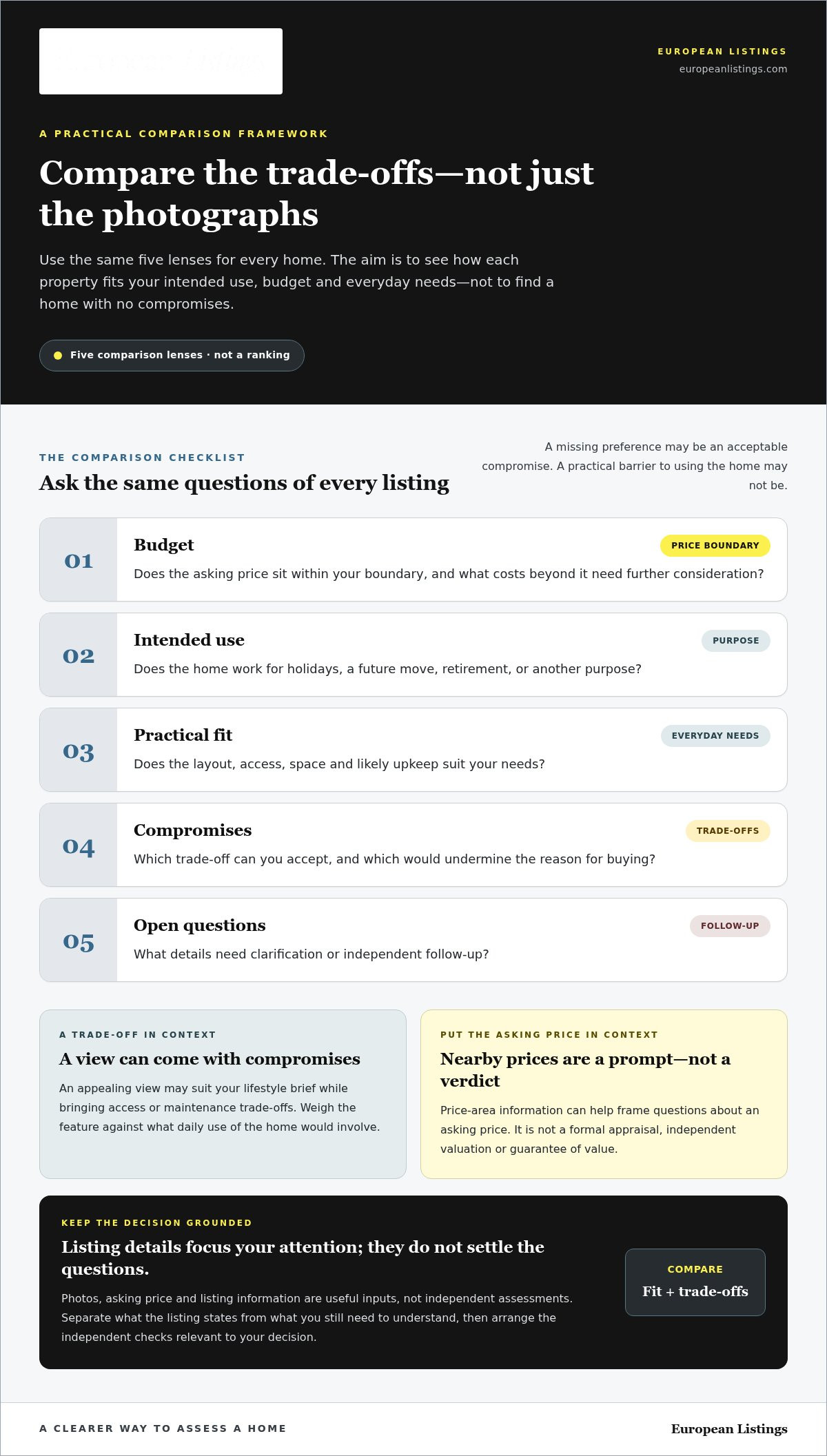
Use a compact framework, adapting it to your intended use and budget. For example, a home with an appealing view might suit your lifestyle brief but come with access or maintenance trade-offs. A missing secondary preference may be a fair compromise; a practical barrier to using the home may not be.
| Compare | Ask yourself |
|---|---|
| Budget | Does the asking price sit within your boundary, and what costs beyond it need further consideration? |
| Intended use | Does the home work for holidays, a future move, retirement, or another purpose? |
| Practical fit | Does the layout, access, space, and likely upkeep suit your needs? |
| Compromises | Which trade-off can you accept, and which would undermine the reason for buying? |
| Open questions | What details need clarification or independent follow-up? |
Price-area context can help frame an asking price against nearby market information, but it isn’t a formal appraisal or a guarantee of value. The asking price is only one part of the picture. For a specific example of expenses beyond it, read this guide to hidden costs when buying property in Italy.
Know when a listing needs independent follow-up
Unclear details are prompts for questions, not reasons to guess. Direct questions about the listing to the listing agent. For legal, financial, technical, or condition assessments, seek appropriate independent professional support. Editorial context can help you decide what to investigate, but it doesn’t replace those assessments.
As your interest in a property becomes more serious, professional guidance can become more relevant to your next steps. Keep your comparison honest: note what’s appealing, what you’d be accepting, and what remains unanswered. The weekly curated property newsletter helps you discover a considered selection against your brief.
How a weekly curated selection can make European home discovery easier
A search can evolve as you see real homes, not just as you refine filters. A weekly rhythm gives that process room to develop without turning discovery into another daily task: share one brief, receive a considered selection, explore the listings, save the homes worth remembering, and return as your priorities sharpen.
The selection can respond quietly to your brief, budget, geographic openness, and engagement. Personalisation shouldn’t become a rigid filter: editorial judgment still matters, including the occasional listing that challenges an assumption or makes a new possibility feel worth considering. In the member survey, 14 of 20 respondents reported receiving mostly relevant homes plus a few surprises. That balance is the point: relevance, with room for discovery.
If you’re weighing different discovery approaches, this guide to choosing a curated real estate newsletter offers another perspective on what a thoughtful selection can look like.
What a useful listing page should help you see
The home should remain the focus. A useful listing page puts its photos alongside the asking price, location, key facts, and source, then keeps supporting context concise. Brief trade-offs and price-area context can help you consider the property in relation to your needs without crowding out the details that first caught your eye.
A save option helps you keep a promising home in view, while a direct route to the listing agent makes it easier to follow up. Together, those details give you a practical record of what you saw and what you may want to explore next. They support discovery, not a verdict on the property.
When discovery should lead to a next step
Saving a listing doesn’t need to start a project. It simply preserves the home so you can revisit it as your search develops and compare it with other possibilities. If your interest becomes serious, contextual introductions to independent professionals can help you navigate next steps. Their role is separate from the editorial work of selecting and presenting listings.
For a considered way to discover hand-picked homes for sale Europe, explore the European Listings weekly service.
Make your next home search more considered
The strongest hand-picked homes for sale Europe aren’t simply the most photogenic. They’re plausible matches for your brief, presented with enough context to compare what matters and enough honesty to see the compromises. Start with your intended use, budget, and essential needs. Then weigh each listing’s trade-offs instead of expecting one home to tick every box.
Good curation should also leave room for discovery. In the member survey, 19 of 20 respondents valued seeing homes they wouldn’t find themselves, while 17 of 20 valued honest downsides and trade-offs. That balance can make a broad search feel more purposeful without suggesting that a selection is exhaustive or guarantees the right fit.
Ready to explore a considered selection shaped around your search? Explore the European Listings weekly service. Keep your brief open to refinement, compare with care, and give unexpected possibilities a fair look. The right fit may become clearer once you see it.
Frequently Asked Questions
What does “hand-picked homes for sale in Europe” mean?
It means listings have been selected as plausible matches for a buyer’s brief, with context and editorial judgment informing the choice. For people searching hand-picked homes for sale Europe, that brief might include budget, intended use, lifestyle, and practical needs. A considered selection can make comparison more purposeful than a stream of results, but it doesn’t mean every home is suitable, inspected, or objectively the best option.
Are hand-picked property listings better than searching a property portal?
Neither approach is automatically better; they serve different discovery needs. A property portal can offer broad browsing and filters, while a curated selection narrows attention to homes considered relevant to a buyer’s brief. Curation can reduce noise, but it doesn’t promise to include every available listing. Some buyers may use both: a considered selection for focused discovery and broader searches to explore beyond it.
How can I tell whether a European home fits my budget and lifestyle?
Start by defining what the home is for, your budget boundaries, and the practical needs you won’t compromise on. Then separate essentials from preferences, such as a view, extra land, or walkability. Compare the asking price with available price-area context for perspective, not as a formal valuation. Consider layout, access, and upkeep alongside appealing features, and note any details that need follow-up.
Does a curated listing mean the property has been inspected or legally checked?
No. Editorial selection indicates that a listing may be relevant to a buyer’s brief; it isn’t a technical inspection, legal review, or independent valuation. Photos, asking price, and listing details are useful starting points, but they don’t establish a property’s condition or legal status. Treat unclear information as a prompt for questions and seek appropriate independent professional assessments as your interest develops.
Can a weekly property selection include homes I would not have searched for myself?
Yes. A useful selection can be mostly relevant to your brief while leaving room for a few considered surprises. That might mean seeing a property type or setting you hadn’t included in your first search, but that still suits your broader priorities. In the member survey, 14 of 20 respondents reported a weekly selection of mostly relevant homes plus a few surprises. Editorial judgment keeps discovery from becoming rigid filtering.
What should I do after finding a promising home for sale in Europe?
Save the listing so you can revisit it, compare it with other options, and remember what caught your attention. Review its key facts and trade-offs, then note anything that remains unclear. The listing page provides a direct route to the listing agent for property questions. As your intent strengthens, contextual introductions to independent professionals can help you navigate next steps. A curated selection supports discovery, but doesn’t execute a purchase.
Disclaimer
European Listings is a media publication. We are not a real estate agent, broker, lawyer, tax advisor, or financial advisor, and nothing here is legal, tax, or financial advice.
Properties, prices, and rules change. We do our best to keep things accurate, but we can't promise every detail is current or correct. Always check with a qualified local professional before you buy, sign, or send money.
We sometimes earn a commission from partners and sponsors we link to. This never changes what we choose to cover or what we say about it.
Any decision you make is your own.
Frequently Asked Questions
It means listings have been selected as plausible matches for a buyer’s brief, with context and editorial judgment informing the choice. For people searching hand-picked homes for sale Europe, that brief might include budget, intended use, lifestyle, and practical needs. A considered selection can make comparison more purposeful than a stream of results, but it doesn’t mean every home is suitable, inspected, or objectively the best option.
Neither approach is automatically better; they serve different discovery needs. A property portal can offer broad browsing and filters, while a curated selection narrows attention to homes considered relevant to a buyer’s brief. Curation can reduce noise, but it doesn’t promise to include every available listing. Some buyers may use both: a considered selection for focused discovery and broader searches to explore beyond it.
Start by defining what the home is for, your budget boundaries, and the practical needs you won’t compromise on. Then separate essentials from preferences, such as a view, extra land, or walkability. Compare the asking price with available price-area context for perspective, not as a formal valuation. Consider layout, access, and upkeep alongside appealing features, and note any details that need follow-up.
No. Editorial selection indicates that a listing may be relevant to a buyer’s brief; it isn’t a technical inspection, legal review, or independent valuation. Photos, asking price, and listing details are useful starting points, but they don’t establish a property’s condition or legal status. Treat unclear information as a prompt for questions and seek appropriate independent professional assessments as your interest develops.
Yes. A useful selection can be mostly relevant to your brief while leaving room for a few considered surprises. That might mean seeing a property type or setting you hadn’t included in your first search, but that still suits your broader priorities. In the member survey, 14 of 20 respondents reported a weekly selection of mostly relevant homes plus a few surprises. Editorial judgment keeps discovery from becoming rigid filtering.
Save the listing so you can revisit it, compare it with other options, and remember what caught your attention. Review its key facts and trade-offs, then note anything that remains unclear. The listing page provides a direct route to the listing agent for property questions. As your intent strengthens, contextual introductions to independent professionals can help you navigate next steps. A curated selection supports discovery, but doesn’t execute a purchase.