
Buying a Holiday Home in Southern Europe: Prices, Costs and Rules
Yes, buying a holiday home in southern Europe for under €100,000 is possible, but the options are a small slice of the market. On 25 August 2026, 4,296 of 122,556 homes listed across Spain, Portugal, France, Italy, Greece and Cyprus were priced below that threshold. The lowest prices can come with trade-offs in location, condition or the work a property needs.
A low asking price is only the starting point when buying a holiday home in southern Europe. Purchase taxes and fees, ongoing upkeep and rules for foreign owners all affect the real cost and complexity. These details vary by country and region, so a useful shortlist needs to account for more than the headline price.
This guide explains where lower-priced homes are more common, what to budget beyond the purchase price, and which ownership and visa rules may apply to foreign buyers. It also sets out how to assess an under-€100,000 listing with clear eyes, so you can distinguish a promising holiday home from a property whose compromises outweigh its price.
Where is the cheapest place to buy property in Europe?
For lower-priced holiday homes, compare listings in Spain, Italy, Portugal, Cyprus and Greece, looking at regions as well as countries. The right choice depends on your budget, preferred property type and the location you want.
Regional Property Listings
Listing totals show the scale of selected markets, not which homes offer the best value. One listing page showed 14,383 properties in Cyprus, 8,585 in Spain and 7,379 in Croatia. Compare local options within each country: an apartment in a regional town is a different proposition from a coastal villa.
Prices vary sharply by location and property type. These examples show why a country-wide price label can hide important differences between regions, apartments and larger houses.
Affordable Southern European Regions
For homes listed under €300,000, Lazio in Italy had 254 of 294 listings, or 86.4%, on 25 August 2026. Portugal’s Centro region had 602 of 1,081, or 55.7%, below that threshold. Cyprus also showed substantial lower-priced inventory in Nicosia, with 2,076 of 3,803 listings under €300,000.
Spain offers a large pool to narrow down: Comunitat Valenciana had 13,664 homes listed below €300,000. In Greece, Crete had 791 of 1,545 listings under the same price, or 51.2%. By contrast, only 14 of 642 Balearic Islands listings fell below €300,000. Treat these regional figures as a starting point, then weigh property type and proximity to the places you plan to visit.
Country and Price Filters
Search in stages. Start with a country, such as Spain or Portugal, then narrow your search to a region. Set a maximum asking price before reviewing individual homes. This makes it easier to compare options such as rural houses, coastal apartments and higher-priced villas without letting one category dominate the results.
Next, filter by property type: apartments, houses, villas or other homes. Compare like with like. A one-bedroom apartment in a town and a detached house in the countryside serve different needs, even when both sit within the same price ceiling. Keep the location and home type fixed while comparing listings across regions.
Use search results to build a shortlist, not to choose a winner based on asking price alone. Each listing represents a distinct property type and location, so price filters work best alongside clear criteria for the home and region.
Can you still buy a house in Europe for under €100,000?
Yes. A traditional trullo in Puglia, Italy, was listed below €100,000, showing that low-priced homes exist, though options are limited. Shared ownership can offer another route, but rental rules and likely income depend on the property’s location and ownership arrangement.
Co-Ownership Options
Co-ownership means sharing a holiday home with other owners rather than buying it alone. Before treating it as an investment, establish how owners will divide use, ongoing costs, maintenance decisions and any future sale. The ownership structure and tax treatment also matter, particularly when owners live in different countries.
Short-term rental rules vary across Spain, Portugal, Italy, Greece and Croatia, including between regions. There is no single rule for all five countries. Consider the local requirements that apply to the specific property and location.
Homes Below €100,000
Under-€100,000 listings can include small traditional homes, apartments or properties requiring substantial work. For example, a 30 m² trullo in Puglia illustrates the compact end of the market. A low asking price alone says little about the home’s condition, location or suitability as a holiday base.
Compare a property’s size and setting with how you plan to use it. A modest rural home may suit quiet breaks, while a coastal villa or apartment may better fit frequent beach visits. These options are not interchangeable, and a low-priced listing may involve compromises that matter more than its headline price.
Rental demand depends on location, visitor access, seasonality and the home’s features. Expected yield depends on rental income relative to purchase and ownership costs, so no single yield figure applies across these countries. Assess a property’s rental potential separately from its appeal for your own holidays.
For a shared purchase, agree on use and costs before choosing a property. For an individual purchase, keep the asking-price filter alongside clear requirements for home type and location. A curated shortlist of lower-priced homes can help focus the search on relevant options.
August co-owners who travel off-peak can enjoy upwards of 12-14 weeks per year in their homes. August homeowners own four to five European homes for less than the price of buying one home.
The villa listed in Baška, Croatia, has an area of 79 m², and the apartment listed in Paphos, Cyprus, has an area of 86.29 m². The Budva, Montenegro, villa listing includes a private plot measuring 737 sq.m. When comparing European property markets, buyers should consider ownership structures and taxation alongside the practical fit of each property.
Budgeting for purchase and ongoing costs
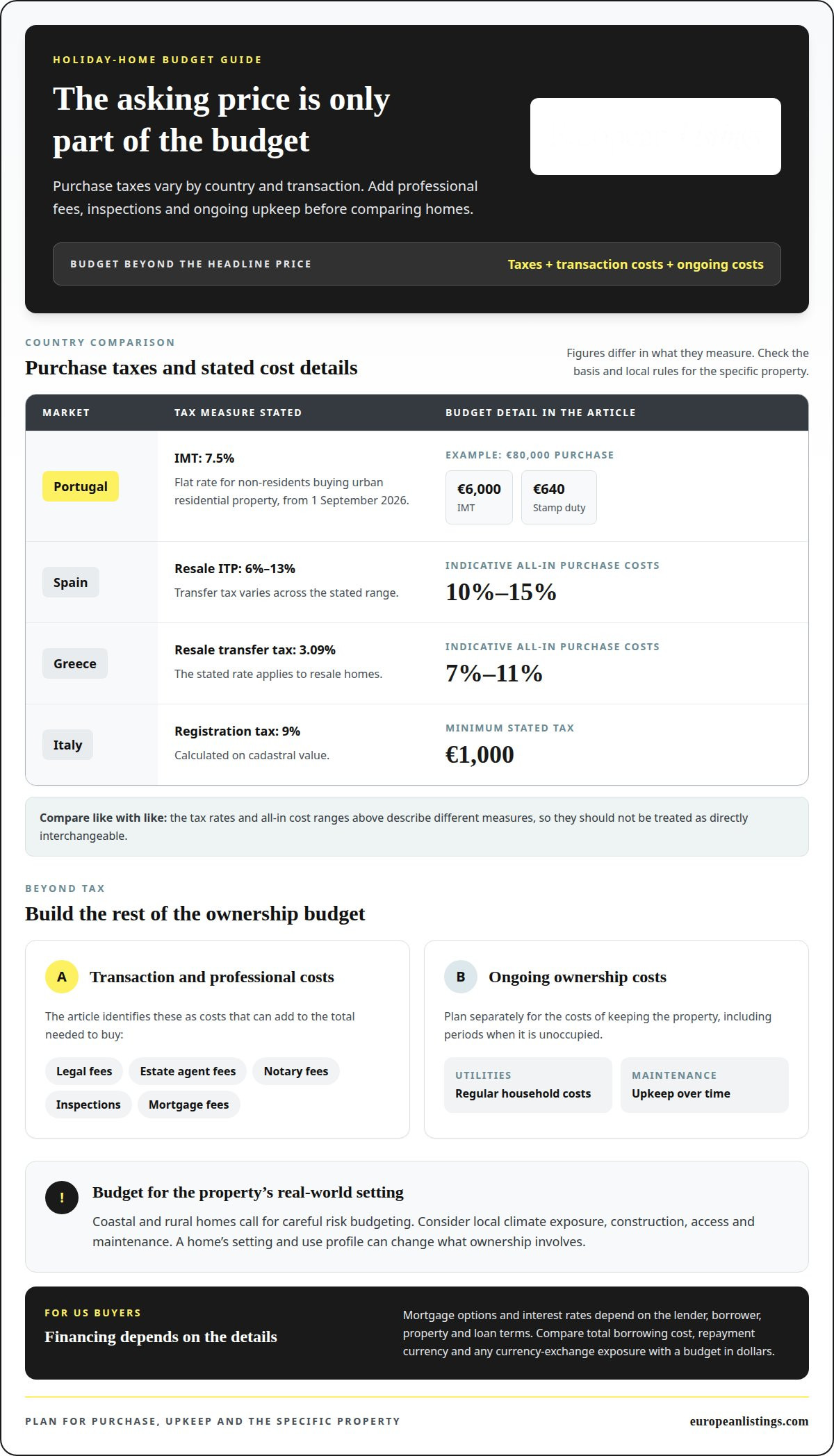
The purchase price is only one part of a holiday-home budget. Taxes, professional fees, inspections, utilities and maintenance all affect what you need to buy and keep a property.
Purchase taxes differ by country and transaction. In Portugal, non-residents buying urban residential property pay a flat IMT rate of 7.5% from 1 September 2026. On an €80,000 purchase, that means €6,000 in IMT and €640 in stamp duty. For resale homes in Spain, ITP transfer tax ranges from 6% to 13%, with indicative all-in purchase costs of 10% to 15%.
Other markets use different calculations. Greece’s resale transfer tax is 3.09%, and indicative all-in purchase costs are 7% to 11%. In Italy, registration tax is 9% of cadastral value, with a minimum of €1,000. These figures show why two homes with similar asking prices can require different cash budgets after tax.
Allow for more than tax. Legal, estate agent and notary fees, inspections, mortgage fees, utilities and maintenance can all add to the total. A home in the French Alps, for example, has a different setting and use profile from a coastal apartment. Budget separately for continuing costs, including utilities and upkeep when the property is unoccupied.
For US buyers, mortgage options and interest rates depend on the lender, borrower, property and loan terms. There is no single rate or financing structure for southern Europe. Compare the total borrowing cost, repayment currency and any currency-exchange exposure with your budget in dollars.
Coastal and rural homes also call for careful risk budgeting. Local climate exposure, construction, access and maintenance needs can affect insurance terms and ownership costs. A coastal home and a rural property may involve different site-specific considerations. Include insurance and likely upkeep in your budget rather than treating the purchase price as the full investment.
Before committing, organise the figures into three stages: completion costs, financing costs and recurring ownership costs. Include taxes and professional fees in the purchase funds, then account for mortgage payments, utilities, maintenance and insurance. This makes comparisons between resale homes in Spain, Greece or Italy more meaningful than asking price alone.
Foreign ownership rules and visa requirements
Foreign buyers need to consider ownership, tax and immigration as separate questions. Rules for holiday homes vary across Europe, so buying in Spain may involve different considerations from buying in Greece or Tuscany. Account for those differences from the outset when planning to buy a holiday home in southern Europe.
The key takeaway is simple: don’t assume one country’s process applies across the region. Property ownership laws, visa requirements, taxes and other regulations can vary by location. Non-resident buyers may need advice from a local lawyer on how the rules apply to a specific purchase.
Start by defining how you plan to use the home. Occasional holidays, rental income and spending part of the year there can raise different questions. A rural home in the interior of Tuscany, for example, may suit long, quiet stays, while a coastal apartment may fit a different pattern of use. Your plans help identify which local rules need attention.
Separate your purchase review into distinct topics rather than treating foreign-buyer rules as one checklist. Consider:
- Ownership: Identify the applicable ownership rules for the property and the buyer’s residency status.
- Tax: Understand which local and regional tax considerations relate to purchase and ongoing ownership.
- Stays: Examine visa and residence requirements separately from the property transaction.
- Use: Clarify which regulations apply to the home’s intended use, including any rental plans.
That separation matters in every market. A buyer comparing an apartment in Portugal with a house in Croatia should not assume the same ownership, tax or stay requirements apply. Regional rules can also affect practical details within one country. Location, residency and intended use all shape the questions to consider when buying a holiday home in southern Europe.
Build local guidance into your decision before committing to a property. A local lawyer can advise non-resident buyers on rules relevant to the specific location, including cross-border succession and estate planning. As you arrange documentation for international assets, you can register will location online so your executors know exactly where to find your paperwork. This advice complements a clear plan for how often you’ll visit, whether you’ll rent the home and how long you hope to stay.
For a focused next step, explore homes suited to foreign buyers while keeping ownership, tax and visa questions on separate tracks. A well-matched shortlist can help narrow the location; local legal guidance can address the rules that apply there.
European Listings: Buying Support and Guidance
European Listings is a natural next step when you’ve narrowed your preferred countries but want a more focused property search. Its Buying Support and Guidance helps you move from broad research toward a shortlist aligned with your budget, intended use and foreign-buyer considerations.
The Weekly Curated Property Newsletter gathers listings from dozens of portals, filters them for foreign-buyer friendliness and delivers 18 vetted properties each Saturday. Premium Membership Plans are another option for readers seeking a structured way to follow opportunities across southern Europe.
These offerings help with finding and narrowing property options. They don’t replace local legal or financial advice, or a property inspection. For support with your next steps, contact European Listings.
Make your next move a considered one
The next step in buying a holiday home in southern Europe is to turn broad interest into clear priorities. Decide how you expect to use the property, which locations fit your plans and what trade-offs you’re willing to accept. A clear brief can focus your search, whether you’re considering a personal retreat or a home with rental potential.
European Listings offers a Weekly Curated Property Newsletter, Premium Membership Plans and buying support and guidance. Its curated listings and property notes can help you refine your search and keep track of homes that match your criteria. Local legal and financial questions remain separate and should be considered with appropriate local guidance.
When you’re ready to discuss your plans, contact European Listings. A thoughtful starting point can make the next decision clearer, and help you move toward a home that suits the way you want to spend your time.
Frequently Asked Questions
Has Portugal’s new tax changed what non-residents pay?
Yes. From 1 September 2026, non-residents buying urban residential property in Portugal pay a flat IMT rate of 7.5%. For an €80,000 purchase, IMT is €6,000, with stamp duty of €640. These figures illustrate the tax on that purchase value; they don’t represent every transaction cost. Include both taxes in your funds-to-complete calculation before comparing a Portuguese property with homes elsewhere.
Is the Algarve still affordable?
Some lower-priced listings remain, but the Algarve isn’t uniformly inexpensive. In August 2026, 994 of 5,953 listed homes were priced under €300,000, representing 16.7%. That share gives useful context, but doesn’t establish the condition, size or location of individual homes. Compare the specific property and its ongoing costs, rather than treating the region’s under-€300,000 listings as a measure of overall affordability.
What should I do next?
Write a concise property brief before reviewing listings. Set your budget, preferred home type, intended use and location priorities, then identify acceptable compromises. If you’re considering rental income, assess that separately from personal use. For a shortlisted property, local legal guidance can help explain rules relevant to the location and your circumstances. Consider financing, tax and inspection questions separately so each receives proper attention.
Which European regions have the highest entry prices?
Asking prices can be high in sought-after coastal and city locations, but individual listings are not regional averages. Treat these as examples of listed homes, not rankings of entire regions. Property type, size and exact location all affect the asking price.
What are typical holiday-home prices in Spain, Portugal, Italy, Greece, and Croatia?
There’s no single typical price that describes five national markets. These are asking-price examples, not market averages.
What taxes and closing costs apply when buying property in southern Europe?
Costs depend on the country, property and transaction. For resale homes, Spain’s ITP transfer tax is 6% to 13%, while Greece’s transfer tax is 3.09%. Italy’s registration tax is 9% of cadastral value, with a €1,000 minimum. Portugal’s non-resident IMT rate for urban residential purchases is 7.5% from 1 September 2026. Also budget for legal, notary, agent, inspection and mortgage fees, plus utilities and maintenance.
Disclaimer
European Listings is a media publication. We are not a real estate agent, broker, lawyer, tax advisor, or financial advisor, and nothing here is legal, tax, or financial advice.
Properties, prices, and rules change. We do our best to keep things accurate, but we can't promise every detail is current or correct. Always check with a qualified local professional before you buy, sign, or send money.
We sometimes earn a commission from partners and sponsors we link to. This never changes what we choose to cover or what we say about it.
Any decision you make is your own.
Frequently Asked Questions
Yes. From 1 September 2026, non-residents buying urban residential property in Portugal pay a flat IMT rate of 7.5%. For an €80,000 purchase, IMT is €6,000, with stamp duty of €640. These figures illustrate the tax on that purchase value; they don’t represent every transaction cost. Include both taxes in your funds-to-complete calculation before comparing a Portuguese property with homes elsewhere.
Some lower-priced listings remain, but the Algarve isn’t uniformly inexpensive. In August 2026, 994 of 5,953 listed homes were priced under €300,000, representing 16.7%. That share gives useful context, but doesn’t establish the condition, size or location of individual homes. Compare the specific property and its ongoing costs, rather than treating the region’s under-€300,000 listings as a measure of overall affordability.
Write a concise property brief before reviewing listings. Set your budget, preferred home type, intended use and location priorities, then identify acceptable compromises. If you’re considering rental income, assess that separately from personal use. For a shortlisted property, local legal guidance can help explain rules relevant to the location and your circumstances. Consider financing, tax and inspection questions separately so each receives proper attention.
Asking prices can be high in sought-after coastal and city locations, but individual listings are not regional averages. Treat these as examples of listed homes, not rankings of entire regions. Property type, size and exact location all affect the asking price.
There’s no single typical price that describes five national markets. These are asking-price examples, not market averages.
Costs depend on the country, property and transaction. For resale homes, Spain’s ITP transfer tax is 6% to 13%, while Greece’s transfer tax is 3.09%. Italy’s registration tax is 9% of cadastral value, with a €1,000 minimum. Portugal’s non-resident IMT rate for urban residential purchases is 7.5% from 1 September 2026. Also budget for legal, notary, agent, inspection and mortgage fees, plus utilities and maintenance.