
4 considerations for choosing a European retirement destination
The best places to retire in Europe depend less on a popularity ranking than on whether residency, healthcare access, pension taxation and daily life fit your priorities. Portugal ranked first in the 2025 Global Retirement Index for retirement visa schemes. That makes it a useful starting point, not a universal verdict.
A pleasant climate and an attractive home matter, but they’re only part of the decision. For American retirees, pension income, healthcare arrangements and legal residence requirements can all affect how suitable a destination is.
This guide covers four practical considerations for comparing European retirement destinations. Learn how to weigh lifestyle against healthcare and pension needs, assess Malta’s residency programmes and tax rules, and narrow your options before searching for a home. The goal is a shortlist shaped by the realities of retirement, not rankings alone.
2. How do you compare retirement destinations in Europe?
Portugal, Spain, France, Italy and Greece suit different retirement priorities. Portugal ranked first in the 2025 Global Retirement Index for retirement visa schemes, while Spain combines a non-lucrative residence route with a substantial income requirement. France and Italy set distinct income conditions for visitor or elective-residence routes, and Greece stands out for its qualifying foreign-pension tax regime.
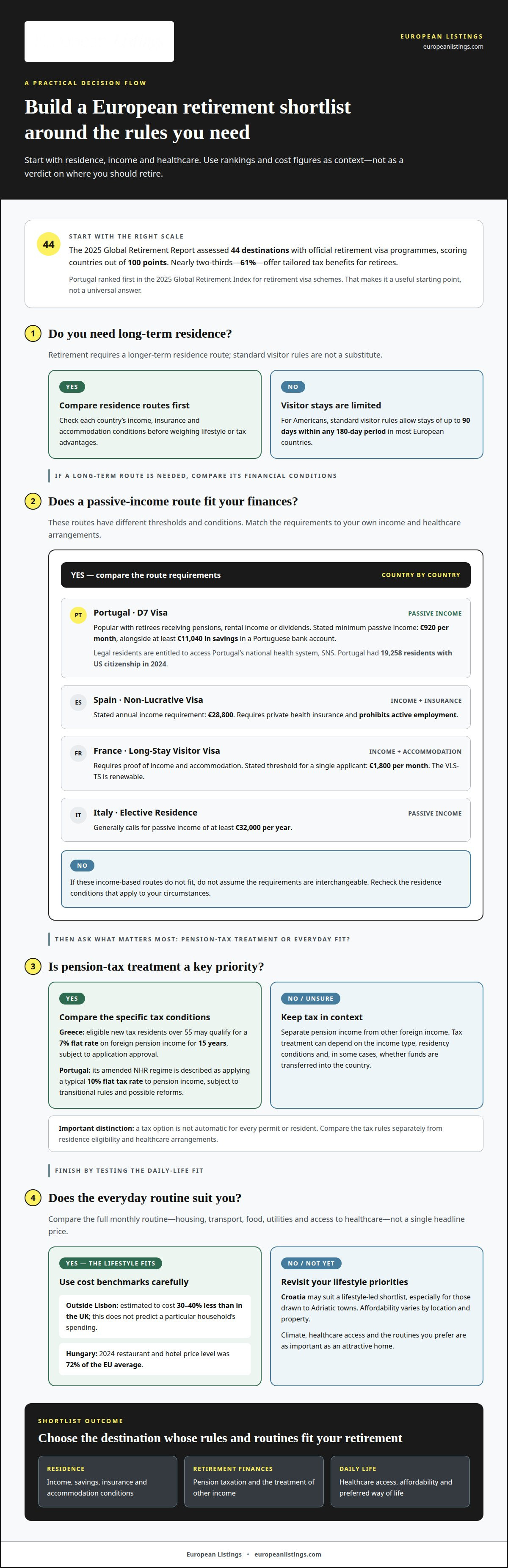
Start with the practical filters, not the postcard. The 2025 Global Retirement Report assessed 44 destinations with official retirement visa programmes and scored countries out of 100 points. Nearly two-thirds, or 61%, offer tailored tax benefits for retirees. Those measures offer useful context, but your pension, healthcare needs, and preferred way of life should determine the shortlist.
For affordability, compare the whole monthly routine: housing, transport, food, utilities, and access to healthcare. Living outside Lisbon is estimated to cost 30–40% less than in the UK, but that comparison doesn’t establish what a particular household will spend. Hungary’s 2024 price level for restaurants and hotels was 72% of the EU average, one concrete benchmark beyond the Mediterranean. Croatia also deserves a place on a lifestyle-led shortlist, especially for those drawn to Adriatic towns, though affordability varies by location and property.
Portugal has a clear appeal for foreign retirees seeking a residency route tied to passive income. Its D7 Visa is described as popular with retirees receiving pensions, rental income, or dividends; the stated minimum passive income is €920 per month, alongside savings of at least €11,040 in a Portuguese bank account. Legal residents are entitled to access Portugal’s national health system, SNS. Portugal had 19,258 residents with US citizenship in 2024, offering another point of reference for Americans considering the move.
Spain’s Non-Lucrative Visa requires sufficient passive income and private health insurance, and it prohibits active employment. The stated annual income requirement is €28,800. France’s Long-Stay Visitor Visa requires proof of income and accommodation; its stated income threshold is €1,800 per month for a single applicant. Italy’s Elective Residence route generally calls for passive income of at least €32,000 per year.
Greece may appeal to retirees prioritising pension-tax treatment: eligible new tax residents over 55 may qualify for a 7% flat rate on foreign pension income for 15 years, subject to application approval. Compare that possibility with residency conditions, health insurance arrangements, and the daily environment you want. The best places to retire in Europe are the countries whose rules and routines fit your actual retirement, not simply the most highly ranked destinations.
3. Malta’s retirement and permanent residence programmes
Malta offers distinct routes for retirees and international residents. The Retirement Programme has a minimum annual tax, so check the current programme terms when assessing its costs. Under that programme, foreign-sourced income remitted to Malta is taxed at a flat rate of 15%. These are material figures, but the programme’s residency and property conditions matter just as much.
Malta’s Permanent Residence Programme and Retirement Programme allow Schengen travel and don’t require full-time residence. The archipelago has eight islands, four of them inhabited, so your location can shape daily routines, transport and access to services. Its climate and English-speaking environment may also appeal to Americans seeking a familiar language in a Mediterranean setting.
Property is part of Malta’s residence-programme requirements: applicants must buy residential real estate worth at least €375,000 or rent accommodation for at least €14,000 annually for at least five years. Malta’s Retirement Programme also has a separate minimum annual tax of €15,000 per family under the GRP. The country is described as having no wealth or inheritance tax. These features don’t make every route interchangeable; compare the programme’s tax treatment with its property and residence conditions.
Residency and citizenship timelines vary across Europe. Portugal’s Agency for Integration, Migration and Asylum says eligible residents may apply for permanent residency or Portuguese citizenship after five years. In Spain, qualifying applicants may access permanent residence after five years, while naturalisation may be available after ten years. In France, retirees may apply for permanent residence or French nationality after five years of continuous legal residence.
For Americans, standard visitor rules allow stays of up to 90 days within any 180-day period in most European countries. Retirement requires a longer-term residence route. France’s Long-Stay Visitor Visa, or VLS-TS, requires proof of income and accommodation and is renewable. Assurance Vie is a French life-insurance savings arrangement, not a residence permit; consider it separately from visa eligibility and assess its terms alongside your broader retirement finances.
Greece offers another combination to consider. Financially independent retirees may be eligible for permanent residency after five years, and Greek citizenship may follow after seven years of residence. Greece also offers a qualifying foreign-pension tax option for some new tax residents. Treat this tax benefit as separate from residence eligibility, rather than an automatic feature of every permit.
For a home search that follows your preferred climate, regions and residency route, explore retirement properties across Europe.
4. Tax treatment of pensions and foreign income
A destination’s headline tax rate can obscure details that affect your net income. Compare how each country treats pension income, other foreign income and money transferred into the country. Keep these categories distinct. Pension and rental income, for example, may be treated differently, so one advertised rate cannot describe every part of your retirement budget.
Portugal illustrates why the specific regime matters. Its amended NHR regime is described as applying a typical 10% flat tax rate to pension income, subject to transitional rules and possible reforms. That figure is not a blanket rate for all income or all residents. Before comparing it with another country, identify whether your income is a pension, investment return, or rental income, then match it to the relevant residency and tax conditions.
Malta takes a different approach. Under its Retirement Programme, foreign-sourced income remitted to Malta receives the programme’s stated flat-rate treatment. The key distinction is where the income originates and whether it is transferred to Malta. Model those flows separately from income kept abroad to see whether the programme’s tax structure suits how you receive and use retirement funds.
Greece offers eligible new tax residents a flat 7% rate on foreign pension income for 15 years, subject to application approval. The option is described for qualifying foreign pension income, not every source of wealth. Its relevance depends on whether pension income forms a substantial part of your retirement resources and whether you meet the programme conditions. A lower rate alone says little about the tax treatment of other income.
Use the same comparison method for each destination. First, list all income sources, including pension payments, dividends, rental income and investment withdrawals. Separate foreign income from locally sourced income, then record the residency route and the conditions attached to its tax treatment. Finally, compare the results with your expected living costs and planned transfers. This is more useful than comparing isolated tax rates.
Language and lifestyle matter, but they should sit alongside the tax calculation, not replace it. Portugal’s language environment, Malta’s international character or Greece’s cultural setting may shape daily life, but none determines how your income will be treated. A destination ranked highly for retirement may still be a poor financial fit. Look for alignment between residency conditions, income treatment, everyday costs and your plans.
4. Which European destinations have the best safety, climate, and quality of life for retirees?
No single ranking settles safety, climate, and quality of life together. The 2025 retirement ranking placed Spain third and Austria fifth, while more than 70% of countries assessed had above-average healthcare, top-level environmental standards, and high wellbeing rankings. Use those results to identify candidates, then assess the conditions you value most.
Assess safety in the places where you would actually live, rather than relying on a country’s reputation. Consider a potential home’s setting, healthcare access, transport and how comfortable everyday errands would feel. A regional capital and a quiet coastal town offer different routines. Think about which better suits your mobility, social life and preferred level of activity.
Climate also needs a local lens. Summer temperatures in Florence regularly reach the low-to-mid 90s°F, while Paris summers are typically in the mid-70s°F. Those figures point to distinct summer conditions, but they don’t describe every season or every region. Compare the places where you might live year-round, including the heat you can comfortably manage and the weather you prefer for outdoor activities.
Spain may appeal to retirees seeking warmer conditions and a high ranking, while Austria’s fifth-place position may warrant a look on a broader shortlist. Neither ranking establishes that a destination will meet your safety needs or suit your routine. Compare locations for healthcare access, transport, housing style and daily life. An urban apartment and a rural home bring different practical demands.
Quality of life is not a single score. More than 70% of the assessed countries combined above-average healthcare with strong environmental standards and wellbeing rankings, but those broad measures don’t tell you how a particular location works for your household. Consider the nearest services you expect to use, the local environment, and whether the climate supports your preferred pace of life.
Start with three filters: your tolerance for seasonal weather, the everyday services you need and the kind of community you want. Apply them to Spain, Austria, Florence and Paris without treating national rankings as a final answer. Then compare homes in locations that meet your criteria. A good fit should work for an ordinary Tuesday, not just look appealing in a ranking or holiday photo.
Mauritius ranked second among the most favourable global retirement destinations in the 2025 Global Retirement Report, while Uruguay ranked fourth, extending the shortlist beyond Europe.
European Listings
European Listings helps turn a retirement shortlist into a focused property search. Its Weekly Curated Property Newsletter gathers homes from dozens of portals, filters them for foreign-buyer friendliness, and delivers 18 vetted properties each Saturday. Listings include homes for retirement, alongside vacation and rental-income options.
Turn to European Listings when you’ve narrowed your preferred countries or regions and want a more considered selection of homes. Premium Membership Plans and Buying Support and Guidance provide further ways to explore property options and move your search forward.
For a clearer view of homes that fit your retirement plans, explore European property listings. Contact European Listings to discuss your search.
Turn your shortlist into a place to call home
Choosing among the best places to retire in Europe gets easier when you connect your priorities with the home and community you want. Don’t search everywhere at once. Focus on destinations that fit your retirement plans, then explore properties in locations that feel right for everyday life.
Keep your shortlist focused. A home suited to a seasonal stay may not work for a permanent move, and the right location depends on how you expect to spend your time. Let that distinction guide your property search instead of relying on attractive photos or a country’s reputation.
European Listings can help you move from destination research to a more focused search for homes across southern Europe. Contact European Listings to discuss your options and take the next step toward finding a place that fits the retirement you envision.
Frequently Asked Questions
Final thoughts: where should Americans retire in Europe?
Choose a destination that fits your residency plans, pension income, healthcare needs and preferred daily routine. Portugal, Malta, Spain, France and Greece offer different combinations, so there’s no universal winner among the best places to retire in Europe. Someone prioritising a familiar language, for example, may weigh Malta differently from someone focused on a particular pension-tax arrangement. Start with your non-negotiables, then shortlist places that meet them.
How do you compare retirement destinations in Europe?
Compare each destination against the same personal priorities instead of relying on rankings alone. Note your preferred climate and housing type, healthcare needs, income sources and residency goals. Then assess how a specific place meets each one. For instance, compare a city apartment in France with a coastal home in Portugal as distinct lifestyles, not just country names. This makes trade-offs clearer before you commit to a location.
Is Paris a good place to retire?
Paris can suit retirees who value urban culture, public life, and access to city amenities, but housing requires careful consideration. Resale purchases typically incur notaire fees of 7–8%. The fit depends on whether city living justifies those housing costs for your plans.
What are the best European countries and cities for retirees from the United States?
Portugal, Spain, France, Italy, Greece and Malta are useful starting points, but the right choice depends on your priorities. Consider Lisbon or another Portuguese location if you’re exploring Portugal’s retirement residency route, and compare Spanish cities if you’re prepared to meet that country’s residence conditions. Paris and Florence offer different urban settings, while Malta is an island option. Treat each as a candidate, not part of a universal ranking.
How do European retirement destinations compare for cost of living and housing prices?
Costs depend on location and housing choice, so compare the specific lifestyle you plan to maintain. A home outside Lisbon has a different cost context from central Paris, where prime apartment prices can be substantial. Include ongoing housing expenses, transport, food and healthcare in your budget. A lower purchase price alone doesn’t guarantee affordability if the location adds travel or daily living costs.
Which European countries have the best healthcare for foreign retirees, and what does coverage cost?
No single healthcare arrangement suits every foreign retiree. Portugal’s SNS is accessible to legal residents, while Spain’s Non-Lucrative Visa requires private health insurance. Coverage costs depend on the policy and your circumstances, so compare what each arrangement covers alongside the residency route. Access to a national health system and a requirement to hold private insurance are separate parts of planning healthcare abroad. Even during preliminary scouting trips to alternative destinations on Europe's periphery such as Georgia, securing travel medical coverage through ecover.ge ensures you remain protected against unexpected medical costs while exploring your options.
Disclaimer
European Listings is a media publication. We are not a real estate agent, broker, lawyer, tax advisor, or financial advisor, and nothing here is legal, tax, or financial advice.
Properties, prices, and rules change. We do our best to keep things accurate, but we can't promise every detail is current or correct. Always check with a qualified local professional before you buy, sign, or send money.
We sometimes earn a commission from partners and sponsors we link to. This never changes what we choose to cover or what we say about it.
Any decision you make is your own.
Frequently Asked Questions
Choose a destination that fits your residency plans, pension income, healthcare needs and preferred daily routine. Portugal, Malta, Spain, France and Greece offer different combinations, so there’s no universal winner among the best places to retire in Europe. Someone prioritising a familiar language, for example, may weigh Malta differently from someone focused on a particular pension-tax arrangement. Start with your non-negotiables, then shortlist places that meet them.
Compare each destination against the same personal priorities instead of relying on rankings alone. Note your preferred climate and housing type, healthcare needs, income sources and residency goals. Then assess how a specific place meets each one. For instance, compare a city apartment in France with a coastal home in Portugal as distinct lifestyles, not just country names. This makes trade-offs clearer before you commit to a location.
Paris can suit retirees who value urban culture, public life, and access to city amenities, but housing requires careful consideration. Resale purchases typically incur notaire fees of 7–8%. The fit depends on whether city living justifies those housing costs for your plans.
Portugal, Spain, France, Italy, Greece and Malta are useful starting points, but the right choice depends on your priorities. Consider Lisbon or another Portuguese location if you’re exploring Portugal’s retirement residency route, and compare Spanish cities if you’re prepared to meet that country’s residence conditions. Paris and Florence offer different urban settings, while Malta is an island option. Treat each as a candidate, not part of a universal ranking.
Costs depend on location and housing choice, so compare the specific lifestyle you plan to maintain. A home outside Lisbon has a different cost context from central Paris, where prime apartment prices can be substantial. Include ongoing housing expenses, transport, food and healthcare in your budget. A lower purchase price alone doesn’t guarantee affordability if the location adds travel or daily living costs.
No single healthcare arrangement suits every foreign retiree. Portugal’s SNS is accessible to legal residents, while Spain’s Non-Lucrative Visa requires private health insurance. Coverage costs depend on the policy and your circumstances, so compare what each arrangement covers alongside the residency route. Access to a national health system and a requirement to hold private insurance are separate parts of planning healthcare abroad.