
How to Search for Property in Italy: Buyer's Guide
A better Italian property search may start with fewer listings, not more. If you’re working out how to search for property in Italy, endless portal results can make it harder to spot homes that fit your life, budget and priorities. Polished descriptions rarely tell the whole story: location, condition and practical trade-offs all deserve closer attention.
Rather than browse without direction, define what matters before contacting agents. Then ask focused questions about each serious option. A clear brief helps you compare homes and understand what an agent’s answers can, and can’t, establish.
This guide shows you how to turn broad preferences into a practical search brief, use property portals selectively and have more useful conversations with agents. You’ll also learn which listing details to scrutinize and what needs independent verification before you move forward. European Listings offers a weekly curated property newsletter, with concise context to help you discover and compare homes without mistaking an online listing for the full picture.
Search for Property in Italy Without Drowning in Listings
The challenge isn’t finding listings. It’s deciding which homes could genuinely suit your plans. A disciplined search moves from defining your needs to exploring the market, comparing promising options and investigating the strongest candidates. At each stage, apply the same priorities. Browsing without a brief often expands the list without bringing you closer to a decision.
Treat portal results as material to assess, not recommendations. Photos and descriptions can help you decide whether a property merits attention, but they don’t settle questions about its condition, precise setting or suitability for everyday life. Treat important details as claims to follow up, and arrange independent checks of material facts before making decisions or commitments.
Start with the decision behind the search
First, decide what the home is meant to do. Will you live there full-time, use it for holidays, plan for retirement or consider rental use? Your answer changes what matters. For example, a holiday home may make outdoor space a priority, while a full-time home may need convenient transport and access to everyday services.
Separate firm limits from preferences. Note your budget, intended use and essential access needs. Then list features you’d like, such as walkability, room for visiting family or a garden. Some preferences may change once you see suitable homes. A requirement that makes daily life workable shouldn’t be treated as a casual preference.
Search broadly without losing your priorities
Use portals to learn what kinds of properties are available, how asking prices vary and how listings describe features. Search terms and filters are useful for an initial screen, but a home that matches your budget and bedroom count may still be wrong for your routine, location needs or intended use.
For each serious candidate, keep a short note of what fits, what doesn’t and what you still need to establish. This makes trade-offs visible instead of letting attractive photography make the decision for you. If you’re still weighing Italy against other possibilities, this property location guide can help frame that broader comparison.
The practical answer to how to search for property in Italy is to stay open while learning the market, then judge each option against the same essentials. European Listings’ curated newsletter offers a considered way to discover homes and compare relevant details. It supports your search, but it doesn’t replace local expertise or independent checks.
How to Work With an Italian Property Agent More Effectively
A useful conversation with an agent starts with clear questions, not assumptions. A listing may come from an agency or another source, but that alone doesn’t tell you whom the agent represents in the transaction. As you work out how to search for property in Italy, establish the listing’s source and ask about the agent’s role. Then you can judge what their answers help you understand and what still needs separate review.
Keep your first exchange focused. Share your intended use, workable budget, timing and essential features. If you’re considering a holiday home, for example, explain whether easy transport access or outdoor space matters more. Mention acceptable compromises too. A clear brief helps the agent respond to your priorities instead of sending a broad stream of listings.
What to clarify when an agent responds
Ask whom the agent represents in this transaction: the seller, you as the buyer or another party. Clarify whether the property is currently available and where key details, such as stated features or condition, come from. If a description is vague, ask for specifics. You’re building a clearer picture, not treating an informal answer as verification.
Keep the limits of the conversation in mind. An agent may explain listing details and arrange next steps, while legal, financial, technical or other specialist questions need separate professional advice. Keep those roles distinct. If you’re preparing to progress, the Italian Revenue Agency explains how foreign citizens can obtain an Italian tax identification number (Codice Fiscale).
How to make your first message useful
Skip the generic enquiry. Identify the property and ask what you need to decide whether a conversation or viewing is worthwhile. For example, ask whether it’s still available, how the stated condition was assessed or whether a practical feature you need is present. Keep the message brief, but make your priorities clear.
- Intended use: full-time living, holidays, retirement or possible rental use.
- Budget and timing: your workable range and when you hope to proceed.
- Essentials and flexibility: must-haves alongside features you could compromise on.
After each exchange, note the answer and any unresolved point beside the listing. This makes comparisons sharper and helps you return to unanswered questions before taking a property further. European Listings’ weekly curated property listings provide a considered selection to explore and discuss. An agent’s response can inform your search, but it doesn’t replace independent professional review.
A Simple Italy Property Search Brief and Listing Comparison
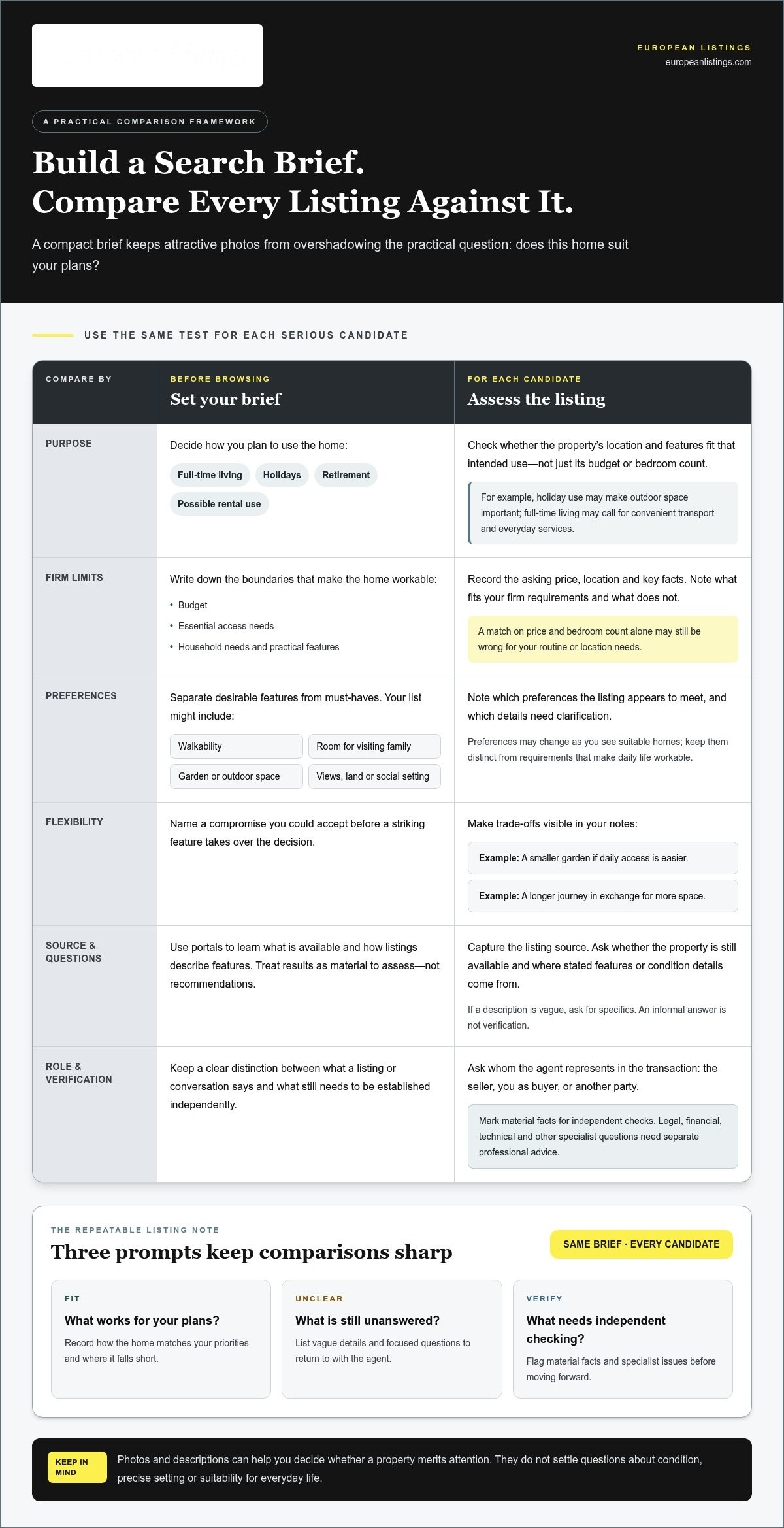
A short written brief gives each listing the same test. It keeps a dramatic view or polished interior from overshadowing the practical question: does this property suit your plans? A sound approach to how to search for property in Italy balances firm requirements with deliberate flexibility. Record what you need, what you’d enjoy and what must be checked before a promising listing moves forward.
The one-brief template: needs, budget, and compromises
Keep your brief compact enough to use. Note the intended use, budget boundary, household needs and essential practical features, such as transport access or outdoor space. Add preferences that matter to your plans: views, land, a lively social setting or possible rental use. Then name a compromise you’d accept. Perhaps a smaller garden works if daily access is easier, or a longer journey is worthwhile for more space.
- Purpose: How will you use the home?
- Limits: What budget and practical needs are firm?
- Flexibility: Which features can vary without making the home unsuitable?
Compare listings on fit, context, and open questions
For each candidate, capture the asking price, location, key facts and listing source. Add three short notes: how it fits your brief, what the listing leaves unclear and what needs independent verification. An advert is a starting point for questions, not proof. Keep drawbacks visible too, including compromises in access, layout or condition that could affect your intended use.
Where reliable context is available, compare the asking price with the surrounding area rather than judging value from photographs or a single figure. For a separate view of expenses beyond the listed price, use this guide to hidden costs of buying property in Italy. Keep that broader budget distinct from the advertised price.
A useful comparison can be as simple as “strong fit,” “trade-off” and “open question.” If a home looks right but key facts remain unclear, keep it in consideration without treating it as decision-ready. This small habit turns browsing into a reasoned shortlist and makes your next conversation more specific.
Use your brief as a guide, not a cage. A weekly selection of carefully chosen homes can surface relevant options and the occasional unexpected fit. Explore curated property listings to compare homes with concise context alongside the essentials.
From Italian Property Search to a Confident Next Step
A promising listing is a reason to ask better questions, not a reason to rush. Move from browsing to a focused conversation when a property looks plausible for your budget, intended use and everyday needs, and its known trade-offs seem acceptable. You don’t need every answer before making an enquiry. You do need to know which uncertainties could change your decision.
Know when to move from browsing to investigation
Use the conversation to establish what the listing says and what remains open. Keep legal, financial and technical questions in view, especially if they could affect whether the property suits your plans. Interest in a viewing doesn’t settle those matters, and an agent’s explanation isn’t a substitute for independent review. Relevant qualified professionals handle specialist work. European Listings supports property discovery and offers buying guidance, but does not provide brokerage, transaction management or legal, financial and technical advice.
That distinction matters. A property can look like a strong fit while important facts still need independent verification. Treat the next step as a chance to clarify, not as a commitment to buy.
Use curated discovery to keep the search moving
A clear brief doesn’t mean limiting yourself to exact matches. A weekly curated selection can bring relevant homes into view while leaving room for a considered surprise. Each listing page brings the property to the fore, with photos, price, location, key facts, source and a route to the listing agent. Concise trade-offs and price-area context can help you compare options, but they don’t replace local expertise or independent checks.
That balance reflects what buyers say they value. In the European Listings member survey, 14 of 20 respondents wanted introductions to trusted experts once they were serious. Discovery can help shape a shortlist; expert input becomes more relevant as your interest in a particular home strengthens. Keep the transition deliberate: stay curious early, then seek independent professional review before moving toward commitment.
In practical terms, how to search for property in Italy is less about reaching the end of a portal feed and more about knowing what deserves your attention next. A considered listing, a focused question and a clear record of what remains unresolved create a more confident next step.
Explore European Listings for a considered way to discover homes, with curated options and concise context to support your search.
Make Your Next Property Search More Intentional
The right search isn’t the one that produces the longest shortlist. It’s the one that helps you recognize which home deserves a closer look and what you still need to learn before taking that step. Keep your brief close as new listings appear. Let it guide your attention without closing the door on an unexpected fit.
Honest context matters. In the European Listings member survey, 17 of 20 respondents valued clear downsides and trade-offs alongside a listing. And 14 of 20 wanted introductions to trusted experts once they were serious. Discovery can help you decide what merits attention; independent professional input can support the next stage.
If you’re ready to make how to search for property in Italy a more focused process, explore a weekly selection designed to bring relevant homes and useful context into view. Explore European Listings and take your next step with greater clarity.
Frequently Asked Questions
How do I start searching for property in Italy?
Start with a short brief, then use it to test what the market actually offers. To learn how to search for property in Italy efficiently, note your intended use, budget limit, essential needs and acceptable compromises before opening a portal. As you browse, save a few examples that seem close and compare what they have in common. If the same mismatch keeps appearing, adjust a flexible preference, not a genuine requirement.
Can foreigners buy property in Italy?
Whether you can buy depends on your individual circumstances, so don’t treat a listing or an agent’s informal response as a ruling on eligibility. Before making a commitment, seek advice from a qualified professional familiar with the Italian process and your situation. Bring specific details about your nationality, plans and intended purchase so the guidance addresses your circumstances. This search guide is informational, not legal advice, and can’t determine your eligibility.
How can I tell what role an Italian estate agent has?
Ask plainly whom the agent represents in this transaction: the seller, you as the buyer or another party. Then clarify what their role covers and who supplied important details, such as availability or the stated condition. Record the answers, especially if different listings come from different sources. An agent can explain information about a property, but legal, financial and technical questions call for separate review by appropriately qualified professionals.
What should I include in a message to an Italian property agent?
Identify the listing, state your intended use and workable budget, then name only the features that would rule a home in or out. Mention a compromise you’d consider, such as less outdoor space for a more practical layout. Ask a few property-specific questions, not a broad request for “more information.” For instance, ask which details in the advert are current and note anything the reply doesn’t resolve.
Should I contact an agent before choosing an area in Italy?
Yes, you can ask about a specific property while you’re still comparing areas, as long as you treat the reply as listing context rather than a recommendation about where to live. Use your own research to compare daily needs, access and lifestyle across possible locations. An agent’s answer may clarify one home’s features, but it won’t establish whether the wider area suits you. Keep your location preferences open until you’ve weighed those factors.
What should I verify before progressing with a property in Italy?
Before taking a listing further, check that it’s still available and identify any important statement that’s unclear, inconsistent or based only on an advert. Keep a record of the claim, who provided it and what remains unanswered. Photos can’t establish a home’s legal position, financial implications or technical condition. Have relevant qualified professionals review specialist questions before making commitments, and don’t let an appealing viewing replace those checks.
Disclaimer
European Listings is a media publication. We are not a real estate agent, broker, lawyer, tax advisor, or financial advisor, and nothing here is legal, tax, or financial advice.
Properties, prices, and rules change. We do our best to keep things accurate, but we can't promise every detail is current or correct. Always check with a qualified local professional before you buy, sign, or send money.
We sometimes earn a commission from partners and sponsors we link to. This never changes what we choose to cover or what we say about it.
Any decision you make is your own.
Frequently Asked Questions
Start with a short brief, then use it to test what the market actually offers. To learn how to search for property in Italy efficiently, note your intended use, budget limit, essential needs and acceptable compromises before opening a portal. As you browse, save a few examples that seem close and compare what they have in common. If the same mismatch keeps appearing, adjust a flexible preference, not a genuine requirement.
Whether you can buy depends on your individual circumstances, so don’t treat a listing or an agent’s informal response as a ruling on eligibility. Before making a commitment, seek advice from a qualified professional familiar with the Italian process and your situation. Bring specific details about your nationality, plans and intended purchase so the guidance addresses your circumstances. This search guide is informational, not legal advice, and can’t determine your eligibility.
Ask plainly whom the agent represents in this transaction: the seller, you as the buyer or another party. Then clarify what their role covers and who supplied important details, such as availability or the stated condition. Record the answers, especially if different listings come from different sources. An agent can explain information about a property, but legal, financial and technical questions call for separate review by appropriately qualified professionals.
Identify the listing, state your intended use and workable budget, then name only the features that would rule a home in or out. Mention a compromise you’d consider, such as less outdoor space for a more practical layout. Ask a few property-specific questions, not a broad request for “more information.” For instance, ask which details in the advert are current and note anything the reply doesn’t resolve.
Yes, you can ask about a specific property while you’re still comparing areas, as long as you treat the reply as listing context rather than a recommendation about where to live. Use your own research to compare daily needs, access and lifestyle across possible locations. An agent’s answer may clarify one home’s features, but it won’t establish whether the wider area suits you. Keep your location preferences open until you’ve weighed those factors.
Before taking a listing further, check that it’s still available and identify any important statement that’s unclear, inconsistent or based only on an advert. Keep a record of the claim, who provided it and what remains unanswered. Photos can’t establish a home’s legal position, financial implications or technical condition. Have relevant qualified professionals review specialist questions before making commitments, and don’t let an appealing viewing replace those checks.