Costa de la Luz Real Estate Services for Foreign Buyers
A compelling coastal home is only the beginning; the details determine whether the purchase makes sense. Costa de la Luz real estate for foreign buyers starts with two practical facts: foreign nationals can buy property in Spain without a residency requirement, and buyers need a Spanish tax identification number (NIE). Buying from abroad is possible, but the paperwork, costs, and terms deserve close attention.
It’s sensible to look beyond the listing price. A resale purchase in Spain carries regional transfer tax of roughly 6% to 13%, and an agent’s contract can set out fees and obligations that shouldn’t be left to assumption. Property value also depends on the home’s individual characteristics, its setting and how well it suits your plans.
This guide explains how to assess a property’s value, what to look for in agent contracts, and how purchase taxes affect your budget. It also outlines practical steps for international buyers, including how to distinguish property-search support from legal and technical services.
Assessing property characteristics and long-term value
Start with your intended use, then compare homes against practical priorities: location, layout, outdoor space, condition, and future resale appeal. Costa de la Luz prices vary by town and property type, so a single regional figure can hide important differences.
Ownership Checks and Nota Simple
A Nota Simple is a useful starting point for checking a property’s registered ownership, description, and recorded charges. Match its details against the home being marketed, including the address and property description. For a rural plot or undeveloped site, pay particular attention to the land described and the rights recorded against it. These checks help distinguish the property on paper from the home presented in a listing.
Prices by Town and Property Type
Compare like with like: an apartment’s outdoor space and location can affect its appeal, while a villa’s plot and condition shape its value. Town-level figures don’t establish how the Costa de la Luz compares with the Costa del Sol—where exclusive rental properties like Apartment Elviria reflect a distinctly different coastal market and setting—or other Spanish coasts; they show why local, property-specific comparisons matter.
Location, Use, and Long-Term Value
The Costa de la Luz follows the Andalusian coastline through Cádiz and Huelva, with towns such as Cádiz, Chiclana, Conil, and Vejer attracting different buyers. Cádiz and Chiclana offer established town settings; Conil and Vejer may appeal to buyers seeking a holiday base with local culture. No town is automatically best for year-round living, holidays, or investment: weigh daily needs, intended use, and the property itself. Foreign nationals can buy in Spain without nationality restrictions or a residency requirement. A coastal or rural location does not replace checks on the individual home and its recorded details.
Define your priorities before searching. For a year-round home, weigh layout and location against everyday routines; for a holiday apartment, consider outdoor space and surroundings. A villa and an apartment can serve different plans, so assess each home individually rather than relying on type alone. For a rural, beachfront, or undeveloped property, focus on the specific characteristics, ownership record, and setting before judging long-term value. A building over 50 years old may have a Technical Building Inspection report assessing condition and required repairs. In Vejer, renovated Old Town homes provide one concrete comparison point, but their starting price doesn’t establish the value of a particular property.
Estate-agent contracts and independent legal review
On the Costa de la Luz, an agent’s written terms can affect your costs and obligations. Before signing or transferring funds, distinguish the agent’s role from independent legal review.
Agent Commissions
Local realtors may charge commission of 2.5% to 5% from both the buyer and the seller. Don’t assume one side pays, or that the percentage covers every service. Read the agreement for the commission rate, who owes it, when payment falls due, and what work it covers. Compare the written terms with any verbal explanation before signing.
Check the agreement’s duration, any exclusivity, and how it can be terminated. These details matter whether you’re considering a luxury villa near Vejer de la Frontera or an apartment in town. Clear terms should identify the property or search scope and explain how the agent’s fee relates to the transaction. If a clause is unclear, pause before accepting it.
Buying-Agent Fees and Legal Review
A buying agent may propose a fixed fee, but the amount and scope depend on the agreement. Ask for written terms defining the work covered, payment stages, and circumstances that trigger payment. Compare that scope with the services already described in the seller-side agent’s contract. A fixed amount alone doesn’t explain what you receive.
Keep legal review independent of the agent’s commercial role. A Spanish property lawyer can review reservation or purchase terms, explain obligations, and identify clauses that need clarification. This review should be separate from advice given by an agent who earns commission if the sale proceeds. That distinction matters for every buyer, resident or international.
Pay particular attention to the arras contract, which sets out the deposit terms. Under Article 1454 of the Spanish Civil Code, a buyer who withdraws forfeits the deposit; a seller who retracts must return double the deposit. Read the withdrawal terms and deadlines before signing. Don’t treat a deposit as a casual holding payment.
Notary costs also deserve a precise allocation in the sale documents. If neither the deed nor an earlier private contract specifies who pays, Article 1,455 of the Spanish Civil Code places notary fees on the seller and the first authorised copy cost on the buyer. The contract can therefore matter. Have its wording reviewed before completion, not after a disagreement arises.
For a more focused view of Costa de la Luz homes, explore curated property listings while keeping contract review separate from property selection.
Purchase taxes for residents and non-residents
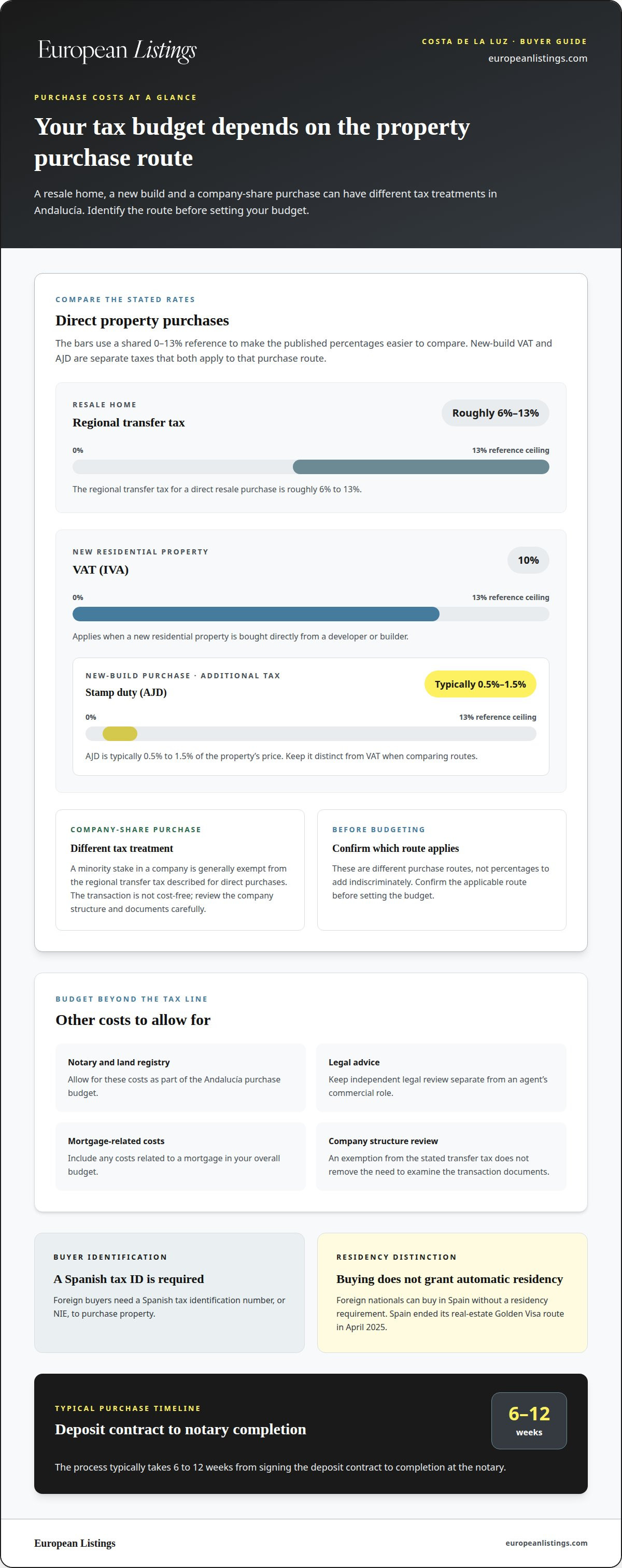
Budget by transaction type, not by a single headline percentage. A resale home, a new build, and a company-share purchase can have different tax treatments in Andalucía.
Foreign buyers need a Spanish tax identification number, or NIE, to purchase property. Foreign nationals can buy without a residency requirement, but buying no longer grants automatic residency: Spain ended its real-estate Golden Visa route in April 2025. Keep the NIE and signed purchase documents together as the transaction progresses; the exact paperwork depends on the purchase structure.
For a direct resale-home purchase in Spain, regional transfer tax is roughly 6% to 13%. A new residential property bought directly from a developer or builder is subject to 10% VAT, with stamp duty, known as AJD, typically ranging from 0.5% to 1.5% of the property’s price. These are different purchase routes, not percentages to add indiscriminately. Confirm which route applies before setting the budget.
In Andalucía, budget for more than the purchase price and tax. Allow for notary and land registry costs, legal advice, and any mortgage-related costs. A minority stake in a company is generally exempt from the regional transfer tax described for direct purchases, but that does not make the transaction cost-free. The company structure and documents still need careful review.
The purchase process typically takes 6 to 12 weeks from signing the deposit contract to completion at the notary. During that period, the parties move from the signed agreement toward the public deed and completion. Notary support forms part of the closing process; the notary formalizes the deed, while legal advice helps buyers understand the contract and tax implications. Allow time for each stage, rather than treating the signing date as the finish line.
Off-plan buyers have a separate protection framework. The current statutory guarantee framework is the First Additional Provision to the Building Act (Ley 38/1999, LOE), as amended by Law 20/2015. If an eligible buyer formally demands a refund from the promoter, the promoter has 30 days to refund before a claim against the insurer or guarantor normally proceeds. This is especially relevant when a new home near Mediterranean beaches is still under construction.
After purchase, ownership can bring tax obligations beyond the transaction itself. Non-resident owners who own directly pay imputed-income tax at 19% if they are EU or EEA residents and 24% otherwise, and they also pay local property tax, or IBI. For rental property, distinguish purchase costs from later rental-income obligations; they are separate parts of the ownership budget.
Real estate services for international clients
For an international buyer, useful support is more than a stream of listings. It should connect the property search to a clear purpose, a workable purchase process, and the right independent expertise. A holiday home, a year-round apartment, and an investment property each call for different priorities. A focused approach to costa de la luz real estate for foreign buyers starts with those choices.
Begin by defining your lifestyle or investment goal. Set out preferred areas, property type, intended use, and essential features in one brief. Someone seeking a private holiday base, for example, may value outdoor space and coastal access. Someone planning a permanent move may prioritize everyday amenities and a practical layout. Clear criteria make properties easier to assess, especially when comparing costa de la luz real estate for foreign buyers from abroad.
Next, distinguish the different roles. Property-search support can help identify and compare suitable homes, while an estate agent handles the transaction role set out in their contract. Legal review and tax advice are separate professional functions. Clear responsibilities help international buyers understand who is selecting properties, who is negotiating, and who is reviewing legal or financial documents.
A structured search can follow a simple sequence:
- Set the brief: name preferred locations and state whether the home is for personal use, rental, or investment.
- Filter listings: compare property type, condition, layout, and location against those priorities.
- Shortlist deliberately: retain homes that meet essential needs, rather than treating every attractive photograph as a serious option.
- Prepare for review: organize listing details and purchase documents for the relevant legal or tax professional.
This approach is especially useful when you’re abroad and can’t visit every home in person. A focused shortlist lets you compare an apartment with a house on practical merits, rather than relying on broad labels such as “beach property” or “investment opportunity.” The location, intended use, and individual characteristics matter more than the marketing category.
Connections can help coordinate the moving parts, but they shouldn’t blur accountability. Keep written agent terms, legal documents, and financial questions in their proper lanes. A buyer considering a home for rental use, for instance, should distinguish property selection from advice about rental obligations. Choose support that sharpens the search and clarifies the process, while specialist legal and financial decisions remain separate.
European Listings
European Listings helps international buyers make a focused property search across southern Europe, including the Costa de la Luz. Its weekly newsletter brings together homes selected for foreign-buyer friendliness, while Premium Membership Plans and Buying Support and Guidance help readers continue their search with clearer priorities.
Turn to this support when broad listings make it difficult to compare homes against your intended use, budget, and preferred location. The newsletter draws listings from dozens of portals and delivers 18 vetted properties to subscribers each Saturday. It can help narrow the field, whether you’re considering a coastal home for holidays, a retirement move, or rental income. Legal, tax, and technical decisions remain separate from property-search support.
For a more focused next step, contact European Listings.
Make your next property search more deliberate
The strongest next step is to write a focused brief, not to keep scrolling through listings. Decide what the home must do for you, where you’re willing to compromise, and which features would make you walk away. Clear priorities sharpen your search and make each promising option easier to assess.
For foreign buyers considering Costa de la Luz real estate, European Listings offers a Weekly Curated Property Newsletter, Premium Membership Plans, and Buying Support and Guidance. These can bring structure to your search while keeping your priorities in view. Legal, financial, and technical decisions remain separate from property-search support.
When you’re ready to take the next step, contact European Listings today. A considered shortlist can turn an appealing idea into a more purposeful search. Start with the home that fits your plans, not simply the one with the most polished listing.
Frequently Asked Questions
Looking for your new home on the Costa de la Luz?
Start with a short brief that separates essentials from preferences. Note whether you want a permanent home, holiday base, or rental investment, then define preferred locations, outdoor space, and acceptable renovation work. A buyer who needs a walkable town setting, for example, should assess homes differently from someone prioritizing a private plot. This makes each listing easier to compare against real needs, not just attractive photographs.
Should You Buy New or Secondhand?
Choose based on the home’s condition, your tolerance for renovation, and the total purchase cost. A new property bought directly from a developer has a different tax treatment from a resale home, so compare applicable taxes before deciding. For a secondhand home, assess its actual condition and renovation needs; professional inspection resources like lininspects.com highlight how detailed property evaluations deliver clarity and peace of mind during real estate investments. For an off-plan purchase, review the contract, stated specifications, and construction progress before committing.
Who Should Buy Here?
The Costa de la Luz may suit buyers who can define what they want from a property and its setting. A holiday-home buyer might prioritize outdoor living and seasonal use, while someone relocating may focus on daily routines and year-round practicality. An investor should assess the home’s intended rental use separately from its personal appeal. The strongest fit comes from matching location, property type, and ownership plans, rather than chasing a broad lifestyle image.
What taxes and closing costs should foreign buyers budget for when buying property in Andalusia?
Budget for the tax tied to the purchase type, along with notary and land registry costs, legal advice, and mortgage-related costs if applicable. Keep ongoing ownership expenses separate from closing costs. For example, local property tax and non-resident imputed-income tax arise after purchase, so don’t confuse them with the initial transaction bill. Prepare a written cost schedule before signing, assigning each item to the relevant stage or ownership period.
What are the steps to buy a home on the Costa de la Luz, from reservation to escritura?
First agree the reservation terms and have the documents reviewed before paying. Next, sign the deposit or arras contract, arrange the funds, and prepare for completion. At the notary, the parties formalize the sale in the escritura, the public deed. Keep the signed agreements, payment records, and final deed together. A clear timeline matters: the purchase commonly takes 6 to 12 weeks from deposit contract to notary completion.
How can buyers verify title, debts, planning permission, and coastal-law restrictions on a Costa de la Luz property?
Use the Nota Simple to review the registered owner, property description, and recorded charges, then compare those details with the home being sold. It does not replace a review of planning permission or coastal restrictions. Have an independent Spanish property lawyer assess the relevant property and planning documents, including restrictions affecting the land. For rural or beachfront homes, make sure the review covers both the plot and the building, not just the advertised residence.
Disclaimer
European Listings is a media publication. We are not a real estate agent, broker, lawyer, tax advisor, or financial advisor, and nothing here is legal, tax, or financial advice.
Properties, prices, and rules change. We do our best to keep things accurate, but we can't promise every detail is current or correct. Always check with a qualified local professional before you buy, sign, or send money.
We sometimes earn a commission from partners and sponsors we link to. This never changes what we choose to cover or what we say about it.
Any decision you make is your own.
Frequently Asked Questions
Start with a short brief that separates essentials from preferences. Note whether you want a permanent home, holiday base, or rental investment, then define preferred locations, outdoor space, and acceptable renovation work. A buyer who needs a walkable town setting, for example, should assess homes differently from someone prioritizing a private plot. This makes each listing easier to compare against real needs, not just attractive photographs.
Choose based on the home’s condition, your tolerance for renovation, and the total purchase cost. A new property bought directly from a developer has a different tax treatment from a resale home, so compare applicable taxes before deciding. For a secondhand home, assess its actual condition and renovation needs. For an off-plan purchase, review the contract, stated specifications, and construction progress before committing.
The Costa de la Luz may suit buyers who can define what they want from a property and its setting. A holiday-home buyer might prioritize outdoor living and seasonal use, while someone relocating may focus on daily routines and year-round practicality. An investor should assess the home’s intended rental use separately from its personal appeal. The strongest fit comes from matching location, property type, and ownership plans, rather than chasing a broad lifestyle image.
Budget for the tax tied to the purchase type, along with notary and land registry costs, legal advice, and mortgage-related costs if applicable. Keep ongoing ownership expenses separate from closing costs. For example, local property tax and non-resident imputed-income tax arise after purchase, so don’t confuse them with the initial transaction bill. Prepare a written cost schedule before signing, assigning each item to the relevant stage or ownership period.
First agree the reservation terms and have the documents reviewed before paying. Next, sign the deposit or arras contract, arrange the funds, and prepare for completion. At the notary, the parties formalize the sale in the escritura, the public deed. Keep the signed agreements, payment records, and final deed together. A clear timeline matters: the purchase commonly takes 6 to 12 weeks from deposit contract to notary completion.
Use the Nota Simple to review the registered owner, property description, and recorded charges, then compare those details with the home being sold. It does not replace a review of planning permission or coastal restrictions. Have an independent Spanish property lawyer assess the relevant property and planning documents, including restrictions affecting the land. For rural or beachfront homes, make sure the review covers both the plot and the building, not just the advertised residence.