Buying a Rural Finca in Spain: Check Land and Building Rules
A well on a finca doesn’t automatically give you the legal right to use its water. Agricultural water rights and household supply aren’t necessarily interchangeable, so the rules and risks of buying a rural finca in Spain begin with the rights and permissions attached to the property, not simply what’s visible on the land.
The appeal is clear: space, privacy and a home with character. But a building’s presence doesn’t prove it’s legal, and a track, well or promised renovation option may come with restrictions. This guide explains how to assess water rights, access, planning limits, building legality and renovation potential before you commit. It also explains why a Spanish conveyancing lawyer’s review matters, particularly when property records and the seller’s claims don’t tell the same story.
1. How can I avoid planning problems?
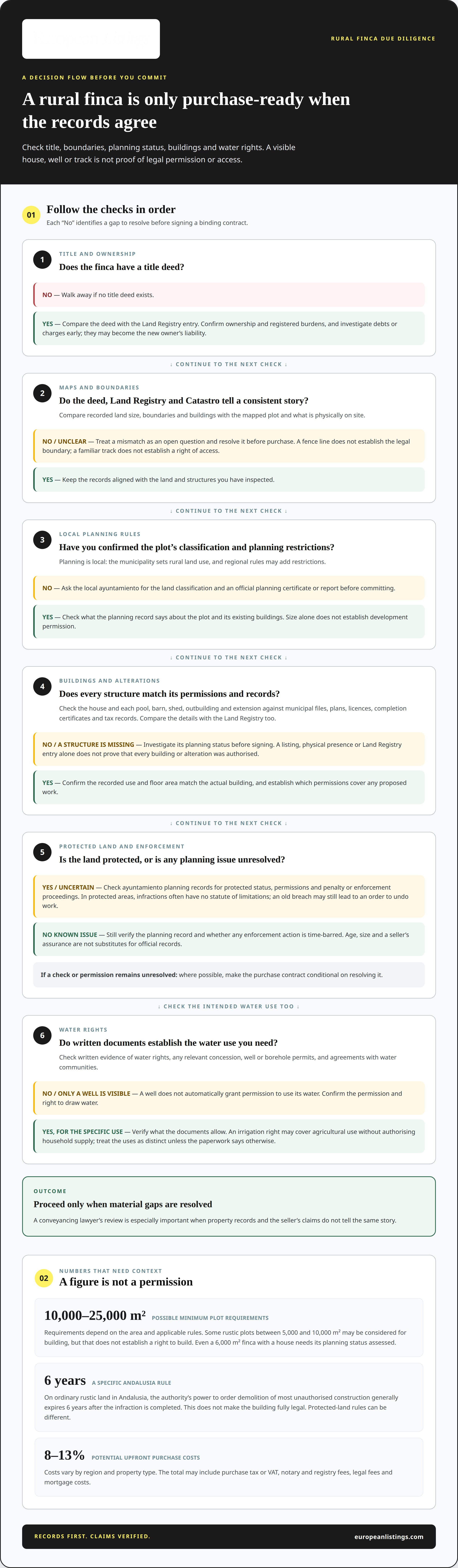
Start with the title deed, then compare it with the Land Registry entry before signing. The Land Registry confirms ownership and registered burdens, but may not tell the full story for rural property. If no title deed exists, walk away. Debts or charges attached to a Spanish property can become the new owner’s liability, so check ownership and burdens early, not as a last step in the paperwork.
Next, compare the Land Registry record with the Catastro, Spain’s tax and mapping register. It can show land size, boundaries and buildings, but its map may not match the registered boundary or the physical fence line. Treat any mismatch as a question to resolve before purchase. A neighbour’s fence or a familiar track does not, by itself, establish the legal boundary or a right of access.
Planning permission is local. The municipality sets rural land use through its general development plan, while the regional government may impose additional restrictions. Ask the local ayuntamiento for the finca’s land classification and an official planning certificate or report. That record can clarify restrictions affecting the plot and existing buildings. A large area does not automatically mean development is permitted; a 6,000 m² finca with a house still needs its planning status assessed.
Compare municipal records with building plans, licences, completion certificates and tax records. Check what those documents describe against the house and every structure on the land, including pools and outbuildings. An estate-agent listing or a building’s physical presence is not proof it was legally built. Before completion, confirm that buildings and extensions are declared, registered and legal. A planning review should also identify penalty proceedings and whether any enforcement action is time-barred.
Protected land demands particular care. Planning infractions there often have no statute of limitations, so even an old breach may still lead to an order to undo the work. Check the ayuntamiento’s planning records to establish whether the plot is protected and whether each structure has permission. Where a check or permission remains unresolved, the finca purchase contract can, where possible, be conditional on resolving it. Age, size and a seller’s assurance are no substitute for planning records.
Upfront purchase costs in Spain can add 8–13% to the price. The total varies by region and property type, and may include purchase tax or VAT, notary and registry fees, legal fees, and mortgage costs. Build these categories into the closing budget alongside the planning checks.
2. How do I know if outbuildings or extensions are legal on rustic land?
A barn, shed or extension on rustic land isn’t automatically legal. Its age and appearance don’t establish that it has permission. Compare each structure with the municipal planning file, building licence and plans, then confirm its status against the property’s Land Registry record. A mismatch matters: a Land Registry entry alone may not establish that every building or alteration was authorised.
Start by identifying the land classification. Rural rules vary between autonomous communities and municipalities, and protected land can carry stricter limits than ordinary rustic land. New construction may require a minimum plot size, an agricultural justification or a connection to farming activity. In some regions, creating another residential unit on protected rustic land isn’t allowed.
Plot size is not a universal building permission. Minimum plot requirements can range from 10,000 to 25,000 m², depending on the area and applicable rules. Some rustic plots between 5,000 and 10,000 square metres may be considered for building, but that range does not establish a right to build. The local plan and land classification determine what the specific plot can support.
Renovation also has limits. Rural land generally permits maintenance or minor renovation, while new construction is heavily restricted. Protected-land rules may also affect fencing, tree removal, road works, terracing, water storage and solar installations. Before committing, distinguish routine repairs from work that changes a building’s size, use or structure. Assess each proposed extension separately, rather than assuming the house gives you an automatic right to add it.
Andalusia illustrates why the detail matters. Certain irregular rural buildings may qualify for AFO status, but that status doesn’t fully legalise them. Regularisation may be possible for some older unauthorised buildings; it may be impossible for others, particularly on protected land. On ordinary rustic land in Andalusia, the authority’s power to order demolition of most unauthorised construction generally expires 6 years after the infraction is completed. That limit doesn’t turn a building into a fully legal one.
Check whether any AFO status or other planning treatment covers the actual building, rather than assuming it includes every extension or outbuilding. Compare the recorded floor area and use with the structure on site. A tolerated building can complicate major works, service connections, insurance, resale and mortgage applications. A lender’s willingness to consider a finca can depend on its registration and planning status, not simply its condition.
Resolve any uncertainty about a building’s status before signing a binding contract. A licence for a small shed, for example, doesn’t prove that a later villa or extension is authorised. Check the municipal planning file to establish which permissions cover each structure and what work remains possible. If the permitted use, registered details and physical buildings conflict, treat the gap as a material risk, not a cosmetic paperwork issue.
3. Can You Renovate or Extend a Finca in Spain?
Renovation plans depend on more than the condition of the house. In Spain, the finca’s land classification, existing licences and local planning rules determine whether it can be used as a full-time home or altered. Municipal planning records and the building’s legal status help establish what the property can support. Regional rules may add restrictions, so any renovation idea must fit both the location and the property’s existing permissions.
Water rights need their own paperwork. Having a well on the land doesn’t automatically give its owner permission to use the water. Before signing, obtain written evidence of water rights, any relevant water concession, permits for wells or boreholes, and agreements with water communities. An irrigation right may cover agricultural use without authorising household supply. Treat these rights as distinct unless the documents establish which uses are permitted.
Trace the water supply from source to house. For a private well, confirm the permission and the right to draw water instead of relying on the well’s physical presence. For a shared irrigation system, establish whether a community or neighbouring landowner holds relevant rights or agreements. A cadastral map can show the plot, but it doesn’t establish the legal terms governing water use or access across boundaries.
Electricity claims also need evidence. If a seller says a connection will be easy, rely on written estimates and permissions, not a verbal assurance. The route, required works and approvals can affect whether a planned renovation is practical. Include the proposed connection in your project assessment before treating an extension or full-time use as feasible.
Inspect the septic system as carefully as the house. Establish its installation history, compliance with current rules, location and maintenance access. A system that works today may still cause problems if it wasn’t installed compliantly or can’t be reached for servicing. Rural septic tanks may need emptying every few years to prevent overflow and seepage, so access for maintenance is a practical part of the property’s long-term use.
Rural finca prices vary with region, acreage, condition, services and legal status. A remote plot with limited utilities and substantial repair needs isn’t directly comparable with a renovated home with documented water and electricity connections.
Before committing, gather the water, power and sewage records alongside municipal and regional planning information. Confirm that the approved residential use aligns with your renovation and full-time living plans. This connects the property’s physical services to its legal status, rather than assuming that existing pipes, a well or a septic tank prove everything is authorised.
4. Property lawyer checks for international buyers
Foreign buyers can buy rural property in Spain, but land classification and planning status can restrict its use. The rules and risks of buying a rural finca in Spain begin with one distinction: the right to purchase isn’t the same as the right to build, renovate or occupy a finca. An independent Spanish conveyancing lawyer should assess the property’s local and regional planning position, not just the sale documents.
Start with ownership and registered burdens. The Land Registry can show ownership and recorded charges, but rural records may not contain the full picture. A lawyer can compare the deed, registry entry and property particulars, then investigate any mismatch. Debts and charges attached to a Spanish property can become the buyer’s liability. A reported €20,000 mortgage debt illustrates why a clear title review matters before completion.
Legal access deserves a separate check. A track used by neighbours or visitors doesn’t necessarily establish a legal right of way. Your lawyer should establish whether access is supported by a registered easement, an agreement or another legal basis. Don’t proceed while access remains unresolved, especially if the finca depends on a track crossing another estate or rural land.
The contract can carry immediate financial risk. A binding private contract may put a buyer’s 10% deposit at risk if signed without legal review. Before committing, have the lawyer review the terms, identify unresolved planning or access issues, and consider whether the contract can make completion conditional on outstanding checks or permissions. The notary formalises the transaction; that role doesn’t replace the buyer’s independent due diligence.
Financing also needs to match the specific finca. Spanish banks generally offer non-resident buyers loan-to-value ratios of 50% to 70% for rural property. A property fully registered in the Land Registry and free from planning irregularities is generally more likely to be accepted as mortgage security. If borrowing is essential, assess mortgage feasibility against the property early, before a deposit or contract creates pressure.
For buyers weighing the rules and risks of buying a rural finca in Spain, planning deserves the same scrutiny as title and access. A lawyer should verify compliance with local and regional rules, including land classification, existing buildings, extensions and restrictions affecting your intended use. Municipal records, licences and the physical property should tell a consistent story. A notarial signature cannot make an unauthorised extension lawful or resolve a planning breach.
Use a clear sequence: establish title and charges, resolve legal access, review planning status, assess mortgage feasibility, then sign only after the contract has been reviewed. For help narrowing the search to properties suited to your plans, explore curated rural property listings.
European Listings: Buying Support and Guidance
European Listings offers Buying Support and Guidance for readers weighing rural properties against their plans and priorities. It can be a useful next step once you understand the legal questions and want a more focused property search. The Weekly Curated Property Newsletter brings together homes selected for foreign-buyer friendliness, while Premium Membership Plans offer another way to explore curated listings.
Use this support to narrow your search and organise your buying decisions. Legal status, water rights, planning permission and building condition still require appropriate professional checks; property guidance isn’t a substitute for legal advice or technical inspection. A considered shortlist can help you focus on fincas that better match your intended use.
To discuss your property search, contact European Listings.
Make your next finca search more deliberate
The rules and risks of buying a rural finca in Spain should shape your search from the outset, not become surprises after you’ve chosen a property. Before pursuing a listing, decide what matters most: a home ready to occupy, scope for renovation or a particular setting. Use those priorities to assess whether a property fits your plans, rather than letting an attractive building or expansive plot make the decision for you.
Keep your shortlist focused. A finca suited to someone seeking a renovation project may be the wrong choice for a buyer who needs straightforward full-time use. Clear priorities help you spend time on properties worth considering and identify the questions that need professional attention before you commit.
For a more considered search, contact European Listings to discuss your property plans. Take the next step with a clear brief and a more confident sense of what you’re looking for.
Frequently Asked Questions
Are water rights automatically included when I buy rural property?
No. Buying the land or a property with a well doesn’t automatically transfer permission to use that water. For example, irrigation rights may permit agricultural use without allowing household supply. Establish which rights attach to the finca, who holds them, and whether a water concession or community agreement governs use. Written records matter more than a tap, well or irrigation channel visible during a viewing.
Can I turn a rural finca into a full-time home legally?
Sometimes, but the answer depends on the finca’s land classification, existing licences and local planning rules. A house used occasionally isn’t necessarily authorised for full-time residential use. Before purchase, establish the permitted use through the property’s planning records and compare it with your intended occupancy. Also distinguish full-time living from holiday letting, which may require applicable regional tourist licences.
How do I know if outbuildings or extensions are legal on rustic land?
Confirm that each structure appears in the relevant planning records and has the required permissions. Check outbuildings and later extensions separately: paperwork for a main house doesn’t establish the status of a pool, shed or added room. In Andalusia, some irregular buildings may have AFO status, but that doesn’t fully legalise them. An old structure can still create practical problems with alterations, insurance or resale.
Is it harder to sell a finca later compared with an urban apartment?
Rural properties can take longer to sell than urban apartments and may be more affected by unresolved legal issues. A finca with clear records, legal buildings and reliable services is generally easier to market than one with unanswered questions about its structures or utilities. If you plan to sell later, keep licences, service records and relevant agreements together so the next buyer can understand the property’s position.
Can I find out the true value of a rural property to avoid overpaying?
You can build a more grounded view, but an asking price alone doesn’t establish market value. Compare properties with similar locations, land, condition, access and services, then account for differences in legal status and permitted use. For example, a renovated finca with documented utilities isn’t directly comparable with a remote property needing major work. An independent valuation and inspection can provide useful evidence before you commit.
Can You Renovate or Extend a Finca in Spain?
Yes, if the proposed work is permitted for that property and land classification. Rural rules often distinguish maintenance from work that changes a building’s size, structure or use. A plan to add a bedroom, convert a barn or install a pool needs its own planning assessment. Check the relevant permissions before budgeting or signing a renovation contract; similar work nearby doesn’t establish permission for your finca.
Disclaimer
European Listings is a media publication. We are not a real estate agent, broker, lawyer, tax advisor, or financial advisor, and nothing here is legal, tax, or financial advice.
Properties, prices, and rules change. We do our best to keep things accurate, but we can't promise every detail is current or correct. Always check with a qualified local professional before you buy, sign, or send money.
We sometimes earn a commission from partners and sponsors we link to. This never changes what we choose to cover or what we say about it.
Any decision you make is your own.
Frequently Asked Questions
No. Buying the land or a property with a well doesn’t automatically transfer permission to use that water. For example, irrigation rights may permit agricultural use without allowing household supply. Establish which rights attach to the finca, who holds them, and whether a water concession or community agreement governs use. Written records matter more than a tap, well or irrigation channel visible during a viewing.
Sometimes, but the answer depends on the finca’s land classification, existing licences and local planning rules. A house used occasionally isn’t necessarily authorised for full-time residential use. Before purchase, establish the permitted use through the property’s planning records and compare it with your intended occupancy. Also distinguish full-time living from holiday letting, which may require applicable regional tourist licences.
Confirm that each structure appears in the relevant planning records and has the required permissions. Check outbuildings and later extensions separately: paperwork for a main house doesn’t establish the status of a pool, shed or added room. In Andalusia, some irregular buildings may have AFO status, but that doesn’t fully legalise them. An old structure can still create practical problems with alterations, insurance or resale.
Rural properties can take longer to sell than urban apartments and may be more affected by unresolved legal issues. A finca with clear records, legal buildings and reliable services is generally easier to market than one with unanswered questions about its structures or utilities. If you plan to sell later, keep licences, service records and relevant agreements together so the next buyer can understand the property’s position.
You can build a more grounded view, but an asking price alone doesn’t establish market value. Compare properties with similar locations, land, condition, access and services, then account for differences in legal status and permitted use. For example, a renovated finca with documented utilities isn’t directly comparable with a remote property needing major work. An independent valuation and inspection can provide useful evidence before you commit.
Yes, if the proposed work is permitted for that property and land classification. Rural rules often distinguish maintenance from work that changes a building’s size, structure or use. A plan to add a bedroom, convert a barn or install a pool needs its own planning assessment. Check the relevant permissions before budgeting or signing a renovation contract; similar work nearby doesn’t establish permission for your finca.